
IMF–World Bank talks address growth challenges and online fraud
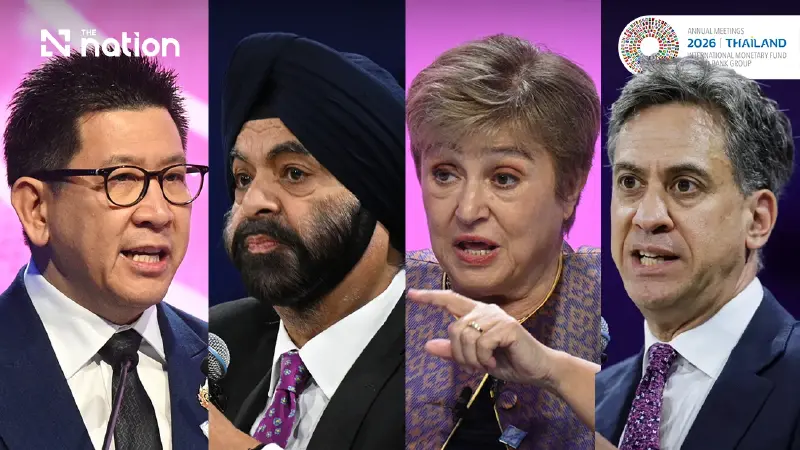


Day three of the 2026 IMF–World Bank Annual Meetings in Bangkok focuses on ASEAN trade, tax and debt reform, private investment and digital financial fraud.
- The IMF and World Bank meetings are addressing global growth challenges, including the need for deeper regional trade, smarter taxation policies, and debt relief for developing nations.
- The World Bank is pushing for private investment to tackle a projected 800 million job shortfall, while the UK is urging global debt reform for developing countries.
- A key initiative, the 'Bangkok Blueprint', was launched with Thailand to create a coordinated international response to rising digital and financial fraud.
The 2026 Annual Meetings of the International Monetary Fund (IMF) and the World Bank Group, dubbed the “financial Olympics”, entered their third day in Bangkok on Wednesday (October 14), focusing on regional trade, taxation, debt relief, private investment and digital fraud. The meetings run from October 12–18.

ASEAN urged to strengthen regional resilience
Regional integration emerged as a response to external shocks. IMF Managing Director Kristalina Georgieva described the Association of Southeast Asian Nations (ASEAN) as an 11-economy bloc worth US$4.5 trillion, with 700 million people and annual growth of roughly 4.5%.
Yet only around 22% of ASEAN trade takes place within the bloc, compared with about 60% in the European Union. Georgieva estimated that market-oriented reforms could raise real gross domestic product (GDP) by up to 3% in the short to medium term, while deeper regional trade could deliver gains of around 5% over the longer term.
Her advice on energy shocks was simple: “Protect people, not prices.” She urged targeted support for vulnerable households rather than blanket subsidies, while protecting fiscal buffers.
Krishna Srinivasan, director of the IMF’s Asia and Pacific Department, warned of trade barriers, energy price volatility and climate risks. Yasuto Watanabe, director of the ASEAN+3 Macroeconomic Research Office, called for agile, credible and targeted policies. Scott Morris, vice-president for East and Southeast Asia and the Pacific at the Asian Development Bank, highlighted its US$10 billion commitment to the ASEAN Power Grid.

IMF calls for smarter taxation to support growth
The IMF also outlined reforms to support growth without reducing government revenue. Its analysis, “Taxing Better to Boost Growth”, argued that high debt and borrowing costs left little room for broad tax cuts. It recommended better value added tax (VAT) refunds, faster deductions for investment, stronger work incentives and more efficient collection.
Removing tax distortions that raise the cost of capital could increase long-term GDP by 2.1–2.7%, the IMF estimated. It cautioned, however, that those losing tax benefits would face immediate costs while broader gains took longer to materialise.

UK urges global debt reforms
UK Foreign Secretary Ed Miliband warned that the global financial system was failing developing countries on debt, economic resilience and climate change. He urged the World Bank and other multilateral lenders to refinance loans at lower interest rates and extend repayment periods, freeing funds for essential services and infrastructure.
Miliband called for faster debt restructuring, measures to prevent private creditors from delaying negotiations and crisis financing accessible within days rather than months. Britain would prioritise debt reform during its 2027 presidency of the Group of Twenty (G20). A Rockefeller Foundation report presented at the event highlighted that sub-Saharan African governments spend more than three times as much servicing debt as on education.

World Bank pushes private investment to create jobs
World Bank Group President Ajay Banga warned that 1.2 billion young people would reach working age in developing countries within 12–15 years, but only 400 million jobs were expected, leaving a potential shortfall of 800 million.
He proposed attracting private capital through regulatory certainty, investment guarantees, local-currency financing and risk-sharing tools. Shriti Vadera, chair of the World Bank Group’s Private Sector Investment Lab, urged implementation, noting that the Group mobilised US$112 billion in private capital in its 2026 financial year, up from US$35 billion in 2022.

Bangkok Blueprint targets digital financial fraud
Thailand joined the IMF and World Bank Group in launching the Bangkok Blueprint for Fraud-Resilient Financial Services. Developed with the Bank of Thailand, it outlines 12 considerations across five pillars: national strategies, fraud prevention, enforcement, domestic and cross-border cooperation, and consumer protection.
Deputy Prime Minister and Finance Minister Ekniti Nitithanprapas stressed that interconnected digital finance demanded a coordinated response to fraud. Bank of Thailand Governor Vitai Ratanakorn warned that no institution or country could fight cyber-enabled fraud alone. Georgieva added: “Trust is the foundation of every financial system.”

Thai music, food and crafts showcase local culture
Beyond the discussions, Thailand showcased local music, food and crafts. Nene Royal (Rattikarn Amloy), the 16-year-old Thai singer and guitarist who won America’s Got Talent 2026, was scheduled to perform “Zombie” and “Som San” at a Government House reception for more than 400 international guests on Wednesday evening, alongside National Artists and the Sorkrao Symphony Orchestra.
Street-food carts also offered changing menus. After fruit and coconut-milk ice cream earlier in the week, Wednesday’s dessert paired foi thong, a Thai sweet made from egg-yolk strands, with geographical indication (GI)-certified bananas from Kamphaeng Phet.

Delegates encountered souvenir bags made from traditional pha khao ma cloth woven in Khu Bua, Ratchaburi. Almost a year of preparation went into the bags, spotlighting local craftsmanship.
