
UK foreign secretary Ed Miliband urges global debt reforms
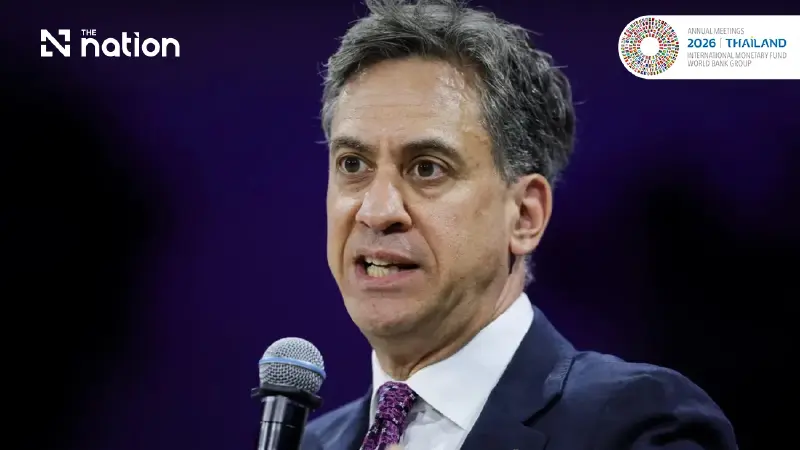


At the IMF–World Bank meetings in Bangkok, UK Foreign Secretary Ed Miliband urged lower-cost debt refinancing and faster restructuring for developing nations.
- Foreign Secretary Ed Miliband has stated that the global financial system is failing developing countries, particularly regarding debt, economic resilience, and climate change.
- He has urged the World Bank and other development banks to use their full financial capacity to ease debt burdens by refinancing loans at lower rates and extending repayment periods.
- The UK intends to make international debt reform a key priority when it assumes the G20 presidency in 2027.
- Miliband also called for a faster debt restructuring process and more rapid access to crisis financing for nations in financial difficulty.
British Foreign Secretary Ed Miliband has urged reforms to the international financial system, warning that the existing global financial system and international order are failing developing countries on debt, economic resilience and climate change.
Addressing the issue during the 2026 Annual Meetings of the International Monetary Fund (IMF) and World Bank Group in Bangkok on Wednesday (October 14), Miliband argued that these failings ran counter to shared values and national interests. In an increasingly interconnected world, he stressed, countries face common challenges and opportunities.
Speaking at an event presenting a report by the Rockefeller Foundation, Miliband also drew attention to the importance of reform. He has personally taken up the UK's seat on the World Bank's board to help advance that objective.
World Bank urged to ease developing countries' debt burdens
Miliband called on the World Bank and other multilateral development banks (MDBs) to make full use of their available financial resources and balance sheets to reduce the pressure facing governments burdened by high borrowing costs.
His proposals include refinancing existing debts at lower interest rates and extending repayment periods, giving developing countries greater fiscal space to invest in essential infrastructure.
The report highlighted how high borrowing costs were diverting government spending away from essential public services.
The scale of the problem is particularly evident in sub-Saharan Africa, where governments spend more than three times as much on debt servicing as they do on education.

UK to prioritise debt reform during G20 presidency
The United Kingdom intends to advance international debt reform when it assumes the presidency of the Group of Twenty (G20) in 2027, using its leadership role to keep public debt issues on the international agenda.
Chancellor of the Exchequer John Healey is expected to outline Britain's G20 policy priorities in Bangkok later this week, including proposals to mobilise additional financial resources from the balance sheets of the IMF and World Bank.
Miliband calls for faster debt restructuring and crisis financing
Beyond increasing access to affordable financing, Miliband advocated substantial changes to the Common Framework for debt restructuring, which has faced criticism for being slow and cumbersome.
He called for measures to prevent private creditors from delaying restructuring negotiations, enabling countries to reach agreements more efficiently.
Miliband also called for financial support mechanisms to be established before crises occur, allowing governments facing financial difficulties to access assistance within days rather than waiting months.
