
ASEAN urged to deepen regional ties to withstand global shocks
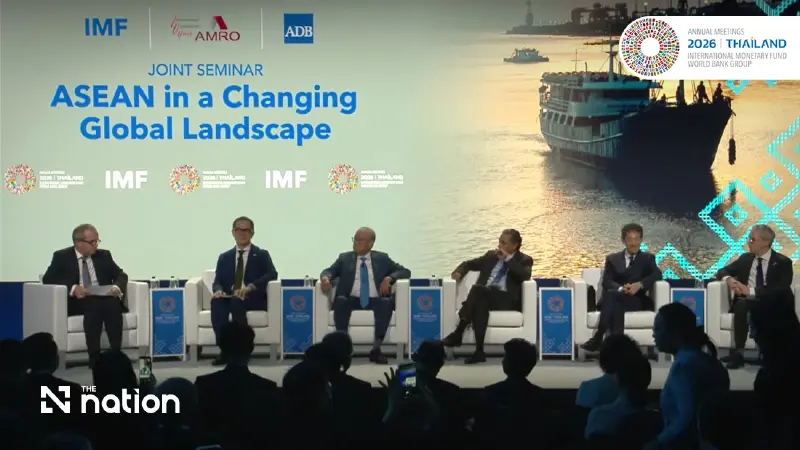


At the IMF–World Bank meetings in Bangkok, experts urge ASEAN to protect fiscal buffers, deepen regional trade and strengthen energy security amid global shocks.
- ASEAN has been advised to deepen regional ties by removing trade barriers, a move which the IMF estimates could increase the bloc's GDP by approximately 5 per cent.
- To better withstand future shocks, officials recommend protecting public finances by providing targeted financial support to vulnerable people rather than implementing broad, costly price subsidies.
- Strengthening cooperation on infrastructure, particularly through the development of an integrated energy market like the ASEAN Power Grid, is highlighted as critical for building regional resilience.
- International financial bodies urge the bloc to accelerate market-oriented reforms, which could increase ASEAN's real GDP by up to 3 per cent in the short to medium term.
The Association of Southeast Asian Nations (ASEAN) can turn its economic strength into more sustainable growth by protecting public finances, removing trade barriers and building regional energy networks, senior international financial officials told participants at a Bangkok forum on Wednesday (October 14).
The seminar, “ASEAN in a Changing Global Landscape”, took place at the Queen Sirikit National Convention Center during the 2026 Annual Meetings of the International Monetary Fund (IMF) and the World Bank Group.

ASEAN’s US$4.5 trillion economy maintains growth momentum
Kristalina Georgieva, the IMF’s managing director, described ASEAN as an increasingly important source of global growth. Its 11 economies form a US$4.5 trillion bloc, home to approximately 700 million people and growing at an annual rate of 4.5%, faster than the global average. She described ASEAN as large enough to rank as the world’s fourth-largest economy.
“Asia is the engine of global growth. It has delivered historically in the last decades two-thirds of global growth.”
Georgieva estimated that Asia would account for 68% of global growth in 2026, a greater share than in previous decades. ASEAN’s progress, she argued, reflected reforms that had encouraged private-sector dynamism and economic development.
Krishna Srinivasan, director of the IMF’s Asia and Pacific Department, highlighted the region’s resilience to trade disruptions. Technology and non-technology exports had performed better than expected despite tariff pressures, with average US tariffs on ASEAN goods at about 12.4%, lower than initially feared.
Several ASEAN members had also diversified their energy sources and adopted measures to cushion households from price shocks, helping their economies adapt to an increasingly uncertain external environment.
Energy shocks and climate risks test ASEAN’s resilience
Despite this performance, ASEAN faces mounting challenges that could undermine its growth momentum.
Srinivasan identified energy shocks as a particularly serious near-term threat. Oil and gas consumption accounts for about 7% of ASEAN’s GDP on average, although exposure differs considerably between energy exporters such as Brunei and Malaysia and countries including Thailand and the Philippines.
The region must also contend with shifting global trade patterns, commodity price volatility and climate-related risks, particularly El Niño.
Yasuto Watanabe, director of the ASEAN+3 Macroeconomic Research Office (AMRO), highlighted the region’s exposure to external disruptions. ASEAN’s trade-to-GDP ratio stands at approximately 110%, compared with a global average of 44%, making international developments especially important to its economies.

Weak fiscal buffers leave ASEAN exposed to future shocks
Limited fiscal capacity presents another weakness. Srinivasan noted that more than half of the government support provided in response to shocks had been untargeted, while revenue mobilisation averaged only 10% of GDP, compared with more than 15% among peer economies elsewhere.
“So you have both: you're not doing very well in terms of revenue mobilisation, and you're providing a lot of untargeted support.”
He warned that repeated shocks could further weaken fiscal buffers, leaving governments with fewer resources to respond to future emergencies. Climate change and ageing populations must also be incorporated into long-term budget planning.
Scott Morris, vice-president for East and Southeast Asia and the Pacific at the Asian Development Bank (ADB), stressed that energy shortages, natural disasters and health emergencies required different responses, all placing additional demands on limited public resources.
He also emphasised the need to maintain pandemic preparedness while investing in energy security and disaster resilience, rather than treating every shock as a short-lived problem.
IMF outlines four priorities to sustain ASEAN’s growth
Georgieva outlined four priorities for sustaining ASEAN’s growth: protecting fiscal buffers, accelerating market-oriented reforms, increasing intra-regional trade and strengthening cooperation beyond trade, particularly in digital systems, infrastructure and energy connectivity.
Her central recommendation was to direct financial assistance towards those most affected by shocks instead of introducing costly measures that broadly suppress prices.
“Do not rush to provide support to those affected by the energy shock in an indiscriminate manner. Protect people, not prices.”
Georgieva estimated that further market-oriented reforms could increase ASEAN’s real GDP by up to 3% over the short to medium term, while deeper regional trade integration could generate gains of around 5% over the longer term.

Deeper regional trade could unlock 5% GDP gains
Georgieva compared ASEAN’s intra-regional trade share of about 22% with approximately 60% in the European Union, highlighting considerable room for stronger commercial links.
Srinivasan identified non-tariff barriers, including local-content requirements and restrictions affecting services, as major obstacles to greater integration.
Reducing these barriers and liberalising services could raise ASEAN’s GDP by approximately 5% over the medium term, according to IMF analysis.
Although ASEAN economies are already closely connected through intermediate goods and manufacturing supply chains, trade in finished products remains less integrated. Srinivasan also highlighted cross-border payment systems as an important means of strengthening financial and commercial integration.
Watanabe proposed a policy framework he called “ACT”, urging policymakers to be agile, credible and targeted in their responses.
Governments must adjust their responses as economic conditions change, communicate clearly to maintain confidence and ensure that limited financial support reaches those most in need.
“In a fragmented world like today, stronger regional ties give us more options and greater resilience. That's my message.”
Greater cooperation, he argued, would allow ASEAN members to withstand external disruptions while creating additional opportunities for investment, manufacturing and trade.
ASEAN Power Grid offers a path to greater energy security
Morris identified regional infrastructure and energy connectivity as critical to turning this ambition into economic gains.
The ADB has committed US30billiontoASEAN,withanincreasingemphasisonlinkingcountry-levelfinancingtoregionalintegration.MorrisalsohighlightedaUS10 billion commitment to the ASEAN Power Grid.
“The ASEAN Power Grid is really a flagship of this: the promise of a regionally integrated energy market. There, we've made a $10 billion commitment to invest.”
Cross-border electricity trading could support renewable energy development by allowing countries to expand hydropower, solar and wind generation for a larger regional market.
Morris emphasised that the initiative’s success would depend on implementation, including the development of individual projects and undersea electricity cables, rather than on commitments alone.

Digital safety nets and private investment strengthen resilience
Morris also advocated investment in digital welfare infrastructure so governments could identify and assist vulnerable populations more effectively during crises. Greater private-sector participation and innovative financing would help address the growing costs of energy security and disaster preparedness.
Srinivasan similarly called for deeper capital markets to support private-sector financing, while Morris identified productivity-enhancing investment as essential to counter the economic pressures associated with ageing populations.
Together, the speakers identified deeper regional integration, disciplined economic policymaking and greater investment as central to ASEAN’s ability to maintain growth despite an increasingly volatile global environment.
“So, simple message: grow together. And I think ASEAN is a great example that this growing together is a possibility,” Georgieva concluded.
