
As China’s Industrial Surge Floods ASEAN, Local Manufacturers Face Their Toughest Test
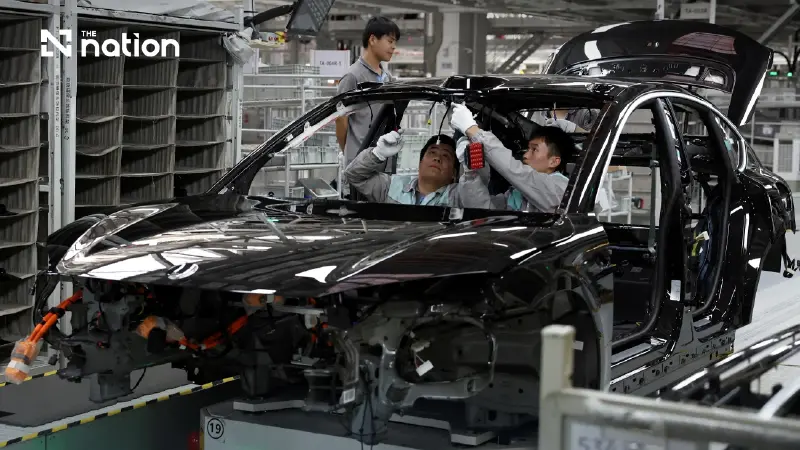


As Chinese overcapacity spills across ASEAN, economists at Singapore’s FutureChina Forum warn that local manufacturers face a structural crisis
- China is experiencing significant overcapacity in high-tech manufacturing, such as solar panels and batteries, as production has far outpaced weak domestic consumption.
- This surplus of efficiently produced, low-cost goods is being exported to ASEAN nations, creating intense price competition for local manufacturers.
- The influx of Chinese products is putting "tremendous pressure" on domestic companies across the region, with some local factories already being forced out of business.
- While the flood of imports is a threat, the same dynamic is also driving Chinese investment in building factories within ASEAN, which can bring capital and jobs.
As Chinese overcapacity spills across ASEAN, economists at Singapore’s FutureChina Forum warn that local manufacturers face a structural crisis.
As Chinese manufacturers push deeper into batteries, solar panels and electric vehicles, economists at the recent FutureChina Global Forum offered a more complicated picture than the usual narrative of seamless industrial triumph — one with real implications for Thailand's own manufacturing base.
Speaking during a panel on China's Economic Transition and Industrial Upgrading, Gao Feng, former chief information officer of the China Banking Association, pointed to a striking divergence in this year's economic data: high-tech manufacturing grew 13.3 percent in the first half of the year, while retail consumption crept up just 1.3 percent.
Behind that gap, he said, lies a specific and acknowledged problem — serious overcapacity in industries such as solar photovoltaic panels and lithium batteries, where Chinese firms have built out production far beyond what the domestic market can absorb.
That overcapacity does not stay within China's borders.
Speaking on a separate panel at the same forum, Stephen Olson, visiting senior fellow at Singapore's ISEAS–Yusof Ishak Institute, offered a blunter assessment of where the resulting output is heading.
"The excess industrial capacity that's produced in China, which formerly would have ended up in the United States, is now increasingly showing up in Malaysia, in Indonesia, and in other countries in the region," he said, warning that a significant price advantage is putting "tremendous pressure on domestic competitors" and that some factories across ASEAN are already going out of business as a result.

Upgrading fast, transitioning slowly
The roots of this dynamic, according to Professor Fan Gang of Peking University, lie in a genuine industrial transformation that has outpaced China's shift toward domestic consumption.
"The industrial upgrading, I think we're doing great, but the economic transition is still developing," he told the panel.
Chinese manufacturing has moved well beyond competing on cheap labour, he said, with productivity gains driving down costs across the board.
"Why are we reducing the price? Because the efficiency is increasing," he explained, describing the resulting price competition as a byproduct of that upgrading rather than a deliberate strategy to undercut rivals.
Exports remain the clearest expression of that shift.

Fan noted that China's export volume exceeded US$1 trillion last year and is expected to grow further, even as domestic investment and consumption remain comparatively weak — a pattern some economists have described as a "K-shaped" divergence between fast-growing sectors and a slower-moving broader economy.
Daniel Zhang, managing partner of First Light Capital and former Alibaba chairman, added a related observation: a significant share of China's national savings currently sits in corporate rather than household accounts, with companies holding cash rather than investing it because they see too few high-return opportunities domestically.
That dynamic, alongside a property market still working through a debt overhang, has encouraged Chinese firms to look outward for growth — reinforcing the incentives to expand production and sales overseas.

A structural, not cyclical, shift
Foo Jixun, senior managing director at Granite Asia, described a broader change in how Chinese companies now approach international markets.
Having invested in China since 2000, he said the past five to seven years have seen a marked shift from purely market-driven expansion to strategies closely aligned with government five-year plans — and, increasingly, active overseas expansion by firms in sectors ranging from robotics to niche technology.
He cited Shenzhen-based exoskeleton maker Hypershell as one example of a Chinese firm moving directly into Western and, by extension, other overseas markets as domestic competition intensifies.
Taken together, panellists suggested this is less a temporary export surge than a structural feature of China's current economic phase: efficient, well-capitalised manufacturers producing more than the domestic market can absorb, with exports — and, where trade barriers make direct access difficult, overseas manufacturing investment — serving as the release valve.

What it means for Thailand
For Thai policymakers and manufacturers, the implications cut two ways, and neither panel suggested the situation was straightforwardly good or bad.
On one hand, the same dynamic driving Chinese overcapacity — steady, well-financed industrial expansion into ASEAN — has fuelled the wave of Chinese factory investment that has become increasingly visible in Thailand's industrial estates in recent years, bringing capital, jobs and, in some cases, valuable technology transfer.
On the other, Olson's warning is a direct one: without careful management, the same forces can undercut domestic manufacturers in sectors where Thai and other ASEAN producers compete directly with heavily subsidised or highly efficient Chinese output.
Olson argued that the central policy challenge is less about broadly restricting Chinese investment and more about distinguishing between the two.
"You need to be selective about FDI," he said, but added that "the real issue that you've got to worry about is the export penetration" — finished goods flooding in and displacing local producers, as opposed to Chinese firms establishing manufacturing operations within the country itself, which tends to bring more durable local benefit.
He also cautioned that the political tolerance for this pressure has limits. Most Southeast Asian governments have so far been "fairly restrained" in imposing anti-dumping duties, he said, but that restraint may not last indefinitely if domestic job losses mount and public pressure builds — a scenario that could, in turn, invite a more forceful response from Beijing.
Managing, not resisting, the transition
None of the panellists suggested ASEAN economies should attempt to wall themselves off from China's industrial transition — nor did any argue the transition itself was cause for alarm.
Fan Gang, for his part, offered a measured long-term view: China's underlying economic direction, he said, remains "on the right path", moving from a first phase built on productivity gains toward a second focused on more efficient capital allocation and stronger domestic demand — a shift that, if it succeeds, could eventually ease some of the export pressure currently being felt across the region.
