
ASEAN Told to "Hold Firm" and Diversify as China Ties Deepen
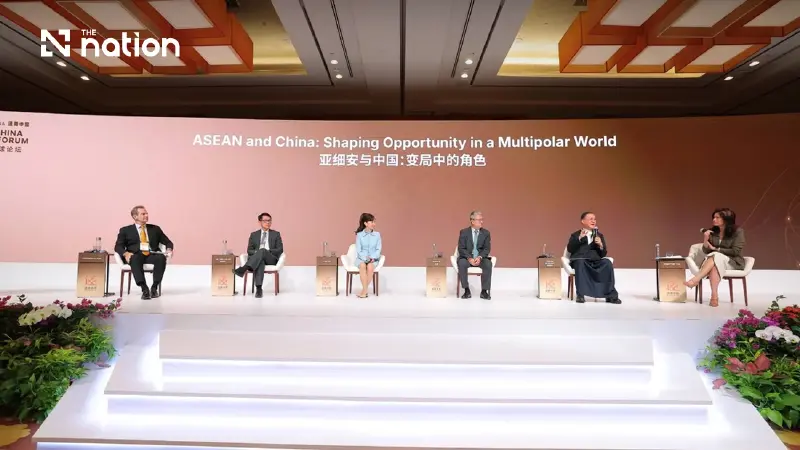


Panellists at Singapore's FutureChina Forum urged ASEAN economies, including Thailand, to balance deepening China trade with strategic autonomy amid US rivalry
- Experts at the FutureChina Forum advised ASEAN nations to "hold firm" against geopolitical pressure from the US and China by aggressively diversifying their economies to maintain strategic autonomy.
- The advice comes as China's economic integration with the region deepens, evidenced by a surge in Chinese investment in industrial parks and a 50% increase in Chinese corporate clients expanding into ASEAN.
- A key risk driving the call for diversification is China's industrial overcapacity, which panellists warned could flood Southeast Asian markets and undercut domestic manufacturers.
- Despite the risks, panellists noted that China-ASEAN trade surpassed $1 trillion, and that ASEAN's strategic position is strengthening in the shifting power dynamic.
Panellists at Singapore's FutureChina Forum urged ASEAN economies, including Thailand, to balance deepening China trade with strategic autonomy amid US rivalry.
As Chinese factories, capital and tourists continue pouring into Southeast Asia, business leaders gathered in Singapore recently had a clear message for the region's policymakers and firms: diversify aggressively, strengthen connectivity, and resist pressure to pick sides between Washington and Beijing.
The advice came during the second panel discussion on the second day of the 17th FutureChina Global Forum, held on Friday (September 25) under the theme "ASEAN and China: Shaping Opportunity in a Multipolar World."
The two-day forum, organised by the non-profit Business China from 24 to 25 September, brought together executives, officials and academics from China and Singapore under the broader banner "Strengthening Resilience, Rebuilding Trust."
For Thailand and its ASEAN neighbours, the discussion offered a practical, if sobering, roadmap: the opportunities from China's economic pivot southward are real and growing, but so are the risks of overdependence.

Geopolitics as a "chessboard"
Stephen Olson, visiting senior fellow at Singapore's ISEAS–Yusof Ishak Institute, opened by describing Southeast Asia as a "chess board" on which Washington and Beijing compete for influence, with both powers increasingly using legal, regulatory and tariff tools to pull countries into their orbit.
His counsel to regional governments was direct: "Hold tight... diversify aggressively [to reduce] the leverage that either of the major powers can exert on you."
He argued this should be a national, rather than a collective ASEAN, strategy, noting the bloc failed to present a unified front when the United States pressed individual countries to negotiate tariff deals bilaterally.
Trade holding up despite friction
Lim Chin Chuan, regional chief executive for Northeast Asia at port operator PSA, said cargo data tells a more resilient story than headlines suggest.
Intra-Asia trade is expanding rapidly as manufacturing supply chains fragment across more countries, with components now crossing borders repeatedly during production.
Singapore's port volumes, he noted, grew 8 percent last year after years of steadier 2-4 percent growth, driven largely by this "less efficient" but more distributed manufacturing model that ultimately generates more trade, not less.
Thailand's factories fill up
The clearest illustration of this shift came from Vikrom Kromadit, chief executive of Thailand's AMATA Corporation, which operates major industrial estates.
Chinese firms now account for roughly 70 percent of investment in his parks, up sharply from earlier decades dominated by American and Japanese tenants, and he said the success rate of Chinese factories there has climbed from around 70-80 percent to over 98 percent.

He said he hopes to grow the number of Chinese-linked factories in his parks from roughly 400 today to 2,000 within a decade, citing Thailand's cost competitiveness, safety, and hospitality toward Chinese investors.
Wang Ke, head of Greater China and chief executive of OCBC Hong Kong, said the bank has recorded a 50 per cent increase in new Chinese corporate clients expanding into ASEAN.
This reflects a shift away from simple factory relocation towards building full manufacturing, distribution and service networks to capitalise on individual countries' strengths.
For example, an electric vehicle's components might be sourced in Indonesia, assembled in Malaysia, manufactured in Thailand and ultimately sold in Singapore.
Tourism as a bridge
Jane Sun, chief executive of Trip.com Group, pointed to three converging travel trends she called the "three Ps": premium travel (including ultra-high-end packages), purposeful travel tied to global events and entertainment, and "bleisure" trips that blend business with weekend family visits.
She said regional travel demand is growing 35 to 45 percent year-on-year, adding, "We hope through Trip.com we can bring people together and create job opportunities for small businesses in the travel industry."
Risks: overcapacity and Japan-China tension
The discussion was not without caution. Olson warned that Chinese industrial overcapacity, no longer as easily absorbed by the US market, is increasingly flowing into Southeast Asian economies, undercutting domestic manufacturers and testing governments' patience with anti-dumping measures.
He suggested countries "need to be selective about FDI" while watching export penetration closely.
Vikrom raised a separate concern: rising defence spending and rhetoric between China and Japan. He also cited unpredictability from Washington as a factor clouding the region's otherwise stable outlook, while stressing ASEAN itself remains largely free of the conflicts affecting Ukraine or the Middle East.
Who needs whom?
Asked directly who needs whom more, Olson argued "China needs ASEAN more," pointing to Washington's historically deeper network of alliances.
Lim countered that interdependence has become too entangled to separate, given how components now cross multiple borders before reaching final markets.
Wang cited trade data showing China-ASEAN trade topping US$1 trillion last year, with exports and imports both growing strongly and the relationship becoming "more balanced".
Looking to 2035
Panellists offered a broadly optimistic, if watchful, outlook for the decade ahead. Sun summarised the stakes for the region: "Divided we will be vulnerable, but united we will prosper."
Wang said he hoped China-ASEAN ties would eventually resemble the closeness of intra-ASEAN relations themselves, while Olson predicted a "shifting power dynamic" reflecting a stronger relative position for ASEAN — though he expected US-China rivalry to persist regardless of who occupies the White House.
