
Back PTT expansion but keep politics out of it


Play
PTT's quest to triple its capacity deserves national support, as long as there is no underlying political intervention behind the plan and a smooth national energy supply and long-term prosperity can be ensured.
The country cannot afford any unfortunate events, in light of the tightness of energy supplies globally and the group’s gigantic size in relation to the size of the economy. PTT’s consolidated revenue of Bt2 trillion last year accounted for 23 per cent of the Kingdom’s gross domestic product.
It was on Monday that the group made a cash offer of US$900 million (Bt28.1 billion) for the remaining stake in Singapore-listed Sakari Resources, which operates two coal mines in Indonesia. This followed a $2.28-billion deal for a 40-per-cent stake in the Kai Kos Dehseh oil-sands project in Canada in 2010, and the $2.2-billion deal for Cove Energy, both undertaken by the 65.29 per cent-owned subsidiary, PTT Exploration and Production (PTTEP).
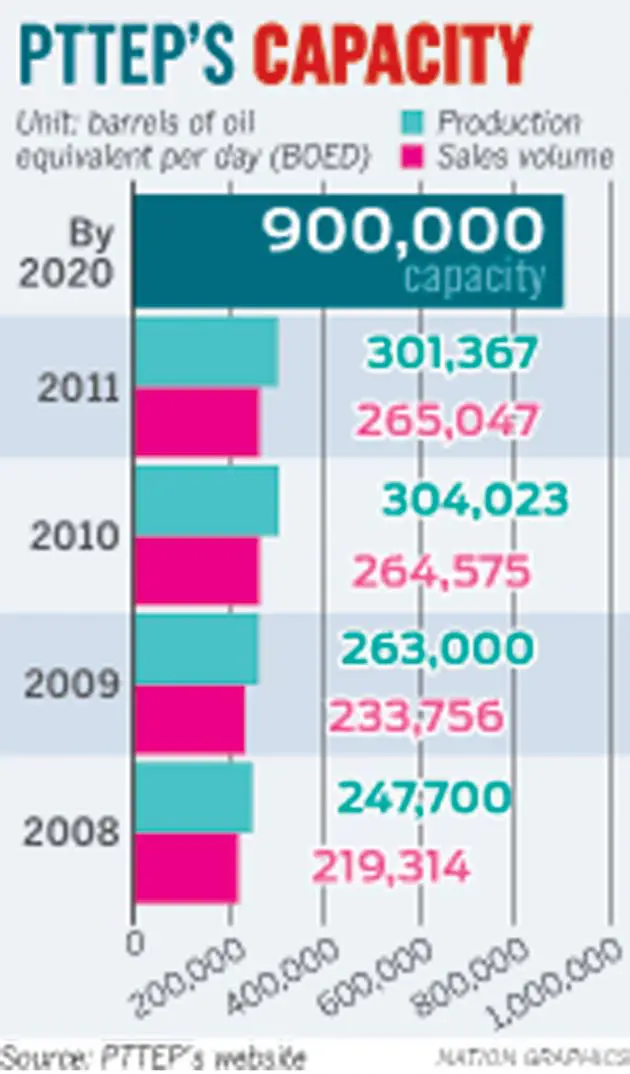
The sum looks huge, but it is incomparable to the group’s plan to invest nearly Bt1 trillion to triple production capacity from 300,000 barrels of oil equivalent a day to 900,000 by 2020.
PTTEP alone plans substantial capital expenditure of $3.6 billion for this year. To support the entire supply chain, PTT needs to build a new oil tanker, a floating liquefied natural gas operation and a new LNG terminal. It has also diversified into coal business as well as coal-fired power generation and hydropower, through Xayaburi Power.
Established nearly 40 years ago as the Petroleum Authority of Thailand, PTT has financed much of its business through government-backed investment. Over the years, the empire has expanded extensively until the group now has about 200 business units, which are coming under a corporate downsizing scheme so that the group can move ahead on firmer ground.
However, just as it is moving forward, PTT should know that there are issues that require clarification, if it wants national support for its international expansion.
Privatised in 2001, PTT is still considered as maintaining a monopolistic business, particularly in the area of natural gas for vehicles. The company is currently the country’s only NGV retailer. Public concern has resulted in criticism that PTT manipulates the price of the gas and, even though global energy prices has advanced, it has been unable to win public support for an increase in the gas price due to these doubts. To gain such support, Chulalongkorn University has had to be contracted to conduct a non-partisan study on the gas-pricing structure.
On the other hand, all eyes looked away when PTT had to take care of imports of liquefied petroleum gas from 2008, even though it operated no LPG fuel stations. Though it had a no-loss guarantee regarding the importation of the high-priced gas, which was resold at a much lower price at home, the company had to shoulder some financial burden before the Oil Fund could replenish the difference.
Much of the doubt is due to the unclear status of PTT, that is, whether it is a state enterprise – which must answer to the authorities – or a listed company, which must answer to all stakeholders, and not just the authorities. To date, it seems there has been no move from either the company or the authorities to clarify this doubt.
Since PTT was listed and the Finance Ministry reduced its stake from 100 per cent to 51 per cent, there have been parties that believe former prime minister Thaksin Shinawatra benefited from the privatisation and is behind PTT’s overseas expansion.
PTT is now chaired by Energy Ministry permanent secretary Norkun Sitthiphong, who briefly resigned during the Abhisit Vejjajiva government to clarify a conflict-of-interest issue. He later returned and looks set to remain there for some time. In the Thaksin era, Norkun – known to be personally acquainted with the ex-PM – was contacted to become a deputy permanent secretary of the newly established Energy Ministry.
Public concern grew as PTTEP made its bid for Cove Energy at such a high price, even though Cove owns a small stake in the Rovuma gas field in Mozambique. The acquisition also coincided with Thaksin’s comments in some of his interviews that Thailand should invest in the field of African energy.
Given that many officials from the ministry sit on the board of PTT or its subsidiaries, it is not surprising that Noppanan Wanthepsakul, a Chulalongkorn economics lecturer, said in recently released research that PTT is at the centre of policy corruption.
Given the group’s unclear status, PTT president and CEO Pailin Chuchottaworn’s suggestion that the government channel foreign reserves to finance an oil tanker looked ridiculous. The timing was also not right, as the government and the Bank of Thailand are wrangling over the allocation of the reserves.
From one point of view, PTT’s overseas quest deserves national support. Globally, based on 2011 revenues, there were only nine countries where a single company’s revenue accounted for at least 20 per cent or the nation’s economic size. PTT’s prosperity will drive the economy, but sustainability is not guaranteed if that prosperity is tainted.
