
BOT urges right balance of policy mix


Play
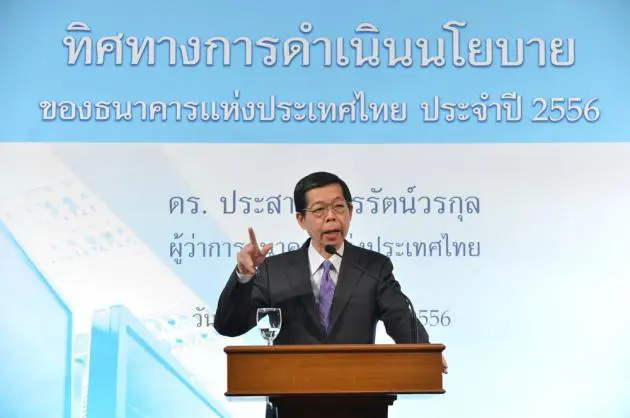
Bank of Thailand Governor Prasarn Trairatvorakul highlighted the need for the right balance of policy mix, to cope with internal and external risks to the financial stability.
In the press conference to unveil the central bank's policy direction in 2013, he said that given robust domestic growth, there is risk to inflation if asset prices overshoot. Meanwhile, Thailand is facing external risks, as it will further attract fund inflows.
Here is the full speech:
Honourable guests and members of the press,
Thank you all for attending this annual event, in which I would like to outline the Bank of
Thailand (BOT)’s policy direction in 2013. Throughout history, our country might at times be faced with economic challenges and obstacles of different nature and severity, but the BOT’s mission and resolve to safeguard Thailand’s economic and financial stability has remained unchanged since its birth over 70 years go. Today our country is moving into an era of ever-closer linkages, whose scope extends well beyond the technology and communication dimension. It involves regional economic integration, not least among neighboring countries or what is collectively known as the CLMV area. Within our country itself, the volume of cross-provincial trade and the number of SMEs outside the capital have grown, suggesting that growth has been increasingly inclusive. On the other hand, the greater economic interdependence brought about by closer trade and financial integration could also be a source of systemic risk, if an imbalance, however small, was allowed to develop unchecked.
The BOT, as one of the nation’s key policy makers, strives to foster a sound and stable economic environment that enables the private sector not only to grow, but also to retain sufficient resilience and flexibility to withstand competition and uncertainties. We continue to place an emphasis on promoting the global competitiveness of Thai businesses, while ensuring the integrity of the economic and financial system as a whole, the very foundation of consumer and business confidence.
The key challenge this year for the BOT and other policymakers is to preserve the right balance
of policy mix, which in turn demands both intra- and inter-agency cooperation. Our common goal is to promote a sustainable growth path and ensure a high standard of living for all Thais.
Economic developments and policy implementation in 2012
Last year, the Thai economy had to grapple with the stagnating global economy, volatile capital
flows, and challenges in recovering from the flood crisis. Notwithstanding these difficulties, the economy proved to be resilient and flexible enough to withstand various shocks and uncertainties. Indeed, robust domestic demand has become the main engine of growth amid the softening global economy, helped in part by government stimulus measures. Overall economic activities consequently improved, and I would like to thank all parties for their collective efforts.
On the monetary policy front last year, a greater emphasis was placed on risks to growth, which
justified the accommodative monetary policy stance throughout 2012. The Monetary Policy Committee (MPC) lowered the policy interest rate twice by a total of 0.50 percentage points. The first cut took place earlier in the year, and was designed to help speed up economic recovery after the severe flood.
The last easing in the latter part of 2012 was intended to provide an additional cushion against the impact of global economic slowdown and to further bolster domestic demand to sustain growth momentum. These policy decisions were deemed consistent with keeping inflation within the target range, as well as maintaining the overall financial stability. In fact, the first joint meeting between the MPC and the Financial Institutions Policy Committee (FIPC) took place last year, where the two committees shared their perspectives and information, as well as discussed in depth potential sources of systemic risk that could arise from economic and financial linkages. Regarding capital flow policy and in collaboration with the Ministry of Finance, the BOT continued to relax regulations to promote outward investment and foster more balanced capital movements.
A clear lesson from the recent global financial crisis is that a good conduct of monetary policy
alone does not necessarily guarantee a sound and stable financial system. As a result, central banks around the world have stepped up efforts to strengthen the supervision of financial institutions, improve risk management, and place a greater emphasis on monitoring systemic risks. Last year, the BOT introduced the Basel III capital regulatory framework with focus on improving capital quality, increasing capital base to provide cushion in the event of a crisis, and strengthening risk management procedures, especially in the realm of credit risks. These initiatives would further strengthen the stability of financial institutions, laying the foundation for stronger financial system and economy in the longer term.
To increase the efficiency of the payment system, the BOT has launched the Imaged Cheque
Clearing and Archive System (ICAS), for Bangkok and its vicinity since February 2012. In addition, the Financial Consumer Protection Center (FCPC) was set up to provide information about the BOT, to receive consumers’ complaints regarding financial services, and to offer financial education to the public, all of which have been well received.
Economic outlook in 2013
Looking ahead, risks to growth have declined on the back of firmer, if moderate, global
recovery, and robust domestic demand which continues to be the main growth driver for the Thai
economy. Private consumption would continue to benefit from the first-car tax rebate program as well as the reduction in personal income tax which would take effect this year. Furthermore, private investment continues to expand steadily on positive growth prospects, post-flood reconstruction in some parts of the manufacturing sector, and various government stimulus measures. Meanwhile, exports started to show signs of a broad-based recovery, and should pick up pace in the latter half of this year, lending an additional support to growth momentum as the effect of government’s stimulus wanes. Inflationary pressure meanwhile should remain contained. The impact of the second minimum wage hike on inflation is expected to be limited, as most businesses manage to keep a lid on cost via increased production efficiency, encouraged in part by a highly competitive goods market. The BOT will however continue to closely monitor any inflationary impact of the wage increase.
Policy challenges for 2013
While it may seem that the worst is behind us, one must continue to be vigilant of risks. It is
crucial for policy to be forward-looking and proactive, quickly adjusting to changing environment and shifting challenges. As I have mentioned, the key immediate challenges is to preserve the right balance of policy mix, in order to ensure that each policy’s effectiveness is maximized and grounded on the basis of sustainable economic well-being, as well as safe and sound financial system. Toward these goals, the BOT has a number of functions to perform.
Monetary policy and exchange rate policy
The overriding objective of monetary policy continues to be the safeguarding of economic
stability, which encompasses the dimensions of growth, inflation, and financial stability. This year, a key challenge will be in striking the right balance between providing sufficient support to growth while ensuring that financial stability is also preserved. In particular, a prolonged accommodative monetary policy may pose risks to financial stability if it encourages excessive debt accumulation, or induces overinvestment in risky assets as investors search for higher yields. Financial imbalances or a bubble may develop as a result, further complicating policy decisions. Thus, the BOT will continue to closely monitor credit developments and household’s debt servicing ability, especially for the lower-income group.
Another key challenge will be the management of volatile capital flows, and implications of
exchange rate movements on the real economy. In meeting this challenge, the BOT has at its disposal various policy options, ready to be deployed under different circumstances. The recently announced Capital Account Liberalization Master Plan was aimed in part to encourage Thai companies to diversify their investments abroad, including towards neighboring countries, and operating their businesses more efficiently using local currencies. The initiative would help foster more balanced capital flows, and promote financial market development that facilitates the regional integration under the ASEAN Economic Community (AEC) in 2015. We will continue to support businesses in strengthening their abilities to cope with exchange rate fluctuations.
Financial institutions policy
It is now universally recognized that economic growth and financial institution development
must proceed hand in hand. The development of financial institutions in Thailand has indeed seen a significant and continuous progress, which has greatly helped support economic activities over the years. Still, many steps must be taken to further enhance the financial system and promote a more efficient intermediation. To deepen financial access, the BOT will cooperate with relevant agencies to allow commercial banks and non-banks to offer microfinance services, under the business model appropriate for risks and behaviour of the targeted group. At the same time, it remains our priority to reinforce the stability of financial institutions by strengthening capital base and improving risk management, to cushion against potential shocks under adverse circumstances.
This year, we will establish a licensing framework for foreign commercial bank subsidiaries,
with a view to enhancing the competitiveness of the banking industry as envisaged in the Financial Sector Master Plan Phase 2. Meanwhile, a guideline will be laid out allowing domestic commercial banks to expand and integrate into the Qualified ASEAN Banks (QABs) network under the AEC. This integration offers an opportunity for Thai banks to step up their efforts to fortify their strategic strengths and prepare for a fiercer competitive environment. Stronger institutions could seize the opportunity to expand internationally and diversify their risks. A balance must be struck between the three objectives of increasing financial service efficiency and access, safeguarding financial system’s integrity, and strengthening consumer financial protection.
Payment systems policy
The priority this year will be to expand the coverage of the ICAS across the country, to speed up
the provincial cheque collection from 3-5 business days to 1 business day. The initiative will help promote a more efficient payment system, enabling fast, safe, and secure economic transactions as well as promoting a substitution of electronic for cash payments. In doing so, the BOT will collaborate with relevant agencies in developing the payment infrastructures that support not only domestic electronic payments, but also cross-border ones, which require risk management mechanisms able to handle foreign exchange settlements under different time zones, and a standardized payment system that allows international connectivity for example. These undertakings, in turn, would lay the foundation for more efficient intra-regional trade and investment within the AEC. The challenge for payment system policy consists of keeping a balance between encouraging development for efficiency gain, and ensuring that there is adequate supervision in place to ensure a safe and sound payment system for Thailand.
Conclusion
I believe that Thailand has one of the highest potentials in the region. Though there are
challenges ahead, opportunities abound. The BOT, as a key policy maker, will endeavour to implement economic policies under its purview in a timely and judicious manner. We are ready to work with all parties, public and private alike, to create a supportive environment conducive to sustainable growth. I trust that, through closer policy coordination among all relevant agencies, a common vision for the country will emerge, leading ultimately to constructive engagements between all parties. With a shared vision and collective efforts, our goal of long-lasting prosperity for the nation is not beyond our reach.
Thank you
