
'Scheme will run till 2017'


Play
Rice price to be cut from June 30 but policy to continue despite huge cost
The Yingluck Shinawatra government has given in to heavy public criticism over the huge Bt130-billion loss incurred through its controversial rice-pledging scheme, agreeing to reduce the minimal price from Bt15,000 to Bt12,000 per tonne.
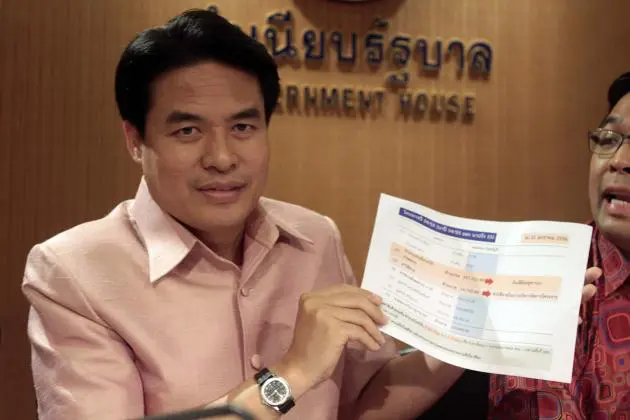
Payment for rice will be reduced from the end of this month – June 30 – till the end of the current crop season in late September, Commerce Ministry Boonsong Teriyapirom said yesterday, as chairman of the National Rice Policy Committee.
But the scheme would continue, with the rate readjusted for the next crop, beginning in November, he said. The government intended to keep the scheme going in line with improved fiscal discipline from now till 2017.
Boonsong said the government planned to outlay “Bt100 billion each year” from now till then to fund the rice scheme. But he did not specify when asked if the Bt100 billion “was a subsidy or a loss”.
The final figure and timeframe for the new lower rate came in the evening after hours of discussions among senior government figures and NRPC members. The decision looks likely to be endorsed by the Cabinet at its meeting next Tuesday so it takes immediate effect.
A crucial joint meeting between the Finance and Commerce ministries on Monday night reached an initial conclusion that the lower rates should vary between Bt13,500 and Bt12,000 – a cut of 10 to 20 per cent respectively, but this was not submitted to Cabinet for consideration earlier yesterday.
Prime Minister Yingluck Shinawatra, who chaired the Cabinet meeting in the morning, was asked about the Bt15,000 payment level being reduced, but did not answer that. She said: “In accounting terms, the scheme might be at a loss, but in reality, the Bt130-billion difference the government has shouldered is a care given to farmers.”
Giving further details of the NRPC conclusion, Boonsong said farmers would be allowed to pledge their output under the scheme at no more than Bt500,000. Asked if the government would admit that the rice scheme was a failure due to a huge loss amounting to Bt130 billion, Boonsong said it wasn’t the government’s fault, but changing factors in the world rice market and the global economy.
The Bt12,000 per tonne amount is calculated under criteria set by the Agriculture Ministry which put a “loss-free guarantee” at Bt8,000 per tonne for farmers, while the remaining Bt4,000 was profit.
Boonsong admitted the global rice market did not favour Thailand and the government’s scheme, as prices for rice grown in India and Vietnam, now the largest and second largest exporters, have got lower, while the rice in government stockpiles would only contribute to greater supply in the world market.
The Agriculture and the Commerce ministries would work out solutions to compensate farmers with a cut in tariffs or prices of farm machinery, along with other subsidies, he said. “I hope farmers will understand the government and accept the reduction in the minimal price guarantee,” the minister said.
In the meeting on Monday night, government representatives said they accepted a finding by a subpanel handling the scheme’s accounting that the pledging policy had suffered a loss of Bt130 billion, on condition that this amount was based on only two rice crops. It does not include the latest crop, which could see 21.5 million tonnes of rice husk or seeds costing possibly Bt40 billion.
