
Price cut 'not a solution'


Academics sceptical of govt move; Pheu Thai to brief MPs on appeasing farmers
The ruling Pheu Thai Party is calling a meeting to brief party MPs on how to assuage upset farmers following the reduction in the pledging price of rice, even as academics yesterday argued that the price cut will not help resolve the financial losses and corruption problem.
A senior fellow at the Thailand Development Research Institute, Nipon Poapongsakorn, spoke at a seminar on “Whether the reduction of pledging price for rice will help solve the loss and corruption problems?” held by the Thai Journalists Association in cooperation with the Isara Institute.
Nipon said that most of the current corrupt activities occurred during the release of rice from stockpiles, which had not been conducted in a transparent manner.
The reduction in the pledging price had not reduced any benefits earned by the rice mills. While the government had not revealed any sales information on the rice, only some of the losses could be cut by reducing the pledging price.
Nipon said the government had yet come up with measures to plug corruption loopholes in the rice-pledging scheme, especially those selling activities of high-level authorities. The activity of siphoning the money from farmers would remain, despite the reduction in prices.
Nipon said the government should abandon regulations allowing any rice mill to take seven days to convert paddy into rice in order to prevent them from having time to bring cheap rice from neighbouring countries to replace the pledging rice set for delivery.
Meanwhile, Wiboonlasana Ruamraksa, director-general of the Internal Trade Department, said that in operating the rice-pledging scheme, authorities had not ignored measures set up to prevent corrupt activity. The committee was seriously in charge of the problem.
She said the reduction in the pledging price might result in some drop in corruption activity – but more efforts should be made to further cut it.
Wiboonlasana said she had not seen how the Finance Ministry’s subcommittee overseeing the rice-pledging scheme’s accounting, had calculated their balance sheet based on the highest cost assumptions.
Farmer representative Rangsan Kasulong said he would lead farmers to petition PM Yingluck Shinawatra on how the rice-pledging price reduction is unacceptable.
He said farmers had faced not only higher wage costs but increases in land leasing from Bt500-Bt700 to Bt1,000-1,500 per rai. He said price reduction would not help root out corruption, which has plagued the scheme from the start.
“Corruption is suspected at every step – right from the registering of farmers to the unusually high rice of planting areas, and irregularities in rice shipments from one miller to another. Irregularities are also suspected because the government cannot tell how much rice has been sold,” he said.
Appointed Senator Yuthana Thaipakdee said he believed three private companies had reaped as much as Bt15 billion profit in the alleged irregularities involving the sale of packed rice under the Commerce Ministry’s low-cost Blue Flag programme.
He said the Bt15 billion is added to the state’s losses from the rice-pledging scheme and the government must be held responsible for the losses.
Meanwhile, the Pheu Thai Party has moved to stem farmers’ growing discontent over the government’s move to revise down the rice pledging price, following a leaked report of the scheme’s huge losses.
Pheu Thai Party spokesman Prompong Nopparit will tomorrow hold a meeting so that concerned ministers can guide MPs on how to explain to farmers why the rice pledging price has dropped from Bt15,000 to Bt12,000 per tonne.
The government is facing growing pressure from farmers who have threatened to rally against the decision to cut the price.
Prompong said the government would come up with handbooks explaining details about the scheme to prevent the Opposition from distorting facts surrounding the scheme to discredit the government.
An opinion survey has found that more than 80 per cent of respondents believe the rice-pledging scheme was hit heavily by corruption. The survey was carried out by Assumption University’s Abac Poll among 1,432 residents of 17 provinces from June 19-22.
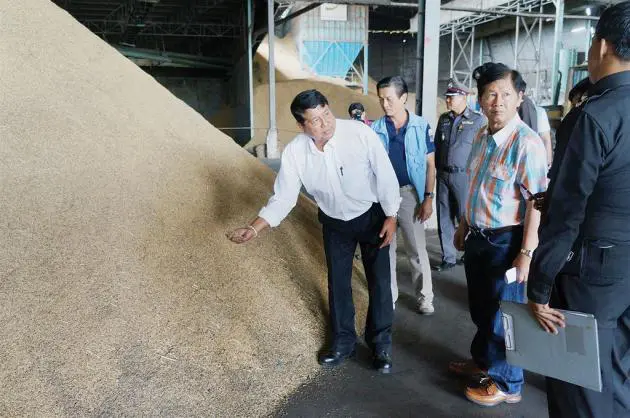
Meanwhile, Phichit provincial Governor Chakrarin Plianwong ordered 33 rice millers involved in the rice-pledging scheme to stop shipments of rice from June 22-29. He said official inspections have revealed that more than 4,000 tonnes of rice pledged by farmers and another 4,000 tonnes of rice under the pledging scheme of the Marketing Organisation for Farmers (MOF) had disappeared from a warehouse in Photalay district. The governor instructed local police to be stationed at rice mills and ordered the MOF to file a police complaint over the missing rice.
The inspection was carried out after farmers in Phichit cried foul that they had not received money and certifications, which show how much rice they had pledged with the rice millers.
