
Boonsong vows to review rice price decision
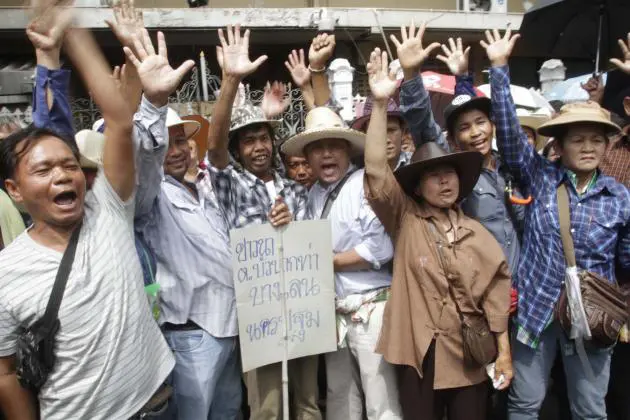


A large group of farmers yesterday converged outside Government House to submit a request that the minimum rice price guaranteed under the price-pledging scheme be raised back to Bt15,000.
The crowd dispersed without incident after Commerce Minister Boonsong Teriyapirom promised to consider increasing the rate from Bt12,000 by Friday, two days before it is due to take effect.
Boonsong said a decision over the rate would rest with the ministry’s National Rice Policy Committee, which would then require Cabinet approval to endorse it.
Around 500 farmers from three groups deemed to be supporters of the Yingluck Shinawatra government had gathered outside Government House, rather than those extremely frustrated with the Bt3,000 reduction and who have threatened a series of large-scale campaigns against the change.
Meanwhile, government-commissioned inspections of state-run warehouses across the country storing pledged rice will begin ahead of the scheduled June 29 date, after teams of inspectors, which are to be assisted by local police, were readied earlier than had been planned, said Thawat Bunfueng, deputy secretary-general to the prime minister.
The Commerce Ministry will lead the inspections, which are aimed at detecting reported cheating or theft of rice stored in the warehouses.
Potentially subject to inspection are rice silos belonging to 680 millers, and 791 warehouses owned privately or operated mainly by the Public Warehouse Organisation and the Bank for Agriculture and Agricultural Cooperatives.
Asked about the possible moving around of rice among the storage facilities in a bid to fool the inspectors, Thawat said local police had been monitoring the situation for two days and reported no evidence of such a ploy. The inspections will be conducted simultaneously in most operations throughout a selected 24-hour period, he said.
“Operational readiness has now reached 60 to 70 per cent, which means the large-scale inspections can now be actioned, although the original time frame was scheduled for June 29,” he added.
SCHEME ‘FRUITLESS’
A Bangkok Poll opinion survey released yesterday found that 56.8 per cent of 1,163 Bangkok residents surveyed were not in favour of the rice-pledging scheme, saying that it was fruitless and a waste of budget, while 43.2 per cent said it was good and helpful to farmers.
A majority of opinion favoured other populist policies, however, with 70.2 per cent supporting the starting salary of Bt15,000 for holders of bachelor’s degrees; 64.1 per cent in favour of the daily minimum wage of Bt300; 60.9 per cent favouring the tax rebate for buyers of first homes; and 55.6 per cent backing fuel credit cards for taxis and public transport operators.
Asked about how the government’s populist policies had affected their daily lives, the responses were: in higher prices of commodity goods (77.5 per cent); heavier traffic congestion (64.1 per cent); more household debt (54.3 per cent); more corruption (47.9 per cent); and more political rallies and division (35.5 per cent).
Meanwhile, Democrat Party MP Ongart Klampaiboon said he had learned imports of methyl bromide, which is used as a pesticide to kill rice-eating bugs, had increased by 62 per cent since the pledging scheme began, even though the European Union was discouraging the use of it.
He was responding to a finding at a warehouse storing pledged rice in Nakhon Si Thammarat, where dead rats and cats were discovered, allegedly having died as a result of the pesticide, which is potentially dangerous if misused.
