
MUFG takeover of BAY reflects shift to region


Play
Big Asian banks eye Thai base for network expansion
Thailand is becoming a tough battleground as big Asian banks seek a foothold here, following their US and European peers to the Southeast Asia region, with Mitsubishi UFJ Financial Group’s takeover of Bank of Ayudhya, the biggest such deal in the country, a flashy part of the trend, according to Kasikornbank.
“BAY from now will become the main competitor not only in the Japan market but all segments because its major shareholder has a larger network overseas,” Banthoon Lamsam, chairman and CEO of the fourth largest bank in the country, said yesterday.
The offshore investment of MUFG in the Thai bank reflects the change in the source of investors in Asean from the West to the East, he said.
After the tender offer is completed, BAY’s assets will grow to Bt1.5 trillion from Bt1.2 trillion, putting it closer to KBank, which has assets of Bt2 trillion.
Industrial and Commercial Bank of China led the way with its investment in a Thai bank – ACL Bank. The Japanese are following in the footsteps of the Chinese.
This demonstrates the power of Asia.
The entry of the Japanese bank is good for the market, as it will try to speed up solutions to customers.
KBank has already noticed the streaming of Japanese businesses into Asean including Thailand, so it is focusing on Japanese customers as the main customer target.
“The rapid adaptation will help secure a presence in the industry,” Banthoon said.
In 2010, KBank joined with 15 Japanese banks to take care of the financial needs of Japanese companies doing business here.
Now with 24 Japanese partner banks, KBank is serving about 4,000 out of the total of 7,000 Japanese SMEs in the country, he added.
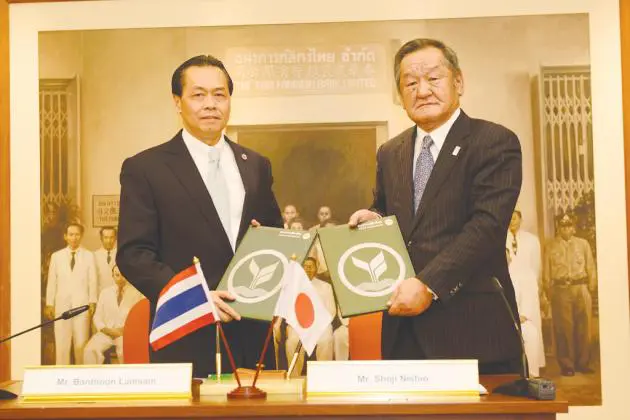
Yesterday, KBank signed an agreement with the Tokyo Chamber of Commerce and Industry (TCCI) to help facilitate the operations of Japanese SMEs planning to expand in Thailand.
Songpol Chevapanyaroj, executive vice president of KBank, said the bank is concentrating on transaction services for Japanese SMEs rather than lending because they already have enough cash. About 80 per cent of the financial transactions of Japanese companies involve payroll accounts, fund transfers, tax payments, mobile banking and supply chain financing.
Even though a mega bank is entering the local banking industry, KBank believes its full range of services, convenience and long relationships with Japanese companies would help secure its customer base.
“Banking in Japan consists of mega banks, regional banks and specialised financial institutions, with each group sharing one-third of the market. The partner banks of KBank are regional banks, so businesses may not overlap,” he said.
Shoji Nishio, executive director of the SME division of TCCI, said SMEs in Japan are forced to seek operations bases outside their country to reduce costs and supply products to Tier 1 and Tier 2 operators.
The demand shock in Japan in the past few years has compelled firms there to migrate to Asean. Thailand is among the first countries for expansion because of the completed infrastructure and larger manufacturers with an operations base here.
Most Japanese SMEs, however, do not have much experience in markets abroad.
This is the duty of the TCCI – to suggest markets and help them conduct feasibility studies to ensure success in doing business outside the country.
However, Thailand should solve the problems of high wages and an insufficient labour pool so that it can support the Japanese SMEs flowing into the country, he added.
