
Stock market tumbles on poor outlook


Play
Thai shares tumbled 47.28 points or 3.27 per cent to 1,398.48, as the latest growth revision raises concerns on economic outlook.
The Office of the National Economic and Social Development Board on Monday revised down the economic growth forecast for 2013 from 4.2-5.2 per cent to 3.8-4.2 per cent, on three major reasons.
A delay in government projects is cited as one of the reasons, that include slowing demand for exports as well as the tapering of quantitative easing in the United States.
"Thai economy in the second half of the year is likely to improve from the first half. Nonetheless, comparing with the same period last year, the growth rate in the second half is expected to be lower than its potential due to the constraints from (i) limitation in exports sector, (ii) headwinds from a high base effect, (iii) the diminishing impulse from economic stimulus measures, (iv) the possibility of a delay in the implementation of public investment plans, and (v) the slow recovery of household income that depends on the exports condition and the price of agricultural products in the global market. As a result, the economic growth in 2013 is likely to be lower than previously projected," the think tank said in its economic outlook report.
The full-year forecast was revised downward, as Thailand showed the second-quarter growth rate of only 2.8 per cent, against the expectation of 3.3 per cent.
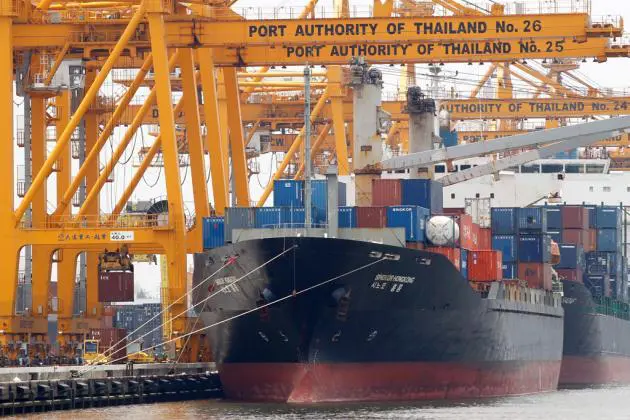
Exports including those of services managed to grow only 2.8 per cent yoy despite a favourable base. This follows growth of 8.3 per cent on year in the first quarter. Within exports, goods exports were particularly weak falling 1.5 per cent on year and broadly reflecting subdued growth in global trade. Following this outturn, the government has cut its full-year 2013 export forecast from 7.6 per cent on year in May to 5 per cent. Considering the ongoing weakness in global trade, even the revised forecast appears optimistic.
The problem was further complicated by a slowdown in private consumption to 2.4 per cent on year (against 4.4 per cent in the first quarter), and investment to 4.5 per cent from nearly 6 per cent previously. This slowdown suggests that credit-led expansion in consumption is getting harder to come by and the impact of various forms of support such as mandated increases in minimum wages and rice pledging is starting to wane. At the same time, investment activity is being suppressed by the inability of the government to implement its infrastructure development programme.
Thai shares down 29.83 points in the morning session of Monday following the downward revision in the growth forecast.
The SET index stood at 1,415.93 points at noon. The index swung from 1,412.39 points to 1,438.78 points in the morning session.
Maybank Kim Eng Securities (Thailand)'s research chief said that the downward revision sparked sell-offs in banking and commerce stocks, as there is no good news at all.
While the Bank of Thailand is expected to maintain the policy rate at its Wednesday meeting, the Bt2 trillion borrowing bill vetting is being pushed off to the end of this month.
