
Energy agency set to invite proposals for Napier-grass power generation


Play
Adviser Chiang Mai University to finish TOR drafting soon
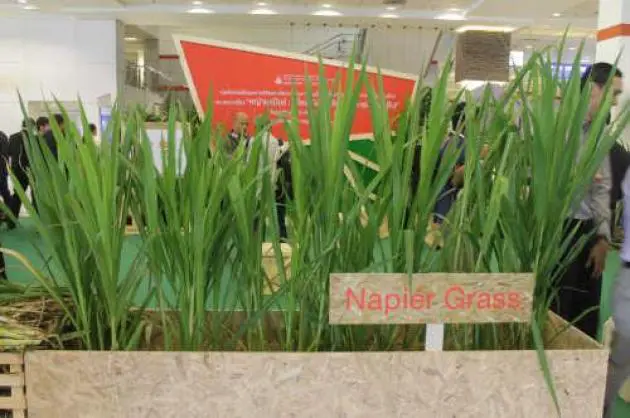
The Department of Alternative Energy Development and Efficiency is expected to invite interested parties next month to submit proposals for its Napier grass-based electricity-production project, a department source said yesterday.
Chiang Mai University, which the department hired as an adviser, is expected to finish drafting the terms of reference (TOR) for the project this month, including the selection of planting locations and the qualifications of participants. Most of the selected locations are in the North, Northeast and Central regions. Some locations are in military areas and the department has already coordinated with the Army to pilot the project in its areas.
The National Energy Policy Council in July raised its target for alternate-energy sources to 13.9 gigawatts from 9.2GW under the revised Alternative Energy Development Plan for 2012-21. By source, the targets were lifted for wind power to 1.8GW from 1.2GW, solar power to 3GW from 2GW, biomass to 4.8GW from 3.6GW, garbage to 400 megawatts from 160MW and biogas to 3.6GW from 600MW.
The increase in biogas reflected the use of Napier grass, while hydropower was cut drastically to 324MW from 1.6GW.
As part of the measure, a dozen 1MW Napier-grass-fired power stations will be piloted next year.
The whole project is expected to cost Bt100 million and require 1,000 rai (160 hectares) of land.
The department will provide financial assistance at 10-15 per cent of the value of each of the 12 pilot projects. The electricity will be sold to the Provincial Electricity Authority at a feed-in tariff (FIT) of Bt4.50 per unit for 20 years.
Kitti Jivacate, president and chief executive of Universal Adsorbents & Chemicals (UAC), said the company was waiting to see the TOR. It is interested in developing one or two biofuel power stations in the North or Northeast.
UAC has already trialled a compressed bio-methane power plant burning Napier grass in Chiang Mai. The Energy Ministry has supported the company to expand the plants to 20, of which 10 will be invested in by the company itself. Three will be in Chiang Mai, three in Lampang, two in Chiang Rai, one in Lamphun, and the location of the last one is under consideration.
It will join with potential partners to invest in the remaining 10, of which six will be in Khon Kaen and four in Loei. All projects will be finished in 2015.
The Energy Ministry said last week that it would hold a meeting with agencies and state enterprises this month to discuss the criteria for selecting participants for the community solar power-plant project.
The FIT for community power plants is Bt9.75 per unit during the first three years, Bt6.50 from the fourth to the 10th year and Bt4.50 from the 11th to 25th year.
The solar farms are expected to start feeding the grid next year. The project is expected to generate income of Bt79.5 million per community throughout the 25-year contract.
