
Energy-saving efforts pay off for firm, community


Play
CPF plant in South engages employees, households in drive to cut power usage
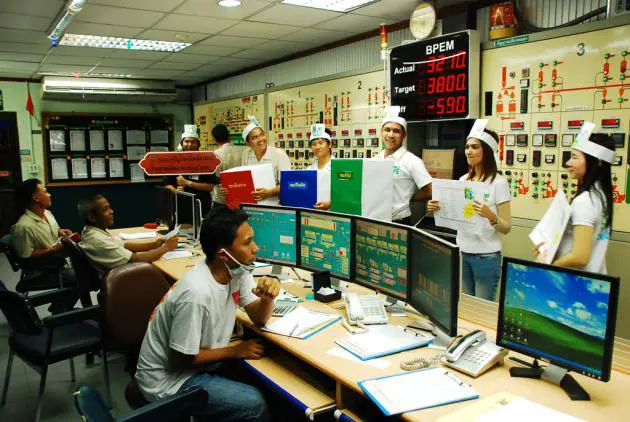
Building on years of efforts by the company to reduce energy consumption, the workforce and people living in the area around Charoen Pokphand Foods’s Ban Phru aquacultural-feed production plant in Songkhla have joined forces to implement energy-saving projects – and a win-win relationship between both sides is being created in the process.
Besides those working at the CPF plant, households in surrounding areas are becoming increasingly aware of energy conservation and saving the environment.
As far as the company is concerned, this approach has resulted in a 30-per-cent reduction in energy usage at the Ban Phru plant. The most important outcome is the encouragement of its human resources to focus even further more on saving energy, so as to grow the business further.
This has been a particularly successful year for the factory, as it has won seven awards. Four were granted by the Energy Ministry under the “Thailand’s Energy Awards” scheme, and three were awarded under the Industry Ministry’s “CSR-DIW Awards” programme.
These awards flow not only from the company’s initiatives, but also as a result of strong collaboration from top-down employee engagement and people living around the plant.
Spreading the message
Looking beyond these successes, the company wants its employees to become more aware of the need to save energy not only in the plant, but also in their homes.
In addition, all members of the workforce should play a part in helping CPF create better processes and develop machines that use less power.
Suvit Praphakamol, vice president of CPF, said CP Group chairman Dhanin Chearavanont’s goal was to cut energy consumption in the group’s plants by 20 per cent, as well as to maximise energy utilisation. At the Ban Phru plant, however, this target has been far exceeded with the achievement of a 30-per-cent reduction in energy usage.
Suvit, who is directly responsible for energy-saving projects at the factory, said the company had a great number of activities aimed at increasing energy-saving awareness and achieving further reductions.
These include an energy-conservation training course from basic practice through to advanced systems; a listening programme to sound out employees’ suggestions in improving the use of energy; and providing knowledge management to encourage employees to concentrate more on reducing energy consumption in every part of the plant.
After running the project, the plant’s overall energy cost fell by Bt12.4 million last year, he said, adding that employees had learned more about the many different ways to save energy, in line with the company’s road map to reduce waste in energy consumption.
“The plant focused on energy management and maximised utilisation, without damaging the environment – and for this, we must have the cooperation of our employees,” said the executive.
To achieve its goal, the Ban Phru plant has drawn up what it calls the “2-high 1-low” strategy. The first part focuses on higher efficiency with less waste, high environmental safety and a high-performance workforce.
The second part aims to ensure low losses by controlling consumption of energy generated by electricity, heat, wind, fuel oil and machinery, in order to ensure less waste and lower energy consumption.
“What we plan is to go further in sustainable manufacturing by having a green plant, for which we have to move together with the surrounding communities,” said Suvit.
The plant has a workforce of 300, of which management accounts for 10 per cent, office staff for 30 per cent, and shop-floor workers for 60 per cent. But all 300 share ideas and information to help reduce energy consumption at the plant.
Suradit Nuanlamun, development and productivity manager at the aquacultural-feed factory, said the involvement of all members of the workforce was the basis of achieving meaningful energy saving.
For example, workers stationed in the plant are well-skilled in controlling their machines, and they transfer these skills to their colleagues. They also regularly check their machines to ensure there is no waste of energy in their area, he said.
Preecha Nimkanjana, assistant vice president of the plant, said the company had granted incentives to units that achieve maximum energy saving. In addition, energy saving is now one of the key performance indicators in the evaluation of workers.
This practice has encouraged all employees to focus even more on energy conservation, and to enjoy what they gain from doing so, he said.
Meanwhile, the plant is concentrating on using other forms of renewable energy beyond oil-palm shells, with sawdust and wood shavings now also being utilised.
Renewable materials now account for 50 per cent of the plant’s energy sources and contribute significantly to its reduced carbon-dioxide emission, he added.
Community engagement
The Ban Phru plant has also created an “Energy Tour” programme to work with local communities through schools. One-hour talks with teachers and students focus on energy conservation both at school and at home. In addition, energy-saving equipment is installed in schools and communities to allow all stakeholders to directly learn more about the various ways to save energy.
The company has also created many activities with a view to working more closely with the surrounding communities.
Successful schemes include a lunch project, a fish-farming project and a vegetable-growing project. These not only allow local children to have a quality lunch, but also provide some working capital from selling left-over fish and vegetables.
“We also plan to invite a rice-farming expert to provide knowledge to students, and to take them to learn more in plantation areas,” said Suvit.
On the wider scale, Ban Phru management is negotiating to purchase an additional 28 rai (4.5 hectares) for the factory’s expansion.
The new facilities will be equipped with energy-saving machinery and systems.
