
Post-audit panel puts pledging loss at Bt330 bn, and rising
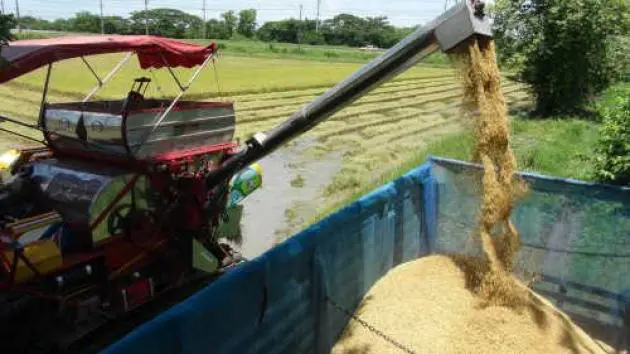


The Post Audit Committee yesterday revealed that the government faced a combined loss of Bt330 billion during its past three rice-pledging projects, amounting to 58.8 per cent of the total spending of Bt600 billion on the programme during the period.
Moreover, the rice-pledging scheme could result in a loss of as much as Bt390 billion when including the current project launched this year, said the committee, which is chaired by Supa Piyajitti, deputy permanent secretary of the Finance Ministry.
"Increasing losses have resulted from more rice having entered the government’s stockpiles, while the release of rice has proceeded slowly. Prices in the market have also decreased following low global demand, while operating costs have risen," said a source.
The audit committee has primarily found that four pledging projects during 2102 through to September this year could create a combined loss of Bt390 billion, with the Bt330-billion loss figure to May having increased by an average of Bt15 billion a month as more rice enters the stockpiles, said the source.
The report from the Finance Ministry said the permanent secretary would revise the auditing outcome.
The Yingluck Shinawatra government, meanwhile, still refuses to accept that the pledging programme is resulting in huge financial losses.
In a related matter, rice farmers have started to express concern over delayed payments by the government under the pledging scheme.
Prasith Boonchuey, president of the Thai Rice Farmers Association, yesterday said some farmers were worried as they had not yet received money from pledging despite having waited seven days.
He said some farmers had asked the Bank for Agriculture and Agricultural Cooperatives about the delay, but they had not received a response.
Meanwhile, following a National Rice Policy Subcommittee meeting to consider the official overall average rice-yield figure, PM’s Office Minister and Deputy Agriculture Minister Varathep Ratanakorn said rice farmers in many provinces found the official average to be considerably lower than their current yield, which prevented them from pledging their surplus output with the government.
The meeting therefore assigned the Rice Department, the Agricultural Extension Department and the Office of Agricultural Economics to compile updated data on the average rice yield, which would be used for the government’s pledging scheme in 2014/2015, he said.
The average-yield computation method has been used for the past 10 years and may not accurately reflect the higher-yield rice strains and improved growing methods used today.
An example of the problem is that a rice farmer harvesting 800 kilograms of rice per rai (0.15 hectare) could only place 600kg for mortgage with the government, leaving a surplus of 200kg that has to be sold in the market, Varathep said.
Since the average yield figure for the 2013/2014 harvest season cannot be changed, the meeting came up with the idea of allowing a 21-per-cent addition to the original average yield figure for first-phase pledging scheme involving 11 million tonnes of rice.
A Bt3-billion budget – for 1.2 miillion-1.5 million tonnes of rice, or an average of Bt2,000 per tonne – would be needed to fund such a measure.
The idea will be proposed to the next National Rice Policy Committee, to be chaired by Deputy PM and Finance Minister Kittiratt Na-Ranong on Friday, said Varathep.
The average rice yield per rai (15-per-cent moisture content) under the 2013/2014 rice-pledging scheme for jasmine rice within an Irrigation Department zone is 423kg per rai, and outside an Irrigation Department zone, 369kg per rai; the average for fragrant rice within a zone is 574kg per rai, and 463kg per rai outside a zone,; and 768kg per rai for Pathum Thani rice within a zone, and 627kg per rai outside.
The average yield for other rice types within an Irrigation Department zone is 632kg per rai, and 514kg per rai outside a zone. Glutinous (sticky) rice within a zone officially yields 501kg per rai, and 384kg per rai outside.
The average official rice yield per rai nationwide within an Irrigation Department zone is 595kg per rai, and 410kg per rai outside.
Varathep said the government expected to absorb 16.5 million tonnes for 2013/2014 rice pledging with a budget of Bt 270 billion, to be divided into 11 tonnes of rice for the first phase, down from the 14 million tonnes in the same period last year.
The volume to be pledged this year is expected to be lower than the targeted 27 million tonnes due to floods and drought, which damaged about 4 million rai of rice fields in 40 provinces.
To date, 2,002,885 of the 2,814,864 rice farmers who have registered to participate in the 2013/2014 pledging scheme have been approved, while 82 per cent have been processed, said the minister.
