
ITU urges Kingdom to make broadband Internet accessible to all nationwide


Play
ICT connectivity should be basic right, PM Yingluck tells seminar
The International Telecommunication Union has called on Thailand to push further to make broadband Internet service accessible to all its people.
ITU secretary-general Hamadoun Toure said at the “Connect Asia-Pacific Summit”
in Bangkok yesterday that mobile-phone penetration in this country had reached 130 per cent but broadband connectivity still needed to be extended to all the people, not only those in Bangkok and the main cities.
Thailand also needs an e-government platform for the private sector to generate more business opportunities and grow the economy, he said.
The Asia-Pacific region has shown extraordinary progress in connecting people, with mobile penetration close to 90 per cent.
“This region’s extraordinary progress can be highlighted by the fact that seven of the 25 top performers in the ITU’s ICT Devel-opment Index are in the Asia-Pacific region,” he said.
The Connect Asia-Pacific Summit was meeting to ensure that everyone in the region can access the opportunities and markets provided in the digital world.
“Despite this remarkable growth, however, we still have a long way to go, because almost two-thirds of the world’s people – some 4.3 billion people – are still offline. In the Asia-Pacific region, just over 68 per cent of people still have no Internet access, and the situation for broadband is even more challenging.
“I firmly believe that we can succeed in achieving our mission to connect the world’s people – and that in doing so, we will see unprecedented social and economic improvement for all,” he said.
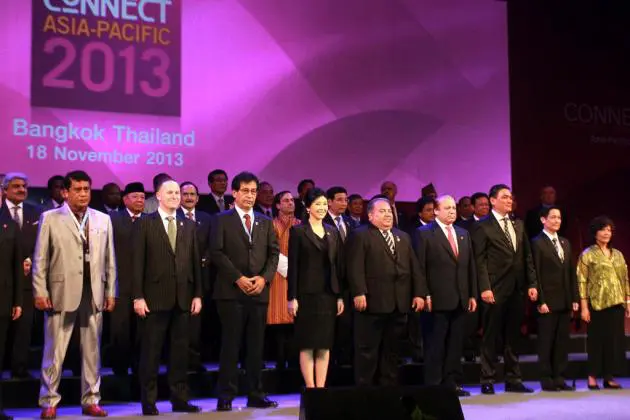
The one-day Connect Asia-Pacific Summit, co-hosted by the ITU and the Information and Communications Technology Ministry, has brought heads of state and governments to Impact Muang Thong Thani to share views on the digital challenges and opportunities facing the region.
It is followed by “ITU Telecom World”, the leading event for networking, knowledge-sharing and debate at the highest level from today to Friday, also at Impact.
Prime Minister Yingluck Shinawatra, who presided over the summit, said her government had made ICT policies one of its top priorities. The country has distributed computer tablets with educational software to schoolchildren. It is enhancing ICT capabilities and coverage in schools and promoting long-distance learning.
“Let all not forget that there are also challenges,” she said.
One of the biggest is the digital divide between countries, especially for the least connected. About 80 per cent of households in developed countries have Internet access, while in developing countries, only 28 per cent have it.
Another major challenge is the misuse of ICT connectivity by individuals or groups. This results in cybercrimes, cyber-terrorism and violations of privacy.
Both of these challenges should be addressed to have a truly connected global community, she said. To move forward together, there are four key steps that everyone can take.
“First, we need to promote universal broadband access to everyone equally. This should be a basic right, like other basic public utilities, such as water and electricity. Thailand is working hard to try and achieve this, by introducing free Wi-Fi in public areas and a high-speed communications network.
“Universal broadband access in our region will require important investments. So it is our hope that international financial institutions can provide the necessary assistance,” Yingluck said.
Second, everyone needs to look more closely at the software aspect of ICT connectivity. This includes issues of regulations and capacity-building of personnel. Special attention must be given to the least connected countries and the least developed countries.
The ITU should focus its studies on future ICT connectivity trends and the needs of these countries and see how training and other programmes might help address some of the problems, the prime minister said.
“Third, we need to enhance partnerships between governments and other stakeholders including the private sector. The challenges and promise of the ‘digital new world’ affects all sectors of society. So solutions need to be worked out by stakeholders working together.”
And fourth, ICT connectivity is key to inclusive growth and development. Growth must benefit and involve everyone. On the part of governments, they can support inclusive growth by having public services, from healthcare to education to public safety, reach everyone, especially in remote and less developed areas, she said.
