
World Bank offers recipe for prosperity


Play
Focus on four factors suggested as essential for Kingdom
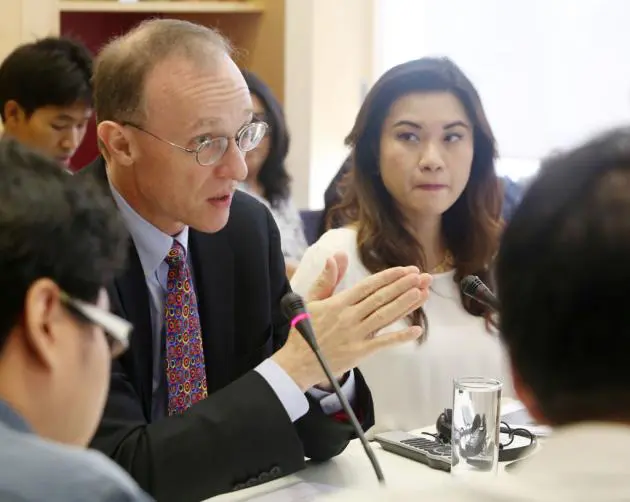
A World Bank official has recommended four key factors that will be critical for the long-term growth of Thailand’s economy, the future increase of people’s incomes, and the extension of shared prosperity within the country.
Ulrich Zachau, the bank’s country director in Thailand, said the first and foremost priority for the Kingdom was to increase its competitiveness, especially in the export sector, by upgrading the mix of products that are exported. However, this is something that cannot be done from one day to the next because the production bases are in place and it takes time for a country to adjust and adapt to changes in demand.
“It is important for Thai industries and for the private sector as much as the public sector that Thailand finds a way to adjust
and adapt its export base and its export structure structurally so that it can ... return to the level of competitiveness it had in the past,” he said.
He added that the approach of the Asean Economic Community next year had provided Thailand with the opportunity to reform its services.
Thailand’s export sector used to be able to grow by double digits every year, but has failed to reach its past glory for five years. The World Bank has predicted growth of 6.4 per cent in volume and 5.2 per cent in value of Thai exports next year.
Ulrich said the second factor that had to be highlighted for Thailand’s long-term competitiveness was the improvement of education and the skills of the labour force. This is another long-term agenda but it is an “absolutely essential one”.
“No country in the world has achieved advanced-income status without investing hugely in human capital and education, not a single one, and for Thailand it will also be critical to invest hugely in good education and skills as much as in capital,” he said.
Ulrich said the quality of education outside Bangkok was poor but was reasonable in the capital. Therefore, there is a huge challenge in terms of raising the quality of education for Thailand as a whole, which has to do with the quality of the teachers, the curricula, the methods of teaching and students’ access to schools.
“Students should be encouraged to do critical thinking beyond learning by heart,” he said.
The third factor is inequality, which can be reduced through tax reform that includes progressive taxes such as property, inheritance, and capital-gains
levies along with the improvement of access to opportunity, education, and public services, Ulrich said.
“One of the key elements that advanced countries have done in order to lower inequality is the introduction of an effective tax system, so the World Bank welcomes the Thai government’s effort to reform critical parts of the tax system and to reform [it so that it] reduces inequality, so that rich people get taxed more than poor people,” he said.
The taxes that are collected should also be spent on the poor, such as to increase the quality of education outside Bangkok, he said.
The fourth and final priority that the World Bank’s country director wanted to address was reducing energy intensity.
“Thailand is one of the most energy-intensive economies in the world, and this has to do with the way cities and urban structure, especially Bangkok, are set up. It has to do with how transport is organised, and the fact that air-conditioning use is heavily intensive,” he said.
He recommended the promotion of air-conditioning units that use less energy, as this could lower the country’s energy costs and is better for the environment.
