
Tensions drag down Thai economic growth


Play
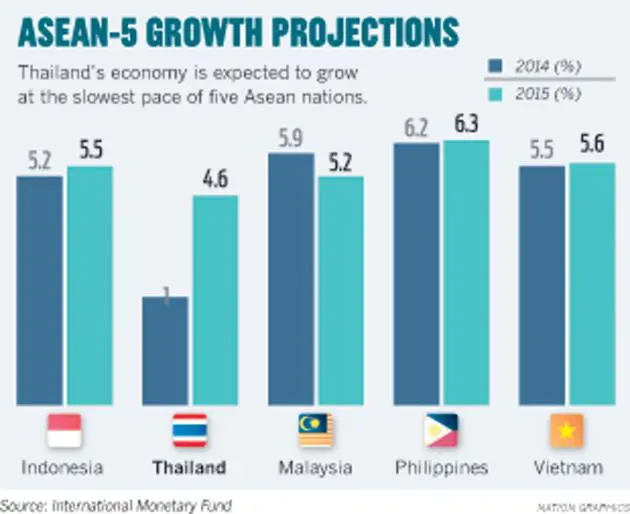
It looks more certain than ever that Thailand's 2014 economic growth rate will lag that of four other key Asean economies, with a projection of only 1-per-cent expansion made this week by the International Monetary Fund.
Throughout Asia-Pacific, economic growth slowed in the first quarter as export growth declined and domestic demand cooled in China. In the period, political tensions were the individual factor that pulled down Thailand’s economic growth, said the IMF.
However, activity picked up in most of the region’s economies in the second quarter, including in China, on new measures to support activity.
Among the Asean-5 – which also includes Indonesia, Malaysia, the Philippines and Vietnam – the IMF’s 1-per-cent Thai growth projection for this year and 4.6-per-cent forecast for 2015 are the lowest in the region.
Leading the Asean-5 is the Philippines, with projections of 6.2 per cent and 6.3 per cent, respectively.
Singapore, classified as an advanced economy, is expected to post a 3-per-cent growth rate in each of the two years.
In its “World Economic Outlook”, released yesterday, the IMF also expects Thailand’s inflation to be the lowest in the region, at 2.1 per cent and 2 per cent in the two-year period.
Good news is that the Kingdom’s unemployment is expected to stay low at 0.7 per cent and 0.8 per cent, respectively.
“The Asean-5 economies are expected to grow steadily, except Thailand, where a sharp slowdown driven by political tensions this year should be followed by a rebound next year,” the IMF said in the report, which contains revisions from its forecasts released in April.
Growth in Indonesia is expected to pick up moderately next year owing to improved investor sentiment in the post-election period, while growth in Malaysia and the Philippines is forecast to remain strong in 2014–15, helped by favourable external demand and broadly accommodative policies and financial conditions, said the IMF.
A similar view on Thailand is shared by the World Bank, which this week slashed its 2014 economic-growth projection from 3 per cent – which it made in April – to 1.5 per cent, on a par with the Bank of Thailand’s projection.
Although the World Bank’s 2015 forecast for the Kingdom has been raised to 4.5 per cent, it remains below the Asean average of 5 per cent.
Aside from domestic sluggishness driven by political tensions, Thailand is expected to further witness greater external volatility.
According to the IMF, the immediate risks Asia-Pacific economies are facing stem from sharp tightening of global financial conditions – triggered, for instance, by greater volatility induced by US monetary-policy normalisation or a spike in global risk aversion – which could lead to capital outflows, asset-price declines, and higher domestic interest rates.
Over the medium term, in addition to risks of spillovers from prolonged low growth in advanced economies, emerging Asia’s potential growth, which has declined in the last few years, could weaken further, particularly if reform implementation is delayed, said the fund.
Globally, growth slowed more than expected from an annualised rate of 3.9 per cent in the second half of 2013 to 2.7 per cent in the first half of this year. It is expected to strengthen to 3.5 per cent in the second half, and to 3.8 per cent in 2015.
Against this backdrop, advanced economies are expected to continue a slow recovery, with growth rising to 1.8 per cent this year, and to 2.3 per cent in 2015.
Growth in emerging-market and developing economies will slow to 4.4 per cent this year, before rising to 5 per cent in 2015, according to the IMF.
The projections are lower than the previous ones announced in April, reflecting the negative-growth surprises in the first half of the year.
Downside risks to the forecasts remain relevant, the IMF noted, adding that escalation in geopolitical tensions is an immediate risk, as it could lead to sharply higher oil prices.
“Thus, for more robust growth, many countries need policies to lift actual growth to its potential level and measures to raise potential growth itself,” said the fund.
