
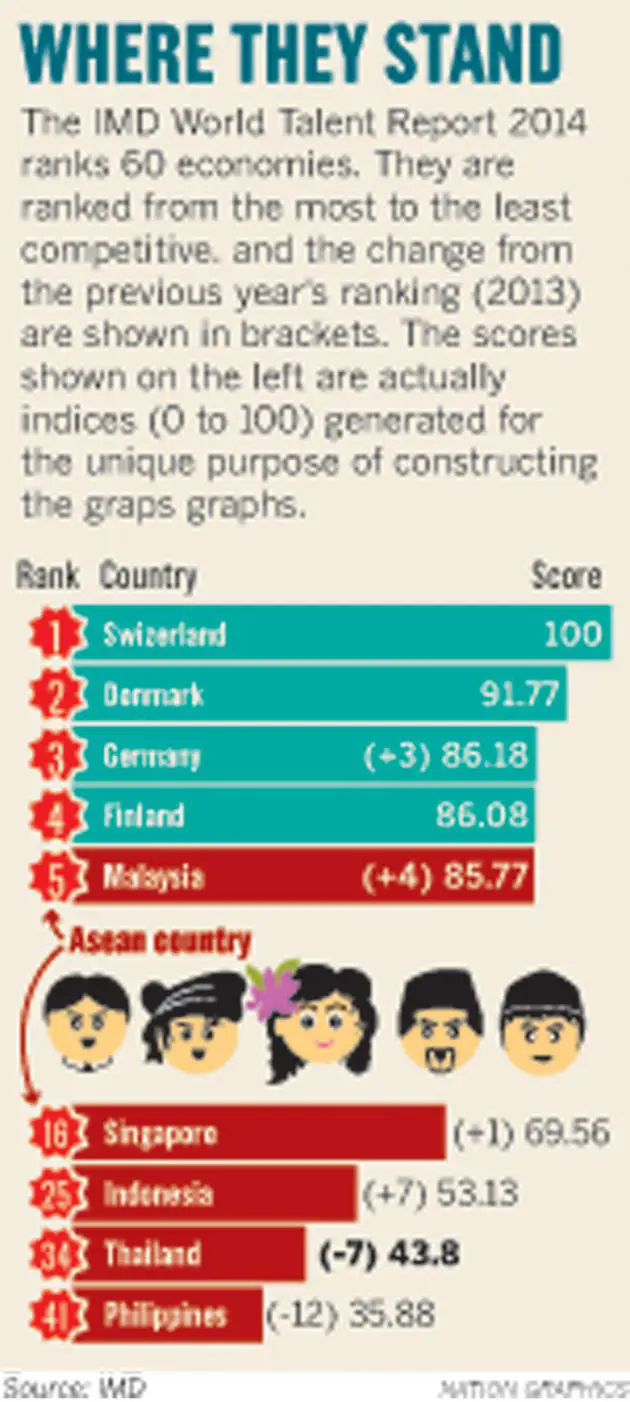
Kingdom ranks 34 out of 60 in 'World Talent Report'


Play
IMD, a business school based in Switzerland, yesterday announced its new "IMD World Talent Report" that gauges the "people development" metric, a key factor for national competitiveness.
The report ranks Thailand 34th out of 60 countries included in the research. The Kingdom slips seven positions from the previous year, based on statistical models that compared year-on-year data.
Arturo Bris, IMD world competitiveness director, said that unlike the school’s global competitiveness rankings, which are based on the outcomes of countries’ efforts, the talent ranking measures an important input to competitiveness, and indicates whether a country will do better or not in the future.
Switzerland tops the talent index, followed by Denmark, Germany, Finland and Malaysia – the only Asian country ranked in the top 10.
Of all of the Asian economies rated in the talent study, Thailand at No 34 outranks only South Korea (40th), the Philippines (41st), China (43rd) and India (48th). In comparison, Thailand is ranked 29th in the IMD global competitiveness index.
IMD’s talent study in essence measures the ability of a country to attract, retain, and develop talent.
“Or I would like to call it ‘people development’ – ability of a country to develop their people’s skills that fit the labour market,” Bris said. “It’s important because it explains truly if a country is best positioned for the future.” The talent index takes into account three major pillars: “investment and development” in education; “appeal”, or the ability of the country to attract talent; and “readiness”, which means the ability of the country to promote and reward talent.
Thailand is ranked 44th on the “investment and development” pillar, 20th on “appeal”, and 43rd on the “readiness” factor. Bris said Thailand shared the typical characteristic of Asian economies that have appealed to talented people but need to invest more in education and prepare their people to be ready for the employment sector.
The investment and development factor incorporates sub-parameters including public expenditure on education, pupil-teacher ratio, apprenticeship, and female workforce.
The appeal pillar takes into account factors such as quality of life, worker motivation, brain drain, and people who have acquired skills overseas. The readiness pillar considers factors such as labour-force growth, finance skills, international experience, competent senior managers, science in school, management education, and language skills.
Bris said countries that performed well in the talent ranking were those that had an education system that allowed their people to join the labour force when they are quite young, such as Germany and Switzerland, which have apprenticeship systems.
On the other hand, countries like Spain and India produce large numbers of engineers in economies that cannot absorb all of them, resulting in a mismatch with the requirements of their labour markets.
