
Ministry unveils plan for sustainable tourism growth


Play
The Tourism and Sports Ministry has unveiled its strategic plan to drive the tourism sector through sustainable growth, even as hospitality experts warn that the travel industry face challenges in the coming years.
Tourism and Sports Minister Kobkarn Wattanavrangkul said her ministry had drafted a one-year plan that aimed to establish fundamentals for long-term growth.
She said the ministry would promote transparency and reduced duplication of work in its departments.
Meanwhile, enhanced cooperation with state agencies and private organisations as well as preparing to deal with crisis and emergency issues will be concerns.
“The ministry has a timeline to work through next year, starting in the first quarter with conducting surveys and obtaining information before kicking off test runs for pilot projects. After seeing the results in the third quarter, we will put them into implementation if the pilot projects have run well,” she said.
She added that encouraging young people to understand and be part of tourism development was one of the ideas as this could bring in communities and locals to help preserve their tourist attractions.
Next year, Thailand aims at 25.5 million arrivals – a slight increase from this year’s projection – and revenue of Bt1.8 trillion. The number of international tourists is expected to reach 29 million in 2016 and generate overall revenue of Bt2.2 trillion.
Tourism has been accounting for 10 per cent of the economy for years, and Thailand was named the world’s best tourist destination in 2013, but many challenges lie ahead.
One of these challenges is tough global competition, since many countries see tourism as a key sector to drive their economies. Moreover, negative images and perceptions that Thailand is a cheap destination need to change. Labour shortages and deterioration of the environment are also considerations.
Opportunities
However, Kobkarn said some opportunities were approaching amid the challenges such as tourism packages catering to the elderly, medical and healthcare tourism, sports training, movie production, and hosting world-class events.
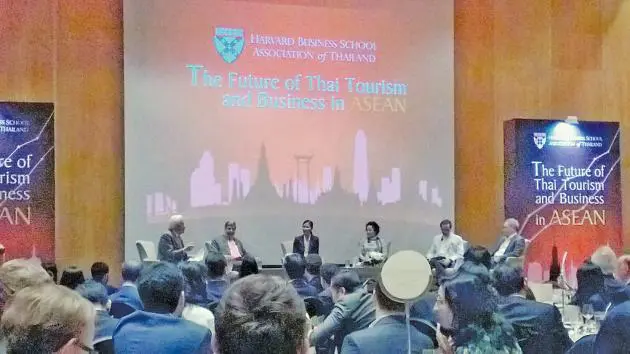
William Heinecke, chairman and chief executive officer of Minor International, said this year’s political crisis resulted not only in a big drop in tourist numbers, but business travel and events also plunged. The Europe and United States markets were particularly affected.
He said lifting martial law would help tourism return to normal.
Despite the chaos, however, some super-rich foreigners had continued to come and spend a lot of money in Thailand, he noted.
Panga Vathanakul, managing director of the Royal Cliff Hotels Group, said the political problem had caused tourists to shift to other destinations. MICE (meetings, incentives, conventions and exhibitions) business also dropped.
She added that Thailand still attracted a lot of visitors, but needed to improve its infrastructure, especially transport systems. Pattaya, for instance, one of the most popular destinations in Thailand since the 1960s, now experiences many problems, including heavy traffic jams.
“Giving intensive training and education about tourism would be a great part of sustainable development,” Panga said.
Chanin Donavanik, managing director and CEO of Dusit International, said Thailand was one of the best destinations in the region, but the tourism sector had been disturbed by the political problems.
He added that to drive the sector in the long term, young people should be given real practice and training to understand tourism.
