
Banking industry braces for a new set of challenges in 2015


Play
Lending growth will not be the main challenge for bankers in 2015, but instead national reform, rapid changes in customer behaviour, and a low supply of talented people will be major factors, they say.
The delayed recovery of the global economy has hit import-export activities, while domestic consumption was weakened by the prolonged political unrest.
Household debt, which has now reached 85 per cent of gross domestic product, largely accelerated by the government’s first-car-buyer tax-incentive scheme, is another factor that hit the banking sector. That programme also increased non-performing loans (NPLs), the banks claim.
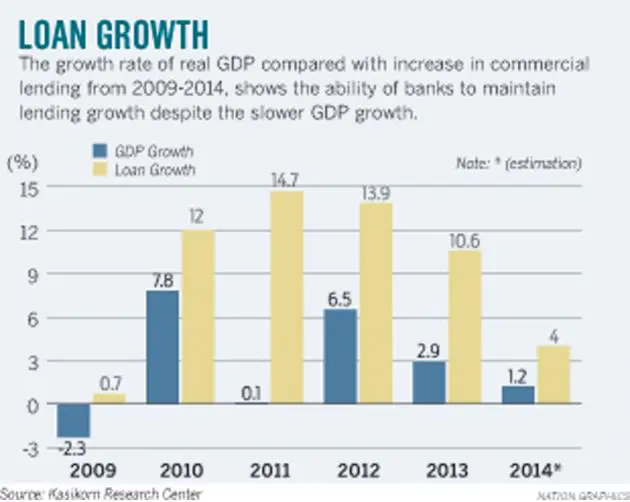
After the coup in May, bankers’ confidence immediately showed improvement, but because of overall weak public confidence in the economy and high debt-service ratios, the top line (gross income) of the banking industry is expected to rise by only 4 per cent this year, the least since 2009.
Growth of the banking sector has relied on the growth of gross domestic product, which this year is expected to be only 1.5 per cent. According to professional-services firm Grant Thornton, Thailand needs to sustain 4-per-cent GDP expansion to remain at “neutral growth”.
In 2013, GDP grew by 1.8 per cent, but for this year, the National Economic and Social Development Board recently lowered the growth forecast to 1 per cent. The International Monetary Fund’s forecast for 2015 is 4.1 per cent (below Asean’s 5 per cent), and 5.4 per cent for the 2016-2018 period.
Thanyalak Vacharachaisurapol, head of money and banking at Kasikorn Research Centre, said new lending in 2015 was expected to resume growth of 7-8 per cent. However, mortgage lending will not repeat the double-digit growth seen in 2014 because the prices of housing units are higher than purchasing power amid a high debt-service ratio.
Still, banks could remain profitable if they can manage operational costs well, she said.
The banks believe that lending growth in 2015 should better than this year based on improving consumer sentiment and tangible public-sector investment, led by infrastructure projects.
Chartsiri Sophonpanich, president of Bangkok Bank, the country’s largest bank by assets, said the key challenge in the banking industry was the national reform imposed by the military regime. This is an ongoing process that will change the fundamentals of the country.
He said attracting talented people would also be a challenge for the banking sector as younger people nowadays wanted to run their own businesses, not work for a corporation.
He pointed to the digitalisation trend as another major challenge for Bangkok Bank, as its consumer-loan portfolio is small, so it will have to refresh its products to tap this trend.
The Asean Economic Community in 2015 will be another challenge for Thai banks, which should prepare themselves to deal with both the opportunities and the unexpected consequences of regional integration.
One of the preparations needed ahead of the AEC is bringing in talent, Chartsiri said. Bangkok Bank is sponsoring a Chiang Mai University programme for Myanmar students. BBL is only Thai bank operating commercially in Myanmar. Siam Commercial Bank also sees the low supply of talented people as a challenge, said its president Kannikar Chalit-aporn.
“Banking has always had a lot of challenges, but if we are to meet the big challenges coming in the next few years, we have to have talented people to support where we are going. We used to work with a ‘silo’ mindset, which means each division was responsible for what it was doing, but [we now face] the increasing complexity of consumer needs and the impact of technologies. We have to change the style of management, so the people of SCB will have to change from a silo base to one team, one agenda, in unity,” she said.
Banks’ call centres and debt-collection operations are also facing human-resource challenges, said Thakorn Piyapan, managing director of Krungsri Consumer. Turnover in these areas has increased, especially debt collection, as this job is in high demand because of rising NPLs.
Predee Daochai, president of Kasikornbank, said its challenge was managing the rapid changes of consumer behaviour and technology.
“We need to prepare ourselves always to ride the rapid changes, as people are key to banking. We have to ensure we have sufficient people to run the business. The AEC will also change the picture of our trading partners, who might move to trade with new partners. Banks have to handle these things quickly,” he said.
Adisorn Sermchaiwong, senior executive vice president of CIMB Thai Bank, said customer engagement was a challenge for retail banking players because the digital channel was posing the question of whether branches are essential for the banks or not.
Banks have to adjust to digitalisation by enhancing the customer experience not just through their products but by customer segmentation, he said.
Digitalisation is one of three mega-trends affecting the way the banking and insurance industries operate.
