
Thailand secures THB81.6m World Bank grants for climate law
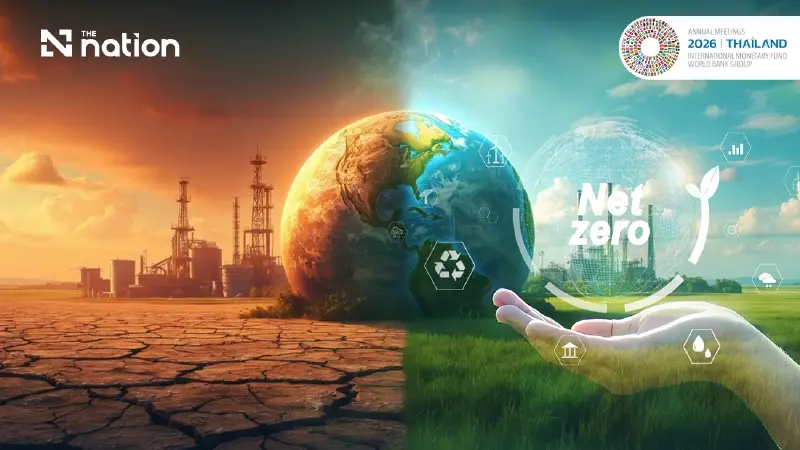


World Bank grants worth THB81.6 million will support Thailand’s carbon-pricing tools and long-term planning towards net-zero emissions by 2050.
Thailand has secured about THB81.6 million, or US$2.4 million, in World Bank grants to develop carbon-pricing mechanisms and strengthen long-term planning for its transition to a low-carbon economy and net-zero emissions by 2050.
Natural Resources and Environment Minister Suchart Chomklin has instructed the Department of Climate Change and Environment (DCCE) to accelerate efforts to mobilise international grant funding to support preparations for Thailand’s draft Climate Change Act.
The ministry aims to use the funding to prepare government agencies, businesses and other stakeholders for future climate-policy mechanisms, including carbon pricing, while supporting Thailand’s Nationally Determined Contribution 3.0 (NDC 3.0) and its net-zero target.
Thailand’s NDC 3.0 sets an economy-wide target to reduce net greenhouse-gas emissions to 152 million tonnes of carbon dioxide equivalent by 2035, a 47% reduction from 2019 levels, as part of the country’s pathway towards net zero by 2050.

World Bank backs two climate projects
Phirun Saiyasitpanich, Director-General of the DCCE, said Thailand finalised discussions on the grants during bilateral talks at the 2026 Annual Meetings of the International Monetary Fund and World Bank Group in Bangkok on October 14.
Thai officials met Jamie Fergusson, Director for Climate at the World Bank Group, and Julia M. Fraser, Regional Practice Director for Planet, East Asia and Pacific.
The World Bank support covers two projects with combined funding of around THB81.6 million.
The larger programme, the Partnership for Market Implementation (PMI), will receive about THB68 million, or US$2 million.
The funding will support studies on carbon-pricing instruments and the design of policy and economic mechanisms suited to Thailand’s circumstances.
The programme is intended to help reduce greenhouse-gas emissions, support businesses moving towards lower-carbon operations and prepare the country for future carbon-pricing measures under its developing climate-policy framework.
The World Bank’s PMI programme supports countries in designing, piloting and implementing carbon-pricing instruments aligned with national development priorities.
Long-term strategy gets THB13.6m
A second project, Thailand’s Long-Term Climate Strategies, will receive around THB13.6 million, or US$400,000.
The project will develop and apply economic modelling to analyse pathways towards Thailand’s net-zero target alongside long-term investment and economic-development planning.
The resulting analysis is expected to help policymakers identify and prioritise measures and investments needed for the transition to a low-carbon economy.
Phirun said the funding was the result of continuing negotiations and reflected international support for Thailand’s efforts to strengthen its climate-policy and legal mechanisms.
In addition to direct financial support, the cooperation is expected to provide technical knowledge that can be used to strengthen Thailand’s climate-finance system.
Just transition central to climate policy
Raweewan Bhuridej, Permanent Secretary of the Ministry of Natural Resources and Environment, said climate finance would be crucial to implementing NDC 3.0 and achieving the country’s net-zero target.
She said the transition to a low-carbon economy must be inclusive and fair, following the principles of a just transition.
Policies should therefore consider their impact on workers, small and medium-sized enterprises, communities and vulnerable groups rather than focusing solely on emissions reductions.
The grants would help Thailand develop mechanisms capable of supporting both climate action and economic adjustment, she said.
Climate law to underpin new mechanisms
Thailand is also advancing its proposed Climate Change Act, which is intended to provide a broader legal framework for the country’s climate policies.
The draft legislation includes mechanisms covering national net-zero targets, climate-risk management, greenhouse-gas reductions and a proposed Climate Fund to finance the transition towards a low-carbon economy.
Suchart said grant funding and other climate-finance mechanisms would be essential for helping businesses adapt, supporting workers in developing new skills and occupations, and creating new economic opportunities for communities.
He stressed that the transition would require cooperation between the government, private sector and domestic and international financial institutions.
The broader objective is to pursue Thailand’s climate commitments without undermining economic competitiveness or people’s quality of life, while increasing resilience to the growing effects of climate change.
Suchart said access to international finance, technology and expertise would help Thailand move towards sustainable growth built around a lower-carbon economy while ensuring that the costs and benefits of the transition are shared more fairly.
Source: Thansettakij
