
Tesla unveils Roadster with SpaceX thrusters, production set for 2028
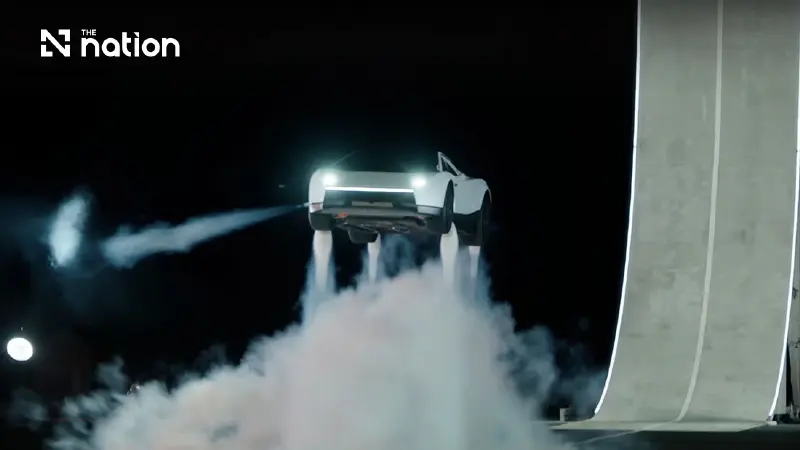


Tesla unveils its long-delayed Roadster with SpaceX thrusters, sub-one-second acceleration and production scheduled to begin in 2028.
Tesla has unveiled its long-delayed next-generation Roadster, demonstrating an electric sports car equipped with SpaceX-developed rocket-style thrusters that can turn in mid-air and land after performing jumps.
Chief Executive Elon Musk said production of the redesigned Roadster would begin in 2028, more than a decade after Tesla first showed a prototype of the second-generation model in 2017.
The white two-seat vehicle was demonstrated at a SpaceX test facility in McGregor, Texas, on October 15.
During the event, the Roadster drove upside down on a ramp using a suction system, rotated in the air and landed with assistance from built-in thrusters. It later used the thrusters to jump over a truck and other vehicles while twisting in mid-air.

Zero to 60mph in under one second
Tesla vehicle engineering chief Lars Moravy said the Roadster could accelerate from zero to 60mph, or about 97kph, in less than one second.
The company said the vehicle would have a top speed exceeding 230mph, or 370kph, and a driving range of more than 300 miles, or around 480 kilometres, on a single charge.
That range is considerably below the more than 600 miles Tesla promised when it unveiled the original prototype in 2017, when the company also said deliveries would begin in 2020.
Repeated delays have since pushed the Roadster further into Tesla’s future product pipeline.

Tesla has yet to announce final price
Tesla did not announce a final price at the October 15 event.
When the vehicle was first presented nearly a decade ago, the company indicated a starting price of US$200,000.
Following the latest unveiling, Tesla’s reservation page offered a Performance version requiring a US$50,000 deposit and a Thrust version equipped with acceleration thrusters requiring a US$250,000 deposit.
An invitation-only Rocket version is described by Tesla as a single-seat vehicle equipped with a “full flight system”.

SpaceX technology gives Roadster new role
The vehicle was developed through cooperation between Tesla and SpaceX, Musk’s rocket and space technology company.
Musk presented the Roadster as the result of close engineering cooperation between teams at the two companies.
The collaboration has also attracted attention because Musk has previously discussed areas of overlap between Tesla and SpaceX, prompting speculation among some investors over whether the two businesses could eventually be combined.
Tesla investor Gene Munster, managing partner at Deepwater Asset Management, characterised the unveiling primarily as a demonstration of engineering capabilities rather than a product likely to have a major commercial impact.
Musk himself has previously played down the Roadster’s financial importance to Tesla, saying it was unlikely to have a major effect on the company’s results.
Roadster becomes Tesla’s showcase car
Morningstar analyst Seth Goldstein said the Roadster could serve as Tesla’s new “halo car” — a high-performance model designed to demonstrate the company’s most advanced engineering and technology.
Tesla’s original Roadster, launched in 2008 and produced until 2012, was the company’s first electric vehicle and helped establish its reputation in the emerging EV market.
The new Roadster arrives as Tesla increasingly shifts its strategic focus beyond conventional electric cars towards artificial intelligence, autonomous driving and robotics.
Tesla this year stopped selling its Model S and Model X vehicles to free manufacturing capacity for its Optimus humanoid robots. It has also launched the Cybercab, a two-seat robotaxi without conventional driver controls such as a steering wheel or pedals.
The Roadster unveiling comes shortly before Tesla is scheduled to report its third-quarter financial results on October 21, when investors are expected to focus on the company’s broader financial performance and its transition towards AI-driven technologies.
Source: Reuters
