
AI is a Formula One Race at Night Without Brakes, Warns Anthropic Co-Founder
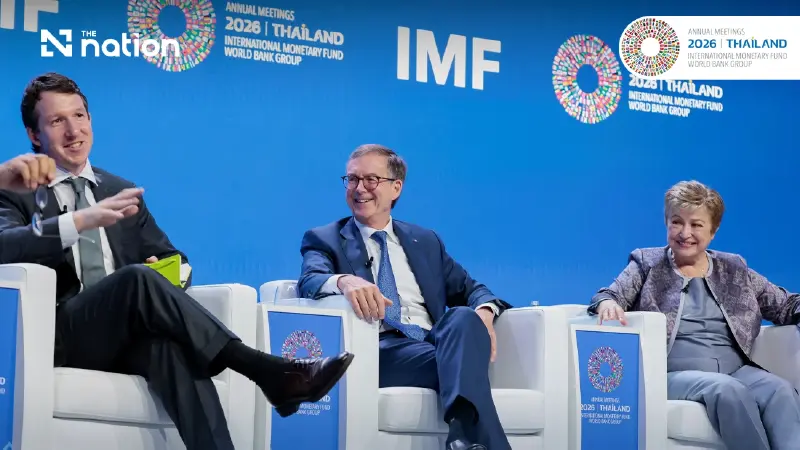


Business and tech leaders at the IMF–World Bank meetings agree artificial intelligence is driving unprecedented investment and productivity, but warn that jobs, safety and regulation remain critically unsettled
- Anthropic co-founder Jack Clark describes AI development as a "Formula 1 race at night, without maybe brakes," to emphasize its rapid advancement without sufficient safety controls or regulation.
- Clark highlights the severe lack of governance, stating that the "super intelligence" he works on is less regulated than the toys he buys for his children.
- The warning is contextualized by discussions of AI's potential for massive disruption, including job losses in repetitive fields and the risk of "chaos" if development is handled negligently.
- In response to the lack of "brakes," Clark and other leaders called for robust regulation, with Clark advocating for national AI security institutes and a "test once, run anywhere" safety framework.
Business and tech leaders at the IMF–World Bank meetings agree artificial intelligence is driving unprecedented investment and productivity but warn that jobs, safety and regulation remain critically unsettled.
Artificial intelligence has crossed the threshold from potential to economic force, yet the world has yet to agree on who will steer it, who will capture the rewards, and who will bear the risks.
That was the core tension at a packed seminar during the IMF–World Bank Annual Meetings. Moderated by CNN's Richard Quest, the session—titled "AI and the Global Economy: From Risk to Opportunity"—featured IMF Managing Director Kristalina Georgieva, Bank of Canada Governor Tiff Macklem, DHL Group Chief Executive Tobias Meyer, Anthropic co-founder Jack Clark, and Dr Ayesha Khanna, chief executive of Singapore-based Addo.
"It is here," Georgieva said. "It has arrived and it is changing our lives, the way we work, the way we live and the prospects for our economies."
Yet she cautioned that the growth dividend remains concentrated in "a small group of countries" plugged directly into the AI value chain, warning that the technology "is already starting to show that it can be incredibly disruptive".
A boom without the immediate payoff
Macklem pointed to hard data to prove the shift. "We had a global savings glut. We now have a global investment boom," he said, noting its visibility across gross domestic product, markets and trade flows. "We don't talk about secular stagnation anymore."
The ultimate prize, he argued, lies in widespread diffusion across every sector, as productivity remains "the fundamental source of rising living standards".

When pressed by Quest on interest rates, the governor noted: "We haven't raised our rates yet. We've been looking through the increase in energy prices, but the longer this goes, the harder that gets. We are asking ourselves that question."
Meyer, whose firm moves roughly 100 million parcels a day with a 580,000-strong workforce, estimated that AI accounts for 60 to 80 per cent of incremental global trade growth in the first half of the year, though data-centre construction has caused severe supply chain friction. He likened the current corporate adoption lag to the dot-com era.
Dr Khanna offered a more sceptical view of enterprise progress.
"Handing every employee a digital assistant has created an illusion of personal productivity without altering corporate workflows," she argued. "Apart from a few high-performance companies like DHL, most of them are realising that the AI transformation has been a failed experiment and they're rethinking how to do it now."
Urging patience, Georgieva cited "Amara's law"—the tendency to overestimate short-term impact while underestimating long-term change—and warned against investors pulling out in premature frustration.
Clark argued that AI behaves fundamentally differently from past technologies. "If you buy AI systems, they come into your company and say, 'Let's get to work. How can I help?'"
That integration could accelerate gains, he suggested, provided organisations embrace "creative destruction" to completely rebuild themselves—a challenge that scales with corporate size.

Meyer added that DHL's tangible returns came from "agentic" systems automating high-volume tasks such as customs clearance. Asked if he would greenlight an extra $25 million IT project, he replied, "The answer is no, because overfunding IT projects has never been a good idea."
Winners, losers and the labour market
On the future of work, the panel divided between reassurance and anxiety. Macklem noted that historical tech waves "created more jobs than they've destroyed", before adding a crucial caveat: "It could be different this time." AI "could be so powerful" that it "could do the new jobs too".
Citing a recent IMF labour market study, Georgieva noted that roughly 10 per cent of jobs now exist in newly created, higher-paying categories. However, "if you are in a repetitive task job, kiss it goodbye," she warned.
\While the investment boom has lifted household wealth and service spending, young professionals "who normally would have gone into professional routine jobs" are increasingly "serving coffee in Starbucks... That is not what young people in the world aspire to."
Clark acknowledged "softness in early graduate hiring in some markets" and urged tech developers to share usage data openly with governments, pointing to Anthropic's Economic Index and research partnerships with the University of Tokyo.
Dr Khanna highlighted Singapore as a policy benchmark.
"We may not be able to protect every job, but we will protect every worker," she said, outlining state-backed free skills training and multi-million-dollar corporate transformation grants.
Georgieva stressed that widespread benefits require foundational support: reliable electricity and internet access (noting half of Africa remains offline), targeted skills training, cross-sector diffusion, and robust regulation.
"If there are no safeguards, then the risks may exceed the opportunities," she said.
Racing without guard rails
The debate grew sharpest over governance. Georgieva compared AI regulation to a Formula One race: "How do we put barriers so if a car was to fly out it doesn't kill people?" While governments struggle to regulate a fast-moving sector, leaving a vacuum where cars can "run over some poor pedestrians", she called on major producer nations—the United States, China and India—to lead.
Clark offered a starker metaphor.
"I think it's worse than you describe. I think it's Formula 1 at night, without maybe brakes in the cars," he said. "The toys I buy for my children are regulated more than the literal super intelligence I work on at my day job."
Advocating for common-sense standards, Clark championed a "test once, run anywhere" framework anchored by national AI security institutes with reciprocal safety validation.
Meyer backed high-level international standards over prescriptive rules, pointing out that ISO-style benchmarks hold immense value for industry.
Meanwhile, Dr Khanna noted that corporate self-interest in cybersecurity will drive boards to enforce tighter internal controls, as a major security incident would severely jeopardise trillions of dollars in data-centre investments.
Though regulatory approaches diverge—with the EU leading on strict rules, China applying its own distinct model, and the US favouring industry trust—Georgieva remained hopeful that "enlightened self-interest" would forge international compatibility to prevent bad actors from outpacing safety measures.
Closing on a cautiously optimistic note, Clark reflected on how far the discipline has evolved over the past decade. "The world is now taking this seriously," he said. "If we succeed at this, we will lock in this true abundance machine. And if we're negligent about this, we're going to get some form of chaos."
