
Spotting the Beast in Plain Sight: How to Outrun the 'Gray Rhino' Charging Straight at Us
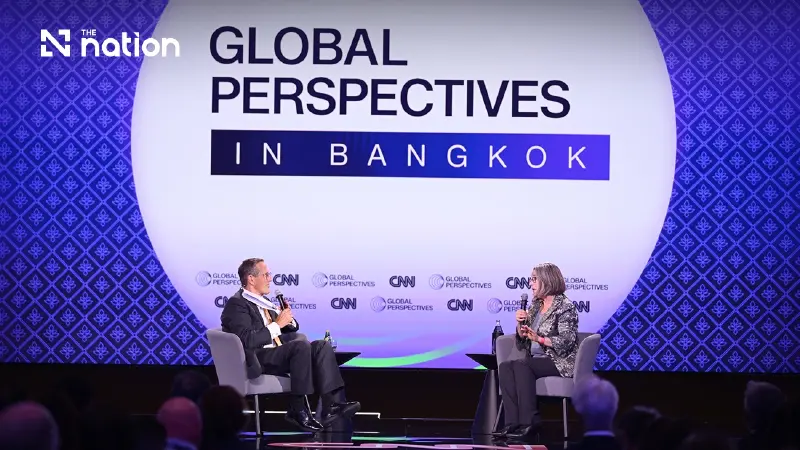


At a Bangkok panel, risk strategist Michele Wucker and CNN’s Richard Quest unpicked why leaders ignore obvious threats—and how to harness them
- A "gray rhino" is a highly probable, high-impact threat that is obvious and in plain sight, distinguishing it from an unpredictable "black swan" event.
- People and organizations often fail to act on these visible threats due to psychological and cultural barriers, such as fear of delivering bad news, feeling overwhelmed by the problem's scale, or social anxiety.
- Instead of just avoiding the threat, the concept suggests that leaders can choose to proactively engage with it, harnessing its power to create positive change rather than simply freezing or stepping aside.
At a Bangkok panel, risk strategist Michele Wucker and CNN’s Richard Quest unpicked why leaders ignore obvious threats—and how to harness them.
When a two-tonne creature with a massive horn charges straight down the middle of the road, most people would step aside. Yet, in business, politics and daily life, leaders and institutions have an uncanny knack for standing frozen until they are trampled.
This was the vivid, charging imagery brought to life by risk strategist Michele Wucker, founder of Gray Rhino & Company, during a lively CNN Global Perspectives panel discussion in Bangkok titled Why Smart People Miss Big Threats.
Joined by CNN anchor Richard Quest, Wucker unpacked a concept that has quietly revolutionised how modern economists, policymakers and corporate executives think about danger: the "gray rhino".
Unlike the elusive "black swan"—an unpredictable, highly improbable event that can only be rationalised in hindsight—a gray rhino is entirely different. It is highly probable, highly impactful, and staring you directly in the face.
"The gray rhino is right in front of you," Wucker explained, gesturing dynamically as Quest gamely played along with the metaphor. "It's a challenge to get people to look at the things they know are happening, the obvious challenges coming right at them that everyone's talking about. Everybody knows about them. And it's not like it's a secret."
The Anatomy of Inaction
So, if everyone can see the beast thundering down the track, why do individuals and organisations repeatedly choose to do nothing?
According to Wucker, the barriers to action are deeply psychological, cultural and systemic. Sometimes, organisational group dynamics create a chilling effect where employees feel that nobody "up top" wants to hear bad news.
Others suffer from "learned helplessness", looking at structural problems—such as climate shifts, mounting national debt or artificial intelligence disruptions—that feel so overwhelming they induce total paralysis.
"Sometimes they start out with, 'Oh, here's a thousand reasons why I can't do [it]. I don't have the budget. I don't have the political will. Nobody wants to talk about it,'" Wucker said. "If I say the word risk, people freak out and they're not going to like me."
Quest, injecting his characteristic dry wit into the debate, compared the phenomenon to the classic public safety announcement: "See it, say it, sorted."
Yet, much like an unattended bag on a crowded bus, people often hesitate to sound the alarm out of social anxiety.
"The biggest one I find is I might look silly," Wucker admitted.
Moving Beyond Denial
The discussion quickly shifted from theoretical zoology to hard economic reality, touching on visible systemic pressures such as sovereign budget deficits and macro-financial instabilities.
When Quest pressed her on whether specific European debt crises or fiscal deficits qualify as classic gray rhinos, Wucker chuckled, noting that she often grows weary of people treating her framework like a fortune-telling service.

"When someone asks me, 'Is this a gray rhino?' I get a little nervous because the whole point of it is that if people are talking about it, if it's obvious, if you can see it, it's something that people should be able to say for themselves," she said. "What is mysterious about that? My whole point is we need a fresh look at the obvious things and we need to think about what makes a difference between the people who see it and respond and the ones who don't."
Jumping on the Back of the Beast
Crucially, Wucker’s theory does not stop at mere avoidance. Stepping out of the way ensures survival, but true leaders do more than dodge disaster—they tame it.
Wucker illustrated the ultimate choice leaders face when confronted with an obvious crisis: "I can freeze and get trampled. I can get out of the way. Or... I can jump up on his back and harness the power and use it to change the direction to make good things happen."
Whether confronting sweeping economic shifts or corporate blind spots, the core message from the Bangkok stage was clear. The dangers facing modern society are rarely hidden in the shadows. They are thundering down the highway in broad daylight—and the only question left is whether we choose to freeze, flee, or take the reins.
