
Climate adaptation could create or protect 150m jobs: World Bank
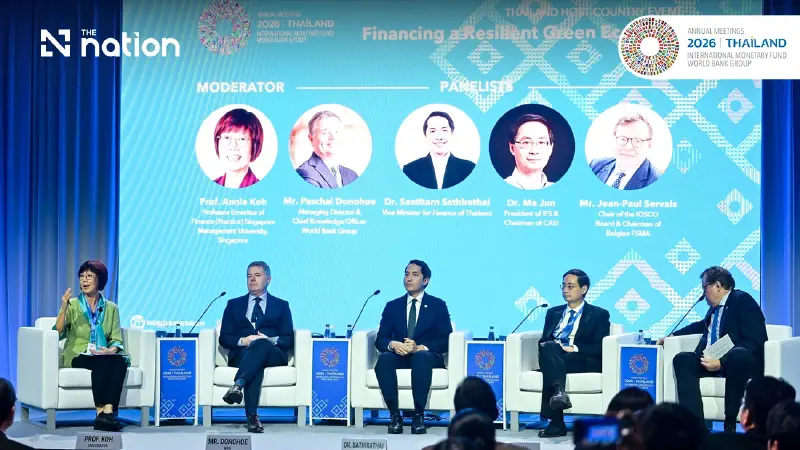


At the IMF–World Bank meetings in Bangkok, Paschal Donohoe says climate adaptation could create or protect up to 150 million jobs, as climate-related funding reaches US$96 billion.
- A World Bank managing director has stated that greater investment in climate adaptation could create or protect up to 150 million jobs across the world.
- The institution views spending on climate resilience as an opportunity to protect livelihoods and support sustainable economic growth, not just as an environmental cost.
- The World Bank is backing its strategy with significant finance, having provided and mobilised a combined US$96 billion for climate-related activities in fiscal 2026.
- It advocates for integrating climate policy into broader economic development to make job creation efforts more sustainable and effective.
Investment in climate adaptation could create or protect the equivalent of up to 150 million jobs worldwide, World Bank Group Managing Director and Chief Knowledge Officer Paschal Donohoe told a Bangkok forum on Friday (October 16), highlighting the economic benefits of strengthening resilience against climate change.
Speaking at “Financing a Resilient Green Economy”, a Thailand-hosted event during the 2026 Annual Meetings of the International Monetary Fund (IMF) and the World Bank Group, Donohoe emphasised that climate action should support economic development and employment while reflecting individual countries’ priorities.
“There is up to 150 million jobs that could either be created or protected by a higher focus on climate adaptation across our world,” he told delegates.
Donohoe argued that investments in climate resilience should be viewed not simply as environmental spending but as opportunities to protect livelihoods, strengthen economic security and support sustainable growth.
He also highlighted the importance of improving energy access, affordability and security, particularly for projects whose economic benefits might take longer to emerge.

World Bank climate financing reaches US$96 billion
Donohoe outlined the scale of financial resources already being directed towards climate-related activities, revealing that the World Bank Group had provided US$48 billion from its own balance sheet and mobilised an additional US$48 billion in private capital during fiscal 2026.
The combined US$96 billion underscored the growing role of multilateral development banks in supporting climate investment and attracting private-sector participation.
He identified two principal ways these institutions could accelerate the transition: deploying public resources to support countries’ chosen development priorities and mobilising private investment through regulatory improvements, guarantees and insurance mechanisms.
These measures could help projects secure financing that might otherwise be unavailable because of investment risks or uncertain returns.
Donohoe also stressed the importance of integrating climate considerations into broader development strategies rather than treating environmental objectives as separate priorities.
He revealed that 80% of the World Bank Group’s Country Partnership Frameworks draw on Country Climate and Development Reports, helping governments identify policies and investments that support both economic development and climate resilience.
The institution was also seeking to place greater emphasis on job creation in these reports, arguing that integrating climate policy into broader economic development could make such efforts more sustainable.
Investor confidence key to financing the green transition
Jean-Paul Servais, chair of the International Organization of Securities Commissions (IOSCO) and of Belgium's Financial Services and Markets Authority, highlighted the importance of investor confidence in mobilising private capital for the green transition.
He argued that internationally recognised sustainability reporting standards could help investors assess environmental risks, compare companies and make informed investment decisions, encouraging capital to flow towards sustainable projects.
Servais reported that 80 jurisdictions had voluntarily decided to translate International Sustainability Standards Board (ISSB) standards, highlighting the growing importance of comparable sustainability disclosures for investors.
“Global standards only have a real added value when they are effectively implemented domestically,” he emphasised.
However, he stressed that sustainability reporting requirements should remain proportionate and focus on material information, while highlighting efforts by IOSCO and the World Bank to help market participants implement the standards.
He also linked common sustainability reporting standards to investor confidence, while highlighting the challenge of channelling available global capital into domestic private investment to support the green transition.

Thailand links green transition to economic security
Thailand’s Vice Minister for Finance, Santitarn Sathirathai, reinforced the connection between climate resilience and economic stability, arguing that the energy shocks experienced in 2026 had brought the two objectives closer together.
“But with the energy shocks that we have experienced this year so far, and we are still going through it, the two have converged. Actually, being greener also helps you to become more resilient,” he explained.
Thailand’s reliance on imported energy remained a significant economic vulnerability, with net energy imports equivalent to nearly 10% of gross domestic product, according to Santitarn.
To address these challenges, the government was pursuing three priorities: stabilising the economy, accelerating the energy transition and expanding investment.
The first involved shifting away from broad fuel subsidies towards targeted assistance for households and businesses, reducing the strain that fluctuations in global oil prices place on public finances.
The second centred on promoting renewable energy, including fiscal incentives for household solar installations and reforms allowing households and smaller businesses greater access to the electricity grid.
Under this approach, electricity users could increasingly become producers as well as consumers, while infrastructure investment would support grid modernisation and transmission capacity.
Santitarn also outlined plans for a Low Carbon City project involving the World Bank and Thai financial institutions. The initiative would support solar installations, improved energy management and digital systems to measure emissions reductions in buildings and industrial areas.
The aim was to create verified carbon credits that could be sold to international buyers, potentially generating longer-term financing for the country's green transition.

Making climate adaptation financially viable
Despite growing interest in sustainable investment, financing climate adaptation remained a significant challenge.
Ma Jun, president of the Institute of Finance and Sustainability and chairman of the Capacity-building Alliance of Sustainable Investment, warned that adaptation projects continued to receive a relatively small proportion of green financing.
He explained that many such projects struggled to attract investment because they lacked sufficient revenue or a viable commercial model to repay loans.
However, technological innovation could help make climate adaptation more financially attractive.
Examples included systems that collect and treat rainwater for commercial use while reducing flooding, drought-tolerant seeds that improve agricultural productivity, and intelligent irrigation systems that use weather forecasts to reduce water consumption and operating costs.
Ma Jun highlighted the importance of linking technology providers with potential users and securing philanthropic support to prepare projects before commercial lenders and development banks become involved.
Such approaches could help bridge the gap between climate adaptation needs and the financing required to deliver practical solutions.

For the World Bank Group, the broader message was that climate resilience and job creation should reinforce each other. By combining public resources, private investment and appropriate policies, countries could strengthen their ability to withstand climate shocks while creating opportunities for economic development and employment.
