
IMF–World Bank Plenary 2026: World Leaders Face Debt Wave, AI Shock, and 800m Job Gap
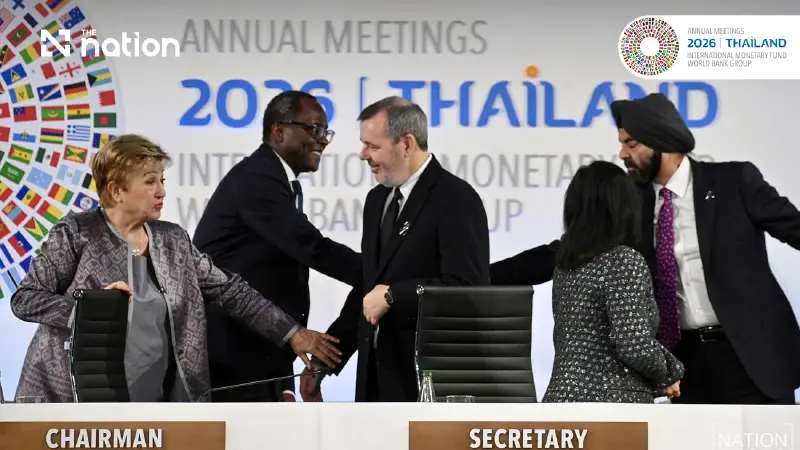


At the plenary session in Bangkok, global financial chiefs urged fiscal discipline, job creation and AI safeguards as civil society groups rallied outside against systemic inequality
- The IMF warned that heavy public debt is severely limiting governments' ability to absorb economic shocks, urging fiscal discipline to rebuild financial buffers.
- The World Bank highlighted a projected 800-million job deficit over the next 10-15 years, as 1.2 billion young people are expected to enter a job market that is only on track to create 400 million new positions.
- Artificial Intelligence was identified as a major economic shock, described by the US Fed as a consequential change that presents both opportunities for productivity and significant risks, including labor market uncertainty and cybersecurity threats.
At the plenary session in Bangkok, global financial chiefs urged fiscal discipline, job creation and AI safeguards as civil society groups rallied outside against systemic inequality.
As the 2026 IMF–World Bank Group Annual Meetings reached their peak on Friday, the official plenary session at the Queen Sirikit National Convention Center brought into sharp focus the defining tensions of the modern global economy.
Finance ministers, central bank governors and international delegates gathered against a backdrop of steady yet fragile global growth, escalating geopolitical conflicts, mounting public debt and the disruptive surge of artificial intelligence.
Hosting the meetings for the first time in 35 years, Thailand opened the plenary by positioning itself as an international bridge connecting markets, capital and human potential.
Prime Minister Anutin Charnvirakul drew on his nation's historic openness, recalling how the ancient capital of Ayutthaya prospered through international trade and diplomacy.
"Siam prospered not by isolating itself from the world, but by embracing and connecting with the outside world," Anutin told the assembly, contrasting the current technological era with Thailand's previous turn as host in 1991.

"Fax machines had symbolised speed 35 years ago... while artificial intelligence is now reshaping economies."
He urged delegates to ensure that international capital translates into practical opportunities, skills development and tangible benefits for ordinary citizens.

Debt waves and fiscal warnings
In her address to the assembly, IMF Managing Director Kristalina Georgieva warned that while the global economy remains on track to grow by 3.1 per cent this year, heavy public debt burdens are severely impairing governments' ability to absorb economic shocks.
Drawing a poetic parallel to a Thai royal barge replica displayed at the convention centre, Georgieva observed: "Today, our boat is being lashed by the waves of technology and geopolitics. Our ability to twist and turn and manoeuvre is impaired by a heavy load of public debt."
The Fund highlighted that persistent inflationary pressures—driven by energy market disruptions, supply chain frictions and agricultural shocks—have forced benchmark government bond yields in major economies to their highest levels in decades.
Supporting recent monetary tightening by major central banks, including the US Federal Reserve, the European Central Bank and the Bank of Japan, Georgieva urged governments to rebuild fiscal buffers and implement credible medium-term deficit reduction plans to protect future growth.

The 800-million job deficit
World Bank Group President Ajay Banga delivered a stark warning regarding demographic pressures across developing nations, estimating that 1.2 billion young people will enter the job market over the next 10 to 15 years, while current trends project the creation of only 400 million jobs.
"A job is not a statistic; a job is dignity," Banga declared. "It is the difference between a young person who can build the future and a young person who is merely awaiting one."

Banga outlined a development model focused on pairing public finance with private investment, revealing that the World Bank Group mobilised $112 billion in private capital over the past fiscal year—nearly tripling its output from 2022.
He urged a shift towards supporting micro, small and medium-sized enterprises (MSMEs) and investing in practical "small AI" applications—such as yield optimisation for farmers and diagnostic tools for healthcare workers—supported by basic infrastructure and dependable energy grids.

Fed Chief Kevin Warsh on AI and price stability
Following the formal speeches, a highly anticipated fireside chat between Georgieva and US Federal Reserve Chairman Kevin Warsh captured the delegates' attention.
Marking his 148th day in the chair, Warsh maintained a cautious stance regarding future monetary policy decisions, refusing to prejudge the Fed's upcoming October and December meetings.
Warsh noted that while central banks operate under individual legislative mandates, the recent synchronised monetary tightening across global economies demonstrated a positive, shared resolve to tame inflation without "free riders".
Turning to technological disruption, Warsh described AI as "probably the most consequential change to the US and global economy in my lifetime."

He noted that while AI currently acts as a demand shock—driving heavy capital expenditure into data centres before productivity gains fully materialise—it represents a powerful positive supply shock over the medium term.
Acknowledging the uncertainty surrounding labour markets over the next 12 to 18 months, Warsh revealed that the Fed has established a dedicated external task force on productivity and employment, set to hold its first field hearing in San Francisco on 16 November.
Warsh also reflected on his early tenure during the 2008 global financial crisis, noting that while returning to international summits brings back "scar tissue", he believes it is "better to be over-scarred than under-scarred".
He emphasised that the Fed's true power rests not on its ability to print money but on institutional credibility.

AI: From enterprise promises to cyber threats
Parallel panels throughout the day further examined AI's economic footprint. At a session featuring Bank of Canada Governor Tiff Macklem, Anthropic co-founder Jack Clark, Addo CEO Dr Ayesha Khanna, and DHL Group CEO Tobias Meyer, panellists debated the gap between AI investments and tangible corporate returns.
While Macklem noted that AI-driven capital expenditure is helping replace the former "global savings surplus", Dr Khanna cautioned that many corporate AI trials have failed to deliver systemic productivity improvements beyond individual task automation.
Meanwhile, Georgieva and Annual Meetings Chairman Carlos Carvallo Spalding both warned of accelerating cyber risks, noting that the window between software vulnerability discovery and exploitation has shrunk from months to mere minutes, requiring urgent international supervisory collaboration.
Protests outside the hall
The high-level discussions inside the convention centre took place under heavy security, as a coalition of over 2,000 civil society representatives and human rights defenders staged demonstrations outside.
Representing 29 national networks—including Slum 4 Regions and the People's Movement for a Just Society (P-Move)—protesters voiced strong opposition to the policies of the IMF and World Bank.
Reading a joint declaration, coalition leaders criticised international loan conditions and austerity frameworks, describing them as financial mechanisms that exacerbate household debt, undermine land rights, and promote "green colonialism" at the expense of local communities and smallholder farmers.
Demonstrators conducted peaceful symbolic performances, deploying giant props depicting capital interests to demand inclusive development and environmental justice.

Looking ahead
Summing up the spirit of the day, Annual Meetings Chairman Carvallo urged international financial institutions to continually update their frameworks to support developing economies facing high borrowing costs.
"The future may be uncertain, but the actions we take today will help define it," Carvallo concluded, calling for another 35 years of shared global prosperity and transformative growth.
