
IMF–World Bank chair backs AI to drive growth amid global risks
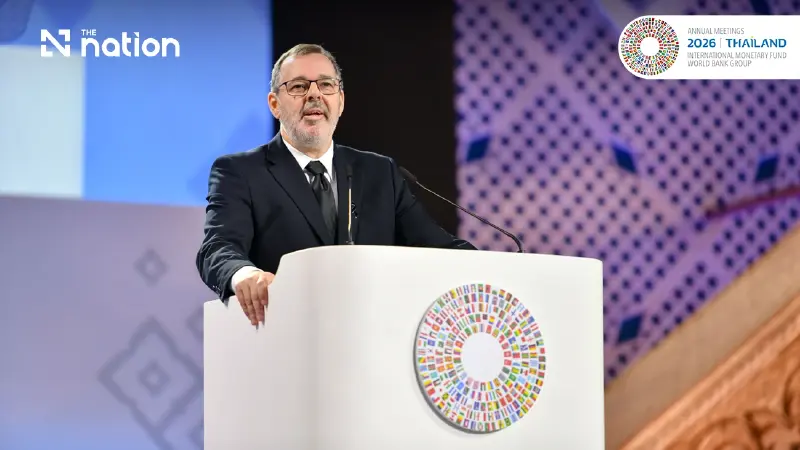


At the 2026 IMF–World Bank plenary in Bangkok, chairman Carlos Carvallo Spalding highlights AI’s potential to drive growth and innovation amid rising debt and global risks.
- The chair of the 2026 IMF–World Bank Annual Meetings, Carlos Carvallo Spalding, has advocated for using artificial intelligence to drive economic growth, improve productivity, and foster innovation.
- This endorsement of AI is presented as a way for countries to tackle significant global risks, such as geopolitical tensions, mounting debt, and climate-related threats.
- Carvallo noted that both the IMF and World Bank are working to help member nations capitalise on the technology's benefits while managing its economic and labour market implications.
Artificial intelligence (AI) could help drive economic growth, improve productivity and support innovation as countries grapple with geopolitical tensions, mounting debt and climate-related risks, according to the chairman of the 2026 Annual Meetings of the International Monetary Fund (IMF) and World Bank Group.
Carlos Carvallo Spalding, president of the Central Bank of Paraguay and chairman of the Annual Meetings, delivered the message during the plenary session at the Queen Sirikit National Convention Center in Bangkok on Friday (October 16).
He emphasised the need for international financial institutions to adapt to changing economic conditions and help member countries prepare for future challenges.
“We are all seeking to understand how best we can use artificial intelligence to drive growth, make work more efficient, and push the frontiers of innovation,” Carvallo told delegates.
He welcomed the growing prominence of AI in discussions at the IMF and the World Bank Group, noting that both institutions were working to help countries navigate the technology's economic and labour market implications.
Their efforts include developing strategies for smaller-scale AI applications and helping member countries capitalise on technological advances while managing the associated risks.

Global debt and climate risks threaten economic stability
His remarks came against a backdrop of heightened global uncertainty, with conflicts, trade disputes, financial pressures and environmental threats complicating economic policymaking.
“We meet at a precarious time. War and geopolitical tensions, global debt, trade frictions, natural disasters, and climate risks are amplifying economic uncertainty,” he warned.
Carvallo drew particular attention to emerging markets and developing economies, where per capita income growth was at its weakest since the pandemic. Rising debt burdens were also increasing borrowing costs, placing additional pressure on governments, businesses and households.
He stressed that such interconnected challenges could not be addressed by individual countries alone, making international cooperation and support from multilateral institutions increasingly important.
Paraguay's economic recovery highlights value of cooperation
Drawing on Paraguay's experience, Carvallo recalled how the South American country had faced severe economic difficulties several decades earlier, including a sharp recession, substantial currency depreciation and double-digit inflation.
“With the IMF and World Bank Group by our side, the Paraguayan people embarked on a decades-long journey of homegrown economic reform and development,” he recalled.
He credited IMF assistance with helping Paraguay restore macroeconomic stability, strengthen its fiscal institutions and improve its ability to withstand economic shocks.
The World Bank Group, meanwhile, supported investment in human capital and essential infrastructure, contributing to the country's longer-term development.
Carvallo highlighted Paraguay's transformation into one of South America's fastest-growing economies, supported by sustained economic reforms and disciplined policymaking. These achievements had also helped the country secure investment-grade status for the first time.

IMF and World Bank reforms target emerging financial risks
Turning to the future of international financial cooperation, he argued that the IMF and the World Bank Group needed to continue updating their frameworks and operating methods to respond effectively to evolving economic challenges.
He highlighted joint reviews of the Debt Sustainability Framework for Low-Income Countries and the Financial Sector Assessment Programme, aimed at addressing changes in global financing conditions and strengthening early warning capabilities.
These reviews also expanded the institutions' ability to identify emerging financial vulnerabilities and cyber security threats.
The IMF had also completed its Comprehensive Surveillance Review and Review of Programme Design and Conditionality, with the aim of making economic surveillance and lending programmes more responsive to individual countries' circumstances.
Carvallo also welcomed the World Bank Group's efforts to simplify its operations, mobilise greater private investment and place job creation at the centre of its development agenda.
He reported that the institution had more than tripled its private capital mobilisation in fiscal year 2026, supporting economic activity, employment and improvements in people's lives.
Preparing for technological change and future growth
While emphasising the importance of investment and job creation, Carvallo stressed that countries also needed to prepare for technological transformation, particularly the opportunities and risks arising from AI.
Reflecting on Bangkok's return as host of the Annual Meetings after 35 years, he pointed to Thailand's economic transformation as evidence of how much progress could be achieved over several decades.
He concluded by urging governments and international institutions to work together to build a more prosperous future despite the uncertainties facing the global economy.
“The future may be uncertain, but the actions we take today will help define it,” he told the gathering, calling for another 35 years of shared prosperity and transformative growth.
