
Amid changing audience behaviour channels pursue multiscreen strategy


Play
With viewers spending less time in front of TV sets, content providers target mobile screens
To manage fragmented viewers following the advances of online connectivity and media convergence, some analog and digital terrestrial TV operators are adapting a multiscreen strategy.
Khanokkhan Prajongsangsri, business director for investment and knowledge at IPG Mediabrands, told The Nation last week that not only would TV channels expand from six to 24 but connected media like mobile and social media are also becoming more diversified. TV audiences have much more choices to watch their favourite TV programmes via both TV and mobile screens.
Today’s viewers spend less time watching TV. They prefer to stay connected to watch video content they like and share them with their “friends”.
According to the “Connected Life” study by marketing research consultant TNS, Internet users in Thailand spend 3.1 hours per day on their mobile phone.
In this new mobile environment, TV was the only other media that commanded a significant share of attention of Internet users in Thailand, who watch over two and a half hours of TV every day.
Some 36 per cent of those participating in this research study said they switched the set on first thing in the morning, while TV commands the attention of 57 per cent of Internet users in the late evening.
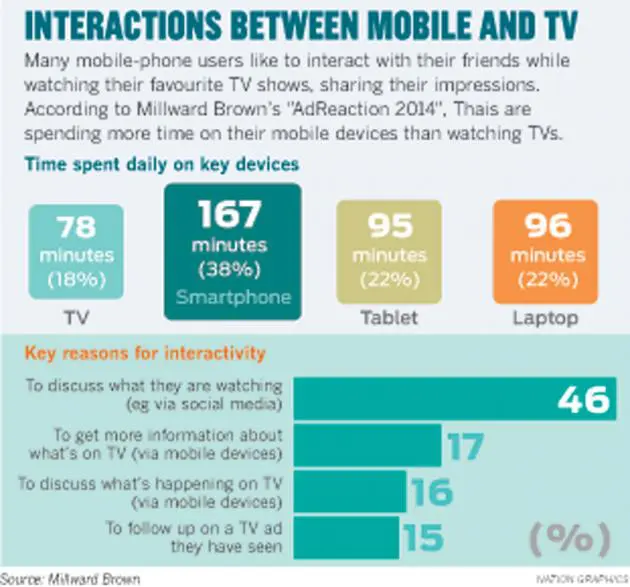
In a study by research agency Millward Brown, the time spent on mobile devices was found to exceed time watching a TV. Thais spend only 78 minutes watching TV a day.
Viewers use at least two devices including a TV, smartphone, tablet and personal computer at the same time and during the same task. Of respondents, 46 per sent said they would discuss what they were watching via social media, 21 per cent wanted to search for more information about what’s on TV via mobile devices, 16 per cent liked to interact with what’s happening on TV via mobile devices and 15 per cent wanted to follow up on a TV commercial after they had seen it.
Khanokkhan said TV broadcasters should deliver their popular TV content across platforms to reach a wider audience and lure advertising budgets from brands and advertisers.
Channel 7’s multiscreen strategy was a good example. Bangkok Broadcasting and Television (BBTV), the operator of Channel 7, appears to be the strongest in both analog and digital TV.
Through its subsidiary BBTV New Media, people can gain access to Channel 7’s popular programmes via three main mobile applications – BBTV CH7, Bugaboo.TV and Do 7 HD – anywhere and anytime. “However, the success of online platforms means high visitor traffic and quality content,” she added.
Chakrapun Leelamasavat, managing director of BBTV New Media, told a recent press launch of the “Do 7 HD” application that this new social TV mobile app aims to provide an enhanced viewing experience for the Channel 7 audience. The app would benefit from the changes in the media landscape after the arrival of all 24 terrestrial digital TV channels and the expansion of third-generation wireless broadband services.
Bangkok Entertainment Co, the operator of Channel 3, is also developing its online media platform in anticipation of higher traffic of viewers watching its soap operas uploaded on YouTube. The station wants to manage and strengthen its online platform.
Nation TV is focusing on a five-screen strategy to reach all potential viewers. They are TV, smartphone, tablet, PC and digital outdoor media.
Mono Broadcast, the operator of the Mono 29 channel, said it was planning a mobile app next year to extend its service to the young generation.
