
"A fillip for innovation?


BATHTUBS that synchronise with iPods, emitting light that changes according to music rhythms.
The world’s first polymer saxophones that are available at Bt10,000 while traditional saxophones made of other materials carry a starting price of Bt30,000.
A TV screen that appears blank except to those who wear special glasses.
These are some of the innovative products of Thailand that the owners – Bathroom Design, Vibrato Saxophones and Index Creative Village respectively – proudly presented to the audience of “CEO Innovation Forum 2015”, an event that kicks off Thailand’s dream to boost research and development, particularly from the private sector.
Several Thai governments have attempted to increase R&D expenditure, convinced that they would enhance the country’s competitiveness and lift it from the middle-income trap. Lessons from Japan, South Korea and Singapore suggest as much.
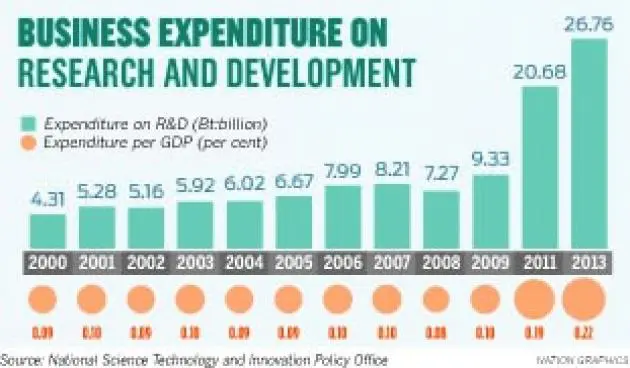
However, because of the absence of concrete and comprehensive strategies, Thailand’s R&D expenditure has remained below 1 per cent of gross domestic product, compared with 4.04 per cent in South Korea and 2.23 per cent in Singapore, according to 2011 World Bank data. Notably, South Korea’s GDP was US$1 trillion in 2013, against $387 billion for Thailand.
Korea-based Samsung spent $13.4 billion (Bt436 billion) on R&D last year, after investments of $10.4 billion in 2013, $10.6 billion in 2012 and $9 billion in 2011. The investment has been fruitful. Innovative products have boosted Samsung’s brand value to $81.7 billion, the second-highest in the world after Apple’s $128 billion, according to market research firm Brand Finance’s “Global 500 2015” report.
At the CEO forum in Thailand, Science and Technology Minister Pichet Durongkaveroj unveiled a number of strategies to boost R&D expenditure to 1 per cent of GDP by the end of next year. As private spending on R&D is expected to reach 70 per cent from 47 per cent last year, there is a policy to allow scholars obligated to spend years at government agencies in return for scholarships to work for the private sector.
This month, an event will take place to offer the matching of a pool of 30,000 researchers nationwide with small and medium-sized enterprises that have difficulties obtaining their own researchers. This is aside from the target to raise the number of researchers per 10,000 population from 10.5 in 2013 to 25 in 2021. Pichet also floated the idea of allowing companies to deduct up to 300 per cent of R&D expenses from taxable income.
Corporate chiefs at the forum welcomed the initiatives and vowed to help the smaller companies.
Siam Cement Group is ready to guide small companies towards the right strategies and execution.
CP All, the operator of the 7-Eleven convenience-store chain, is ready to turn some 8,000 outlets nationwide into testing stores for new products. According to Poonsawat Phoaprapat, CP All’s vice president for innovation, the service is now being extended to Siam Makro, which is also partly owned by Charoen Pokphand Group, as well as 10 other business organisations.
He said it could be extended to SMEs as well as Otop (One Tambon One Product) ventures. Successful products could then be exported to 7-Eleven outlets in other countries. Boiler sensors developed for 7-Eleven Thailand are now exported to Taiwan.
“With millions of customers each day, our chain can help them cross over the Valley of Death. They could go ahead with mass production, once they know which products are saleable. Who knows, these products could be exported to all Asean countries, like Myanmar,” Poonsawat said.
CP All last week presented seven innovation awards to products by SMEs. Bagasse paper, one of the winning products, is selling well with a target of Bt800 million this year, up sharply from Bt240 million in the first year of marketing. This is on top of in-house R&D proposed by employees at all levels.
Seagate Technology (Thailand) spent Bt1.8 billion on R&D last year and according to its vice president Sirirat Euaypadung, this will be continued. This includes training opportunities for thousands of technicians as well as collaboration with three universities in the Northeast to allow engineering students to spend three months at its plants. This is planned to be extended to six to 12 months, she said.
“Innovation-driven corporate growth requires education and extra courses. Knowledge must be integrated with corporate drives,” she said.
She noted that R&D required continuous investment, particularly at a time when products’ life cycles are getting shorter. At her company, hard-disk-drive capacity must be improved continuously in line with connectivity rates. Now, its HDDs’ highest capacity is 7 terabytes.
“The [government] initiatives are good but they should be properly executed. As long as concrete plans are there, the private sector is ready to assist,” she said.
Another challenge is that there is not yet a bridge to align corporate drives and researchers’ interest, something that results in a low commercialisation rate of Thailand’s research.
Poonsawat noted that 7-Eleven now fetched annual revenue of more than Bt2 billion from sandwiches. But this means it has to toss away thousands of sandwich-making machines – designed for home use – every three to six months. Concerned with waste, he is calling for researchers’ help in designing a machine that will last longer.
“Researchers must connect to consumers, understanding customers’ demands,” he said.
