
West failing to recognise importance of SE Asia, Wharton dean tells forum
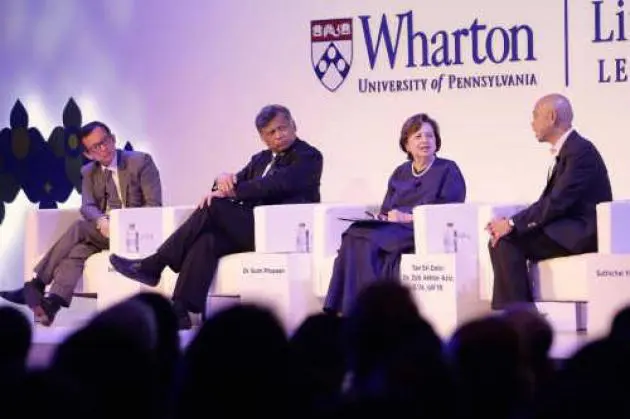


SOUTHEAST Asia is the most important region of the world that the people in the West know the least about, the dean of the Wharton School of the University of Pennsylvania told a forum in Bangkok yesterday.
The unprecedented rise of the middle class along with the expected increase of investment in infrastructure mean that the Asean region will become one of the main economic drivers of the world for many years to come, Geoffrey Garrett said.
“The last concept that should be understood [about Southeast Asia] has everything to do with the emergence of massive middle classes on a scale that the world has never seen before,” Garrett said during his keynote speech at the “Wharton Global Forum: Asia in a Borderless World”.
“Today and tomorrow, the big story is going to be about massive consuming middle classes in Asia, not only in China but in Southeast Asia too.”
He explained that the middle class in Asean would soon be as large as in China at more than a billion people. This means that the region’s economic growth will become more balanced and depend more on domestic demand.
“Global companies and the rest of the global economies will increasingly look on this region as an engine for growth and the region of opportunity for international firms and exporters from around the world,” he said.
“Thailand is a crossroads of Asean and Asia. It’s a gateway to Asia. It’s a hub for Asia. All of those words equate to enormous economic opportunity.
“Think about where we are today. China is to the north. Myanmar and India are to the west. Cambodia and Vietnam are to our east, and towards the south there are Malaysia, Singapore and Indonesia. You put that together and we have half of the world’s population,” he said.
“The incredible rise of the consuming middle classes is good for Thailand’s economy because it will make the country less dependent on export and more consumption-led. That would make the country much more attractive as a market,” he said.
Garrett said that to unleash the full potential of Thailand would require massive infrastructure development, and the key to tackling the infrastructure challenge was likely to be public-private partnerships.
“The potential here from half a million or more middle-class consumers is incredible, but to realise the full potential I think infrastructure is the key, and the government can unleash the potential of the society by involving the private sector in what we used to think of as public responsibility.” He said the real challenge was how to strike a deal so that the private sector was incentivised to invest today even if the returns don’t come until tomorrow, and that would require smart government.
“Smart government will partner with the private sector to generate outcomes that are not going to generate returns for investors but will generate bigger returns for society at large,” he said.
Simon Tay, chairman of the Singapore Institute of International Affairs, said he was concerned that the ongoing currency-devaluation battles would turn into currency wars.
“Currently there is a concern about the competitive currency devaluation,” which could trigger the next financial crisis, he said.
Zeti Akhtar Aziz, governor of Bank Negara Malaysia, said she disagreed with Tay’s assessment, since she did not believe that the “competitive depreciation” environment actually exists. The region’s currencies are depreciating because of the withdrawal of the earlier surges of fund inflows and liquidity.
“Most of the economies and the central banks in the region are not trying to depreciate our currencies but it [the depreciation of each currency] is a result of a volatile capital flows,” she said.
