
Ajinomoto banks on localisation
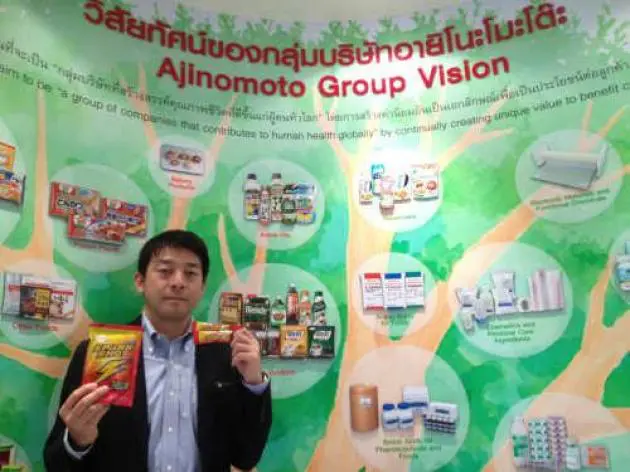


AJINOMOTO, a Japan-based manufacturer of seasoning, processed food and beverage products, has adopted a basic concept of "localisation" for its affiliated operations throughout Asean to promote local strengths and enhance the company's understanding of
The strategy is aimed at allowing Ajinomoto’s regional affiliates to keep up with the different degrees of urbanisation in particular Asean markets, which will affect consumers’ behaviour and their needs differently from one country to another.
Haruhiko Emura, manager of the processed-foods and beverage unit at Ajinomoto Co (Thailand), said that regarding the implementation of the Asean Economic Community (AEC) by the end of this year, Ajinomoto already had affiliates in many countries in the region, including Thailand, Indonesia, Malaysia, Vietnam, Cambodia and the Philippines. All these affiliates have applied the localisation concept.
In addition, they cooperate to some degree in terms of utilisation of assets and business opportunities.
“We [Ajinomoto Thailand] have covered Laos in distributing products into the market. We are studying business potential also in Myanmar in expanding our beverage and processed-food business into the country from Thailand,” Emura said.
Ajinomoto started its beverage business in Thailand with the launch of Birdy canned coffee into the market in 1993.
Emura said the canned-coffee market in Thailand was currently worth about Bt10 billion based on Nielsen’s data. Birdy shares 70 per cent of the market.
“We [will] continue to grow in this canned-coffee market by 4 per cent this year,” he said.
Emura said Ajinomoto 12 years ago also launched its three-in-one powder-based instant coffee in Thailand. The product now has about 10 per cent of the market, ranking second after Nescafe 3-in-1, which has a share of 55 per cent.
“Our strategy for Birdy 3-in-1 is to establish a strong No 2 position in the marketplace. We aim to become a strong player in the total coffee products [market] in Thailand,” Emura said.
He added that the company was studying using Thailand as an export hub for Birdy canned coffees and related products into neighbouring markets.
He said the company had just launched a new category of products into the Thai market. Spark Shot is the first powdered energy drink to be launched by Ajinomoto. Thailand was chosen as the first market for Spark Shot because of the high potential of the domestic energy-drink market, which is worth more than Bt20 billion. The market has been dominated by local brands M-150, Carabao Dang, and Krating Daeng.
“The energy-drink market in Thailand is quite huge and we want to find a business opportunity for our powdered energy-drink product. We want to increase the market share of our Spark Shot brand to 10 per cent within the first 12 months and up to 20 per cent within three years.
“Our strategy is to let Thai consumers understand the products and their portability benefit,” said Emura, adding that key target customers of Spark Shot are blue-collar employees, such as factory workers and farmers, who demand portable energy-drink products.
“We are also studying other potential beverage categories, such as functional drinks, to be launched into the Thai market in the near future,” Emura said.
He added that Ajinomoto had launched a functional drink for athletes in Japan under the Amino Vital brand.
He said Ajinomoto’s localisation policy had been applied by all of its affiliates, including in Thailand. Under the policy, any Ajinomoto affiliate is able to localise strategies and practices, such as in product development, to suit local consumers, based on their understanding of the consumers’ needs in the local environment.
“For Thailand, we don’t plan to introduce our products from Japan. What we will do is develop our own local products with the utilisation of technology and know-how from our Japanese headquarters,” Emura said.
“There are around two to three new product categories we would like to generate within the next five years,” he said.
Emura said beverages contributed 30-40 per cent of Ajinomoto Thailand’s revenue, and processed foods 10 per cent. The largest contribution is still from seasoning products, which account for 60-70 per cent.
“We believe that [the contribution from our] beverage and processed-food businesses will be growing higher than seasoning products as people’s consumption behaviour changes to a preference for convenient and healthy products. Thailand is moving towards an ageing society and urbanisation. What we are trying to do is to catch up with this trend,” he said.
