
National oil firm 'should be operator'
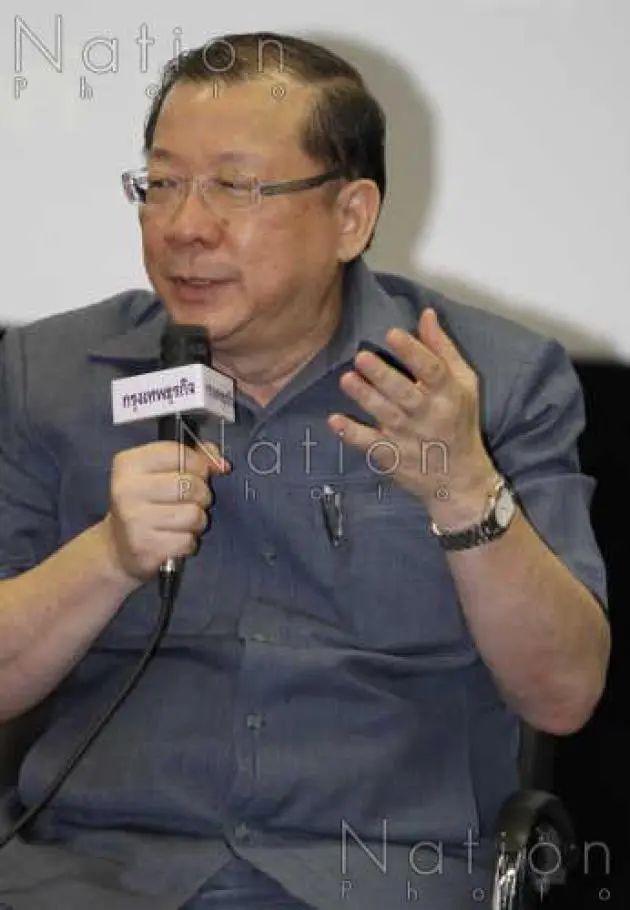


THE government is considering the pros and cons of forming a new national oil company that would attempt to acquire stakes in Thailand's two largest natural-gas concessions, in a bid to ensure a continuous supply of energy for the country, said Praipol K
Speaking at a dinner talk held by the Fellowship of Energy Reform for Sustainability on Thursday, Praipol said he was not against the idea of setting up the new entity provided it confined its function to that of an operator of petroleum assets, and did not try to be a regulator as well. That kind of conflicting role was proposed in draft legislation recently submitted to the National Legislation Assembly by the Thai Energy Reform Watch group led by Rosana Tositrakul.
“If we are going to have a national oil company, its purpose should be to represent the state to learn about the concessions, ideally before they expire, to ensure continuity” of gas production, he said.
The Energy Ministry is considering a number of options to manage the expirations of two major petroleum concessions currently operated by Chevron and PTT Exploration and Production (PTTEP). Natural gas from these two blocks satisfies half of the total demand in the country, but the concessions expire in 2022 and 2023, and the ministry needs to ensure there is no disruption in the gas production before or after the end of the concessions.
The ministry’s permanent secretary, Kurujit Nakornthap, told the forum that the two oil companies had been spending a combined Bt80 billion annually to drill about 500 new petroleum wells every year, just to keep their current gas-production levels at about 2,200 million cubic feet per day (mmcfd). So, if there is no proper strategy for dealing with the expiring concessions, those two companies might hesitate to keep investing, and their combined gas production could slide to just 500mmcfd.
“If there is no investment [to keep the current production level] during the period before the expirations of the concessions, the country will lose income from royalties and petroleum taxes amounting to Bt375 billion, and will have to spend an additional Bt350 billion to import pricier liquefied natural gas. These costs would have an enormous effect … [on] electricity tariffs,” he said.
Natural gas currently fuels nearly 70 per cent of Thailand’s electricity production, in addition to feeding the petrochemical industry.
Piyasvasti Amranand, chairman of PTT, said the most practical way to handle the issue was for the government to negotiate for the state to have some stake in these gas fields before their concessions expire. In return, the government would allow the two oil companies to take some shares in the blocks after the expirations of the concessions.
He said it should be possible to achieve such an agreement to ensure production continuity.
However, Piyasvasti said he did not favour setting up a new national oil company that is wholly owned by the state, since it could be prone to corruption and abuse by politicians.
Chevron is the operator of the Erawan and other nearby fields in the Gulf of Thailand that altogether hold an estimated 2P (proven and probable) petroleum reserve of 647 million barrels of oil equivalent (mboe), whose concession will expire in 2022. PTTEP runs the Bangkot and nearby fields that altogether hold a 2P reserve of 572mboe, whose concession will expire in 2023.
Current Thai law does not allow the extension of a petroleum concession, which has to be returned to the state after expiry.
