
'Fear of smuggling probe' prompted closure of deep South petrol stations


Play
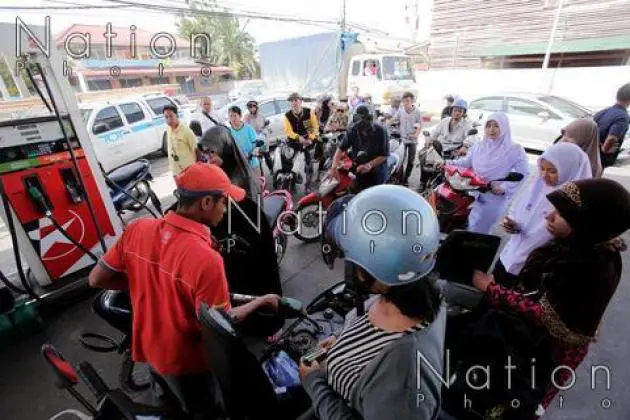
ENERGY MINISTER Narongchai Akrasanee said yesterday that the closure in the morning of 162 filling stations in the three southernmost provinces of Yala, Narathiwat and Pattani was due to their fear of being investigated for petrol smuggling.
This problem, which came after the provincial administrative organisations (PAOs) decided to levy a municipal tax on the service stations of 5 satang per litre, was under the responsibility of the Interior Ministry, as its local administration bodies wanted to collect the local tax, he said.
However, the Energy Ministry has a law that authorises officials, in a bid to prevent fuel shortages, to order petrol stations to reopen or face a maximum 10 years’ jail term and Bt100,000 fine, provided the prime minister has given the order to do so, he said.
According to the latest reports, some petrol stations in Narathiwat began to reopen in the afternoon after learning that the president of the Narathiwat PAO had sent officials to withdraw charges from the stations in Rusoh district that had not registered with the authorities nor filed tax returns.
All stations in Muang district have reopened, while all of those in Sungai Kolok district remained closed pending negotiations between the presidents of the three southern provinces’ oil traders clubs and the president of Narathiwat PAO over changing the tax-collection point from the stations to the depots.
The shutdowns led to an influx of smuggled petrol as some traders took the chance to sneak in fuel from Malaysia to sell along peripheral streets. Sources from the Energy Ministry said the three southernmost provinces had never charged a municipal tax on motor fuel before, while all the other provinces in the country had already done so. The law allows local administrations to levy up to 10 satang per litre as a municipal tax.
“From our investigation, there has not been any impact on petrol stations [from the tax], since they can pass it on to motorists. But the collection of municipal tax would open the way for authorities to inspect the petrol-trading accounts of each station,” he said.
“Some stations might not want this to happen if they’re trading in smuggled fuel.”
Ministry to decline request
Narongchai also said the ministry would decline the request by the People’s Network for Energy Reform, a civil group, to withdraw the two bills amending two petroleum laws from the National Legislative Assembly (NLA). The draft bills have been approved by the Cabinet.
The ministry has already explained to the public the necessity of opening the 21st round of petroleum exploration and production bidding, he said.
In late February, the energy minister withdrew the invitation for companies to submit applications to explore for oil under the 21st bidding round, pending the amendment of the petroleum laws. The announcement follows a decision to delay the bid for government oil and gas concessions.
Once the NLA passes the amended laws, the ministry will start inviting interested companies to submit documents to take part in the bid and it will shorten the period of bid applications to 60 days from 120 days in order to complete the round this year.
The potential bidders have already prepared their bid packages, as the ministry had announced the first invitations last October.
The government will consider how to proceed after the expirations of Chevron’s concession for the Erawan petroleum field and that of PTT Exploration and Production for the Bongkot field.
The Energy Ministry will try to submit the natural-gas plan for 2015-36 for the consideration of the National Energy Policy Council before the ministry’s permanent secretary – Kurujit Nakornthap – retires in September.
The highlight of the plan is to build more liquefied-natural-gas tanks to serve forecast imports of 18 million tonnes per year over 10 years.
PTT has already finished building the first LNG tank with a capacity of 5 million tonnes per year and is close to completing the second one with the same storage capacity. It will build two more tanks – one in Myanmar’s Dawei Industrial Zone with a capacity of 3 million tonnes and the other in the South with the capacity of 5 million tonnes.
This forecast of imports of 18 million tonnes of LNG assumes that the country can set up two coal-fired power plants, one in Krabi and the other in Songkhla.
If the two power plants cannot be established, the country will have to import more LNG and set up a coal-fired plant in Myanmar. The ministry wants to see the successful establishment of the two power plants in Thailand in order to promote investment in Thailand.
