
UK, Germany support energy-efficient and climate-friendly technologies


Play
THAILAND’S refrigeration and air-conditioning industry is prepared for the next development phase, thanks to a joint effort by Germany and the United Kingdom together with GIZ (a German company that specialises in international development) supporting cli
Under the project titled “Refrigeration and Air Conditioning Nationally Appropriate Mitigation Action” (RAC NAMA), they provide support to Thailand’s effort to reach its energy-saving and climate-protection targets. It supports the cooling industry’s aim of staying competitive and is expected to attract international climate finance to the country.
“On the supply side, the RAC NAMA project aims to support Thailand in preparing for the next generation of refrigerants by cooperating with the responsible ministries and agencies in Thailand to define safety standards and building codes in line with international best practices. The project will also train servicing staff to prepare the sector for different safety challenges,” said Tim Mahler, project director of RAC NAMA at GIZ Thailand.
GIZ was contracted by the British-German NAMA Facility to implement the project with total funding of 14.7 million euros (Bt572.5 million). The four-year project kicked off this year.
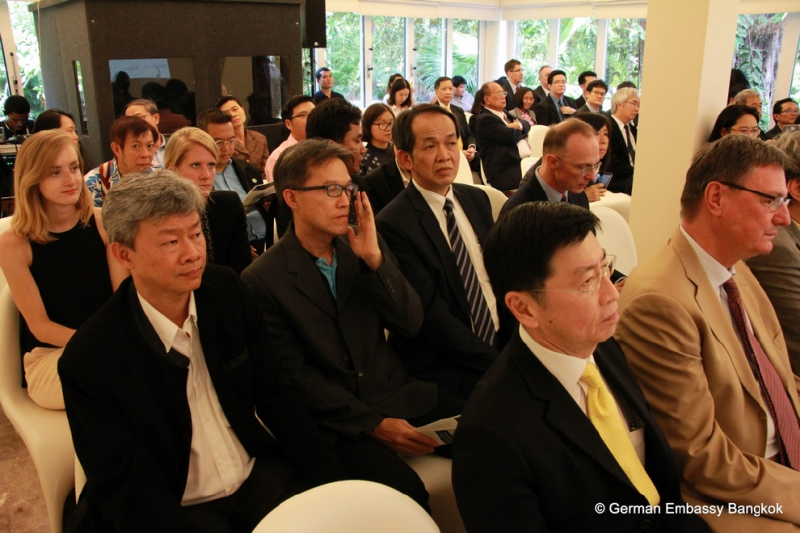
At a ceremony to mark the project opening on Tuesday, German Ambassador Peter Pruegel emphasised the high public interest in this scheme.
“Thailand is an important industry hub in the cooling sector for both national and international companies. To be competitive, companies need to be able to adjust to the changing requirements, among others triggered by international agreements. Consequently, their challenge will be to produce highly energy-efficient and climate-friendly technologies.
“Our goal is to join forces also with international organisations like UNEP [United Nations Environment Programme], UNESCAP [United Nations Economic and Social Commission for Asia and the Pacific] and the World Bank for sustainable development,” Pruegel said.
The British Embassy charge d’affaires, Paul Bute, said: “The UK has a strong commitment to tackle climate change and to develop well-functioning energy markets. This commitment is both national, where we are considering how we can deliver net-zero emissions in the UK, and international, where we partner with countries like Thailand transitioning to a low-carbon economy.”
Mahler said that on the demand side, the project first aims to direct demand towards more energy-efficient products by demonstrating best practices of energy performance standards, labels and other incentive schemes.
Second, the project aims to increase the demand for energy-efficient and climate-friendly technologies by setting up a financial incentive scheme that increases the attractiveness of such technologies for consumers in Thailand.
According to Thammayot Srichuai, director-general of the Energy Ministry’s Department of Alternative Energy Development and Efficiency, the project is in line with government energy-saving targets, which call for a 30-per-cent reduction of energy usage by 2036 compared with that in 2010.
Asdaporn Krairapanond, deputy secretary-general of the Office of Natural Resources and Environmental Policy and Planning, added that Thailand aimed to reduce greenhouse-gas emissions by 20-25 per cent by 2030.
“Demand for air-conditioning and refrigeration in Thailand is growing very fast. This sector consumes a lot of electricity, produced in general by burning fossil fuels that emit [carbon dioxide]. It was projected that, without intervention, this demand will triple by 2030 …
“I am looking forward to working closely with the RAC NAMA project and defining fields of cooperation between my ministry and the project,” Asdaporn said.
