
Farmers tap tech ethos


WHILE AGRICULTURE had formed the backbone of the Thai economy for centuries, the sector has in recent years been characterised by malaise and dependence on government support. But the farming sector’s fortunes may be changing, kicked along in 2016 by the prospect of benefiting from the Thailand 4.0 policy or the innovation-driven economy.
Against the backdrop of low prices for farm products, in part due to a sluggish global economy, farmers have struggled to achieve sustainable growth. Now the talk is encouraging smart farming.
Rice farmers are beginning to embrace a new mindset under which they are less inclined to wait passively for government support or sell their rice through middlemen traders. They have learnt the value of producing rice byproducts, adopting online trading and networking for their farming ventures and devising marketing plans.
Last year saw the government draft a plan to reform rice farming and marketing under a 20-year strategy. It also drew up a 10-year plan to modernise cassava farming and trading.
As part of the government’s plans it decided to reduce rice production to 25 million tonnes of paddy from about 30 million to 33 million tonnes each year. It hopes that this will lead to the industry’s sustainable development and long-lasting stable prices. Under the plan, the government has set up a zoning measure for encouraging rice farmers to grow rice in the most suitable areas, while encouraging farmers to grow other economic crops such as sugarcane, maize, cassava, sunhemp, and livestock feed.
The government has also provided farmers with quality seeds, cheap fertiliser and other kinds of support such as soft loans. Moreover, the government will encourage rice farmers to integrate their rice farmyards in order to reduce the cost of production and the packing of rice.
By late 2016, the move toward so-called mega-rice farming saw 57,775 farmers integrate 386 farmyards covering 838,403 rai of rice growing areas in 66 provinces. Farmers who joined the project will be able to sell rice above the market price by Bt200 per tonne, while also reducing production costs. So far, 209 rice mills are participating in this project.
Agriculture Minister Chatchai Sarikulya said the government would continue to encourage more farmers to join the mega-farming project, while those producing other crops would also be helped in switching to integrating farming.
Moreover, the government has provided soft loans to support farmers and assist in research for creating by-products from rice, and so add value to rice products.
An institute to encourage innovation in the production of rice and other farm crops was initiated in 2016. The institute aims to promote the development of rice and other crops into more value-added products.
For example, Thai rice would be developed as a value-added ‘super food’ in the form of various products. The institute would contribute to adding value to Thai rice and thus enable farmers to boost their incomes.
Farmers change
Rice farmers have also taken the initiative to become smart farmers and learnt how to become traders in both the traditional and online markets.
Suthep Kongmak, president of the Thai Farmers Association, said rice farmers understand the market situation and are ready to adjust their plans to ensure sustainable development. Groups of farmers have joined hands for mega-farming ventures or formed cooperatives to increase their bargaining power and sell rice by their own efforts.
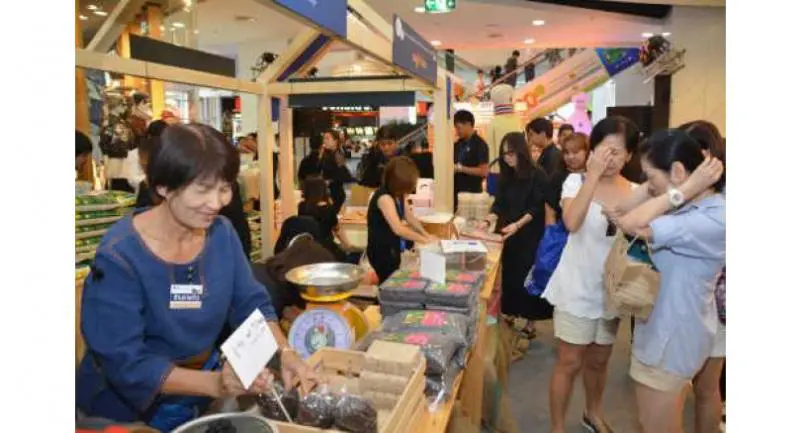
Many forward-thinking farmers have also modernised their approach by creating their own rice brands that they sell directly to consumers via traditional marketing and online trading.
Lung Nuay, a farmer from Si Sa Ket province who has his own Facebook page to sell rice, said he had turned to online sales as a way to secure for him and his family, along with the neighbours, a fair price.
“Normally, most of the rice produced by my family and neighbours will be sold to the middleman. And that means low prices. So we set up a shop online to help everyone sell rice at an acceptable price for good quality,” he said.
Meanwhile, the Commerce Ministry has provided support for farmers by helping them to sell rice both via online and offline channels.
In cooperation with the Thai Wholesale and Retail Trade Association, vending spaces have been set up inside wholesale and retail shops in 65 provinces nationwide. With the department’s help, rice sales can now also be conducted on the ThaiCommerceStore.com platform, which links visitors to other websites and the Facebook pages and Instagram accounts of rice farmers.
Cassava farming change
Despite Thailand’s status as a major producer of cassava on the world market, the government is planning a strategy to promote the country as the leading Asean cassava producer based on innovation and the use of technology. The strategy will be implemented from this year to 2026.
The vision for developing Thailand’s cassava industry with innovation and technology development would add value to cassava products, and result in Thailand relying less on cassava exports, chiefly to China. The 10-year strategy will ensure a balanced supply of and demand for cassava for the long term, while continuing to emphasise Thailand as the key centre of cassava production and trading built on innovation and value-added processes. The first strategy is to manage a cassava-growing area of 8.5 million rai (1.36 million hectares) and set up zoning to ensure the most efficient production and quality.
Yield per rai is expected to increase from less than 5 tonnes currently to 7 tonnes in 2026, while it is hoped the cost of production will be cut by 10 per cent. It is also expected that demand for cassava in many industries will be increased, mainly in the glue, paper, textile, sweetener and pharmaceutical sectors. Under this strategy, the export value of cassava products is expected to be at least Bt150 billion as of 2026, from an estimated Bt120 billion in 2019.
The government would also support the production of cassava on a commercial scale by promoting integrated farms in order to reduce production costs. The government will encourage farmers to adopt technology such as solar systems and water-dropping methods to grow cassava. It will also provide soft loans to help farmers invest in new technology. The government will also give soft loans for farmer cooperatives engaged in cassava processing. Industries related to cassava processing using alternative energy and zero-waste production will be promoted.
Research on new products from cassava will be supported, such as in bio-plastic production and in food industries. The government will also amend regulations to facilitate innovation and research for the industry.
