
MCOT’s plea to import equipment raises doubts
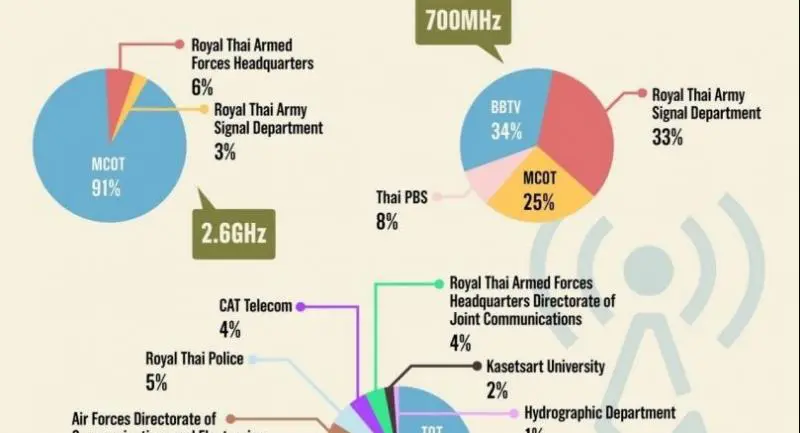


MCOT RECENTLY asked the National Broadcasting and Telecommunications Commission (NBTC) for permission to import equipment that it will use in co-|operation with True Corp and Advanced |Info Service (AIS) to operate wireless |services on its portion of the 2.6 gigahertz spectrum.
But a telecom analyst was doubtful about whether the move reflects another bid by operators to seek extra bandwidth at a lower cost than they might face under a new round of spectrum auctions.
Last October, MCOT requested per-|mission to import Huawei cellular base |stations that are compatible with the |2.6GHz spectrum the NBTC office per-|mitted MCOT to import 30 base stations.
Agreements reached
Last November, MCOT again sought |permission to import more Huawei base |stations. It also asked the NBTC to grant it the network code used for conducting telecommunication systems.
It said it had reached agreements with AIS subsidiary Advanced Wireless Network (AWN) and TrueMove H Universal Communication (TUC) on the use of their wireless broadband technology to broad-cast TV signals. It also asked for the net-|work code needed for providing a 2.6 GHZ service.
The NBTC’s broadcasting committee refused to assign the network code to MCOT and declined to back its request to import more Huawei equipment.
The broadcasting committee also asked the NBTC board to consider again if MCOT still has the right over its 2.6 GHz spectrum.
Last Wednesday, the NBTC board decided initially on whether to grant the network code to MCOT and if MCOT has ownership right to the 2.6GHz spectrum. However, that agenda item was later withdrawn from consideration.
It is still not clear if MCOT has rights to the band. The NBTC panel assigned to study state agencies’ spectrum ownership ruled recently that MCOT no longer has rights over the band, contradicting an earlier NBTC ruling.
NBTC secretary-general Takorn Tantasith said last week that MCOT had informed the commission that it wanted to return 90 megahertz of the 160MHz it holds on the 2.6GHz spectrum.
A new NBTC law under consideration |by a committee of the National Legislative Assembly would allow the commission |to compensate state agencies for spectra |they relinquish before their concessions |end or before their rights to the spectra expire.
The NLA committee concluded last week that the NBTC had no authority to pay compensation to the state agencies that no longer had rights to their spectra.
Piset Chiyasak, director and acting president of MCOT, said that his company was developing its new business over some portions of 2600MHz radio frequency under its joint venture company.
The portions of 2600MHz bandwidth will be used for its pay-TV business with Playwork Co Ltd through a 15-year contract under which MCOT will receive the revenue sharing and Playwork will be the entity that invests.
Meanwhile, MCOT is willing to return some of its holding 2600MHz band-|width to the NBTC for auction in the |near future while requiring the broadcasting watchdog to pay its compensation in return.
An NBTC source said that according to this interpretation, whether MCOT would be compensated under the new law would depend on whether or not the NBTC rules that MCOT retains rights over the 2.6GHz spectrum.
The NLA committee also determined that in cases where compensation to state agencies is justified, the NBTC would use the proceeds from its spectrum auctions to pay them.
AWN and TUC have acquired additional bandwidth by paying hefty prices to secure licences to operate wireless services on the 1,800MHz and 900MHz spectra at NBTC auctions.
AWN won the auction for 10MHz of the 900MHz spectrum last May by bidding Bt75.654 billion. True won 10MHz of the same spectrum in December 2015 by bidding Bt76.298 billion.
Unlike its two rivals, Total Access Communication (DTAC) failed to clinch licences on either the 1,800MHz or 900MHz spectrum at those auctions. Like them, DTAC currently holds a licence to use the 2.1GHz spectrum.
However, its 1800MHz and 800MHz concessions will expire in September next year.
Recently the company said it was keen to partner TOT to provide cellular service on that state telecom agency’s 2.3GHz spectrum. A telecom-industry observer said if TOT finds that it would receive large compensation under the new NBTC law, it might consider returning half of the 60MHz it holds on the 2.3GHz spectrum to NBTC and keep the rest for providing its cellular service.
Uncertainty over 800MHz
It is still uncertain how much of DTAC’s 800MHz bandwidth will be made available in a future auction.
Thanapant Raichareon, deputy secretary-general of the NBTC, said half of a 10MHz band on the 800MHz spec-|trum should be allocated for providing |railway communications after the DTAC concession ends, if the government de-|cides to deploy the Chinese high-speed-|rail system. This was the preliminary |conclusion of a consultant the NBTC |hired to study the railway-communication issue.
The other half would be put to auction, he added.
The NBTC will allocate 400MHz for railway communications if the government decides to use a Japanese high-speed-rail system.
“The NBTC will discuss with the Transport Ministry again which of these two high-speed-rail systems it will select,” Thanapant said.
Compensation study
The NBTC has hired King Mongkut’s Institute of Technology Ladkrabang to conduct a study on how to compensate the state agencies after the NBTC reclaims the spectra from them.
KMITL held the first meeting on the issue with a focus group on January 17. The second one will be held in June, and the last one in September.
It will reach a conclusion on the study in October.
The study mainly focuses on three spectra: 700MHz, 2.3GHz and 2.6GHz.
At the first meeting, the agencies holding spectra shared the view that the NBTC should state clearly which bands it would reclaim and for what reason.
KMITL proposed that the NBTC |should reclaim those bands without cur-|rent ownership, those bands whose equipment had expired, and those with too few users.
Representatives from some military units told the forum that they opposed “too few users” as a justification for reallocation as this could include the spectra used for some military purposes.
Representatives of True and MCOT |asked what appraisal method would |be used to calculate the compensation |amounts.
KMITL proposed that whether bandwidth was returned voluntarily or not, the compensation should be based on the losses caused to that agency by the cessation of operations.
The calculation would be based on the assumption of the profit they would have received if they continued operating the service until their right to that spectrum expired.
