
Limited education no obstacle as developer hires women
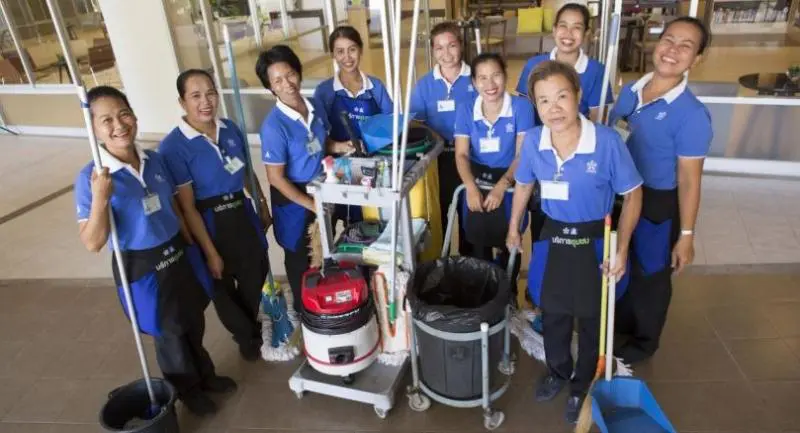


JUTHARAT BOONMAN, 38, jumped at the opportunity to work for LPN Development under the listed developer’s programme of employing underprivileged women in non-construction jobs.
“I got the opportunity to work as a housekeeper at Lumpini Park Rama 3 Riverside despite graduating after primary school, and it has changed my life from labouring at a construction site to now generating income averaging Bt12,000 a month, as well as training me to do other jobs to bring in more money to support the family,” she said.
Her quality of life has improved and her earnings are also enough to meet her family’s needs.
“Under the programme, LPN has also opened up the opportunity to learn and study in order to upgrade my education and improve my work prospects for the long term,” said Jim Kanngang, 47, who works as a housekeeper at Lumpini Town Rama 4.
Having been in the residential-development business for more than 20 years and developed 143 condominium projects serving some 130,000 households, LPN is acutely aware of its responsibility to develop local communities and people’s quality of life – especially for underprivileged women.
Surawadee Suewaja, managing director of Lumpini Property Service & Care (LPC) – a subsidiary of LPN Development with responsibility for property services at the developer’s projects, and for cleaning and administration in particular – said that during the LPN’s growth over the past two decades, it had not only developed condominiums, housing projects and communities consistently with its Lumpini-brand condominium projects and Porn Santi-brand housing estates, but had also increased the scope of its corporate social responsibility (CSR) activities.
CSR through project management
CSR at LPN is not limited to donating goods or direct assistance to communities, she said, explaining that it entails another style of business model – one that is laid out in connection with the development of its condominiums and housing projects, while answering questions on human-resources development in each and every community in which it is involved for new project development.
Under LPN’s CSR policy, emphasis is placed on providing assistance to poorly educated women – including many with no formal education at all – earning lower-than-normal wages, she said, adding that many of these women have family problems, such as being single mothers.
LPN, via LPC, therefore engages many of these underprivileged women as cleaning staff at each of its projects and, with no less than 130,000 condo units to service, there is sufficient work to employ women from several communities around its projects in each area, Surawadee stressed.
LPN has carried out the CSR activity through this channel for more than 20 years and, apart from giving underprivileged women the opportunity to work, it provides them with training for additional skills and literacy, as many are unable to read or write prior to joining the programme, due to their poor education.
Alongside their work for LPC, these underprivileged women have been trained in other professions like Thai massage as a means of providing them further ways to earn additional income, she said.
They are instructed, for example, in how to make desserts and other foods – and to become marketers themselves.
In addition, this group of women are drawn into providing services at activities and events that LPN organises, LPC’s managing director said.
LPN also intends to extend more of its services for underprivileged women via LPC, as its core unit taking care of after-sales services in regard to cleaning and other property services, and to more communities around the areas in which it has residential projects.
This type of operation comes as the business returns some of its profit to society via job creation and providing a higher quality of life for underprivileged women in its Lumpini communities.
Currently, about 1,800 underprivileged women have joined LPC under the programme, and the number will increase as new LPN projects are developed, Surawadee said.
Moreover, apart from expanding its services to other LPN projects, LPC’s direction from this year onwards is to provide its property services to a further 20 projects – all of them non-LPN projects.
These will be new markets for LPC staff, she added.
Extending employment to the handicapped, elderly
The LPC executive said that, aside from underprivileged women, LPN would add other groups of underprivileged persons, such as the handicapped and the elderly, to its employment programmes in the future.
Once this type of service expansion gains traction and expands, LPC’s next target will be to shift its business strategy to become a social enterprise with a serious and consistent determination to help the underprivileged, she added.
LPN spends no less than Bt20 million-Bt22 million per year for LPC’s property services, demonstrating its focus on providing employment opportunities for underprivileged persons, she stressed.
This is evidenced by the developer having been recognised with an “SET Social Enterprise Investment Award 2015”, while the company consistently maintains its target to extend more job opportunity and a higher quality of life for the underprivileged in society in every area of the country where it develops its projects, the MD said.
