
AI Boom and Hardened Supply Chains Propping Up Global Economy, CNN Bangkok Panel Says
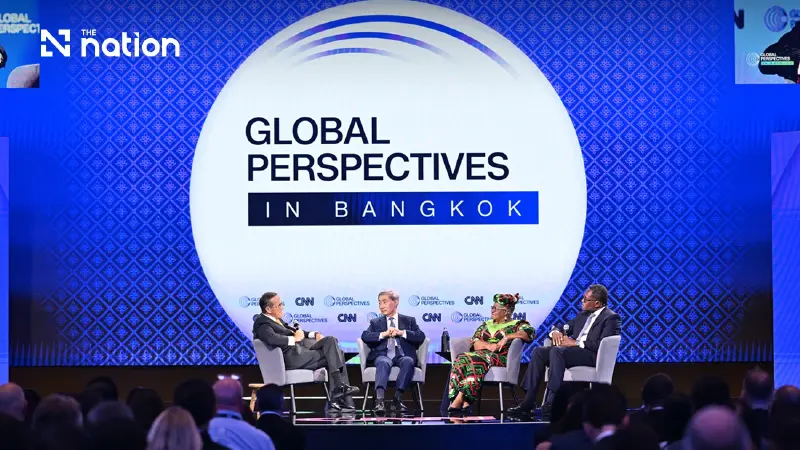


Convening alongside the IMF-World Bank meetings in Bangkok, global economic leaders debate the "three-legged stool" of trade, capital, and government
- According to the WTO Director-General, a surge in artificial intelligence trade is a primary driver of economic resilience, with AI components contributing nearly 50% of recent global trade growth.
- Global businesses are hardening supply chains by shifting from a "just-in-time" to a "just-in-case" model, investing in redundancy and diversified manufacturing to better withstand volatility.
- A panel of economic leaders in Bangkok concluded that despite geopolitical and financial pressures, the global economy is holding firm, largely reinforced by the AI boom and these structural adaptations in supply chains.
Convening alongside the IMF-World Bank meetings in Bangkok, global economic leaders debate the "three-legged stool" of trade, capital, and government.
As global financial leaders converge on the Thai capital for the high-stakes IMF-World Bank Annual Meetings, the dialogue surrounding the international economic order has shifted from outright pessimism to cautious, pragmatic adaptation.
Set against the vibrant backdrop of Bangkok, CNN’s inaugural Asia-based Global Perspectives event brought together some of the world's most influential policymakers and financial executives to debate the theme "Who Wins the New Economic Order".
Moderated by CNN Business editor-at-large Richard Quest, the panel featured WTO Director-General Dr Ngozi Okonjo-Iweala, Bank of America International President Bernard Mensah, and Bank of Korea Governor Hyun Song Shin.
The discussion centred on a simple yet evocative metaphor: the global economy as a "three-legged stool" supported by governments, capital markets, and private investment.
While geopolitical fragmentation, debt pressures, and regulatory hurdles have threatened to destabilise international commerce, the panel delivered a reassuring verdict—the stool is holding firm, heavily reinforced by structural adaptations and an unprecedented surge in artificial intelligence (AI) trade.

A Surprising Resurgence in Global Trade
Opening the session with a counter-intuitive dose of optimism, World Trade Organization (WTO) Director-General Dr Ngozi Okonjo-Iweala addressed the unprecedented headwinds facing international supply chains.
While acknowledging that trade is navigating its most severe disruptions in the 80-year history of the General Agreement on Tariffs and Trade (GATT) and the WTO, Okonjo-Iweala highlighted that global trade has proven remarkably resilient.
"In spite of the battering and the undermining and whatever is going on with the rules, we find that 72% of world trade is still taking place on global rules of the WTO," Okonjo-Iweala noted.
Citing impressive statistical rebounds, she pointed out that merchandise trade growth projections have been repeatedly revised upward.
What is driving this unexpected vitality?
According to the WTO chief, the digital revolution is playing an outsized role, with trade in artificial intelligence components contributing nearly 50% of recent growth.
"We have a saying at the WTO: no trade, no compute," Okonjo-Iweala remarked, encapsulating how the technology boom is actively counterbalancing regional conflicts and supply chain blockades.
This sentiment closely mirrors the core tone emerging from the ongoing IMF and World Bank Annual Meetings in Bangkok, where global economic assemblies are heavily focused on leveraging technological innovation, managing public debt, and boosting job creation amid a complex multi-speed global recovery.

Private Capital and the Shift to "Just-in-Case"
Echoing the theme of structural adaptation, Bank of America International President Bernard Mensah provided an insider's view on how global institutional capital is reacting to volatility.
Rejecting the notion that investors are fleeing turbulent markets, Mensah asserted that capital remains highly active and strategic.
"Capital is actually very active at the moment; it is not passive. As far as I can see, it is not running for the hills. It is not looking for safety. It is actually out there deploying as actively as it can," Mensah stated.
Mensah explained that corporate clients are fundamentally restructuring their operational blueprints.
Moving away from the hyper-optimised, lowest-cost models of traditional globalisation, businesses across North America, Europe, and Asia are transitioning from a "just-in-time" philosophy to a "just-in-case" posture.
This involves heavy investments in supply chain redundancy, diversified manufacturing hubs, and robust digital infrastructure.
However, Mensah also pointed out emerging areas of risk, contrasting healthy corporate and consumer balance sheets in key markets with mounting pressures on developed-market sovereign debt.
His observations align directly with broader institutional warnings issued during the Bangkok meetings regarding the rapid depletion of fiscal buffers across various economies, underscoring why policymakers must address structural imbalances before new shocks materialise.

Asia’s Financial DNA and the Fight for Stability
For Asian economies, navigating external turbulence is a familiar exercise. Bank of Korea Governor Hyun Song Shin drew a direct line between historical trauma and modern policymaking, noting that the region's approach to macro-financial stability is deeply rooted in the lessons of past crises.
"Korea and many of the other countries in the region experienced a very severe crisis in the late '90s... that's really been a formative experience in our approach to macro-financial stability, and if you like, it's in our DNA," Governor Shin explained.
Shin emphasised that central banks must remain exceptionally vigilant against excess financial leverage, warning that delayed policy interventions risk triggering disruptive corrections.
Highlighting the reality of a K-shaped economic divergence, he reiterated that inflation disproportionately harms lower-income populations, cementing the central bank's unwavering commitment to price stability targets.
Looking Forward: Experience Over Anxiety
As the panel discussion drew to a close, the leaders reflected on whether today’s macroeconomic environment is inherently worse than previous eras.
Drawing parallels to the 1987 market crash, the 2008 global financial crisis, and the COVID-19 pandemic, the panel concluded that history frequently rhymes rather than repeats.
Dr Okonjo-Iweala dismissed anxieties surrounding ageing leadership or institutional wear and tear, championing the value of accumulated experience in steering global institutions through uncharted waters.
"I'm glad to be old and to be older. I have no problems with it because you accumulate so much experience... The only difference with this crisis is the uncertainty that we've seen all the time, but all the same, I think the three-legged stool has been a bit wobbly, but it is showing resilience, surprising to us," Okonjo-Iweala concluded.
