
PTT Group Showcases LNG Resilience and Green Vision at Gastech 2026
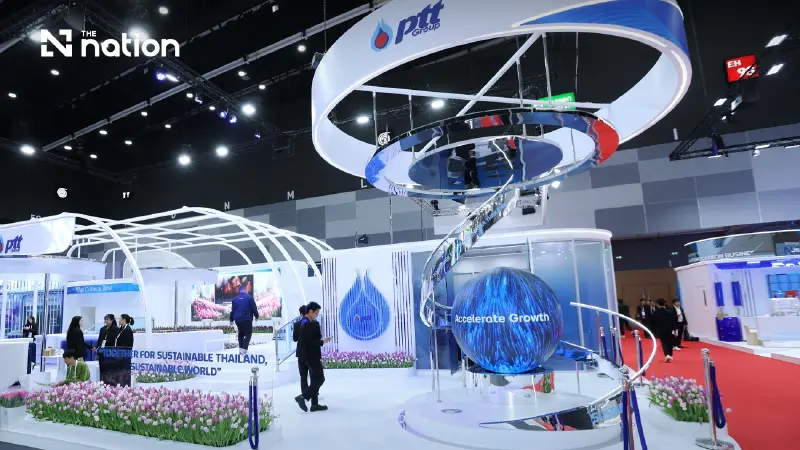


PTT Group used Gastech 2026 in Bangkok to set out plans for securing Thailand's gas supply, expanding LNG trading and reaching Net Zero
- PTT Group is bolstering LNG resilience through diversified supply sources, flexible portfolio management, and developing infrastructure to create a connected regional delivery network.
- The company's green vision involves balancing energy security with sustainability, accelerating investments in clean energy and carbon capture to support Thailand's 2050 net-zero target.
- Key green initiatives showcased include the I-SPARK clean-energy industrial project in Rayong and the Arthit project, the country's first carbon capture and storage (CCS) development.
- PTT emphasized that natural gas and LNG will remain crucial "destination fuels" to ensure grid stability and support the integration of renewable energy across the region.
PTT Group used Gastech 2026 in Bangkok to set out plans for securing Thailand's gas supply, expanding LNG trading and reaching Net Zero.
PTT Group used its home-ground platform at Gastech 2026 this week to make its clearest case yet that natural gas and liquefied natural gas (LNG) will remain central to Thailand’s — and the region’s — energy security for decades, even as it accelerates investment in carbon capture, clean energy and lower-carbon industrial development.
Across executive panel sessions and a dedicated exhibition at the Bangkok International Trade and Exhibition Centre (BITEC), held from 14 to 17 September, PTT Group leaders delivered a consistent message: energy security, affordability and sustainability must advance together, with gas continuing to play a durable role as the region electrifies.
Balancing three goals Opening the group’s contribution to the conference, Dr Kongkrapan Intarajang, President and Chief Executive Officer of PTT Public Company Limited, told delegates that the energy transition must balance three dimensions simultaneously: energy security, affordability for households and businesses, and long-term sustainability.
Each country, he said, must adopt an approach suited to its own circumstances.
Natural gas and LNG are “destination fuels” with a long-term role in the energy system, he said, helping to keep power grids stable and flexible as demand rises from industry, broader electricity consumption, and new sources of load such as artificial intelligence and data centres.
He described a future in which gas and renewables work together, with gas providing the reliability needed to integrate more renewable capacity safely into the grid.

On supply security, Kongkrapan said LNG resilience depends on diversified sourcing and flexible portfolio management: securing supply from multiple origins, actively managing contracts, and maintaining trading networks that allow cargoes to be redirected during disruptions.
“Crisis readiness is part of energy security,” he said, pointing to efforts to connect PTT’s exploration, trading and infrastructure businesses with ASEAN partners to strengthen collective resilience.
He also linked decarbonisation to competitiveness, citing work on efficiency, methane reduction and carbon capture as support for industrial emissions-reduction efforts and Thailand’s national net-zero target.

From transition to transformation
Dr Buranin Rattanasombat, Chief Operating Officer of PTT’s New Business and Sustainability Group, said Thailand’s energy transition had become more tangible over the past five years, pointing to the decision to bring forward the national net-zero target to 2050, the new Power Development Plan 2026, progress on climate legislation, and domestic carbon capture and storage (CCS) projects.
However, he cautioned that the transition was proving more complex than expected.
Geopolitical uncertainty and regional price shocks, he said, underscored the need to pursue emissions reductions alongside energy security and affordable access.
“We are not just changing energy sources — we are transforming the whole system,” he said, describing PTT’s approach as a shift from “energy transition” to “energy system transformation”.
The aim, he added, is to create a cleaner, more secure, flexible and competitive energy system.
He pointed to I-SPARK, PTT’s area-based clean-energy and infrastructure development initiative in Rayong province, as the clearest expression of that approach.
The initiative brings together government, industry and international partners to accelerate lower-carbon projects and attract investment in clean energy, low-carbon infrastructure, and the bio- and circular-economy sectors.

Building a flexible, connected LNG network
Bandhit Thamprajamchit, Chief Operating Officer of PTT’s Upstream Petroleum and Gas Business Group, focused on infrastructure, telling delegates that gas continues to serve a dual role as both a transition fuel and a long-term “destination fuel”, particularly in Asia, where demand is rising from power generation, industry and emerging users such as data centres and AI.
He said the LNG supply model was shifting from a traditional point-to-point system towards a “connected, flexible network” linking supply sources, shipping routes, infrastructure and end markets.
In a volatile environment, he argued, energy security is no longer simply about securing sufficient volumes; it requires genuine flexibility in sourcing and delivery.
PTT’s strategy rests on developing infrastructure and its LNG portfolio in parallel. On infrastructure, the group is moving beyond capacity expansion towards greater connectivity, adding storage, reloading, re-export, break-bulk and ship-to-ship capabilities, alongside a “virtual inventory” system.
On the portfolio side, PTT is diversifying supply sources, regions, sellers, contract structures and destination markets.
The group is balancing long-term contracts — the foundation of supply security — with short-term and spot purchases that provide greater agility.
Together, these efforts are intended to support Thailand’s potential to become a regional physical LNG delivery hub, underpinned by the principle that security comes not from capacity alone, but from having more options.

Flexible contracts for an uncertain demand outlook
Jaturong Worawitsurawatthana, Executive Vice President for International Trading at PTT, offered a buyer’s perspective. For Thailand and other emerging Asian economies, he said, the question is not only whether enough LNG will be available but also whether buyers can access it at reasonable prices during a crisis.
Additional supply alone cannot guarantee energy security if importing countries cannot absorb higher costs, he said.
Jaturong maintained that LNG remains an important transition fuel, supporting grid stability and helping to manage the variability of renewable generation.
Long-term contracts therefore retain a role in underpinning supply security and providing developers with the demand certainty needed to approve new projects.
However, with future demand clouded by economic conditions, policy changes and renewable-energy growth, he said such contracts should become more flexible in terms of volume, delivery timing, destination and pricing structure.
Cargo swaps and closer regional co-operation could further strengthen collective energy security across Asia, he added.

An industrial blueprint and a first for carbon capture
Rathakorn Kampanartsanyakorn, Executive Vice President for Corporate Sustainability, used a separate panel session — alongside the Governor of the Industrial Estate Authority of Thailand and the Director-General of the Department of Climate Change and Environment — to present I-SPARK as a blueprint for Thailand’s next industrial transformation.
The Rayong-based initiative is built around three pillars: low-carbon energy solutions, including renewables, CCS and low-carbon ammonia; shared infrastructure to reduce costs; and high-value, low-carbon industries, including recycled and bio-based products and sustainable aviation fuel.
PTT projects that I-SPARK could attract more than US$5 billion in investment, generate over US$3 billion in economic value, create more than 13,000 jobs and reduce emissions by about 9 million tonnes of CO₂ annually by 2035.

Separately, Kanita Sartwattayu, CEO-designate and Acting Executive Vice President at PTT Exploration and Production (PTTEP), said the company had responded to this year’s price volatility by ramping up gas production in the Gulf of Thailand to maximum levels and delivering supplies through all three of the country’s main pipeline corridors.
She said the move had helped shield households, businesses and the wider economy from higher global energy prices.
Kanita also highlighted the Arthit CCS project—Thailand's first, sanctioned in 2025, with the capacity to capture and store up to 1 million tonnes of CO₂ a year—as a template for further developments, including a proposed Eastern Thailand CCS Hub.
She also pointed to PTTEP’s new Integrated Operations Control Centre in Bangkok as a step towards more data-driven management of its offshore gas fields.

A booth built around ‘Flow’
PTT Group’s Gastech exhibition, staged under the theme “Flow”, used the concept to represent the movement of energy, opportunity, collaboration and sustainability.
A Business World Map zone presented the group’s value chain, from PTTEP’s upstream operations in 10 countries to its international trading arm, which operates through six offices in Bangkok, Singapore, Abu Dhabi, Shanghai, London and Houston.
The trading business serves more than 80 countries and aims to expand its LNG portfolio from a 2026 target of 3.7 million tonnes to 10 million tonnes by 2030 and 15 million tonnes by 2035.
Visitors were also shown PTT LNG’s two receiving terminals at Map Ta Phut, which have combined capacity of up to 19 million tonnes a year.
Other displays covered I-SPARK, the Arthit CCS project, LNG cold utilisation — which repurposes cold energy generated during regasification to grow strawberries — and AI-driven smart-energy-management tools that help industrial customers monitor and optimise energy use.
Taken together, PTT Group’s Gastech presence positioned the company less as a conventional fuel supplier and more as an integrated energy partner — one betting that flexibility, diversification and continued investment in lower-carbon technologies will help Thailand and Southeast Asia navigate an increasingly uncertain energy landscape without compromising climate commitments.
