
Tech, AI and Upskilling Crucial to Power Thailand’s Economy, Business Leaders Say
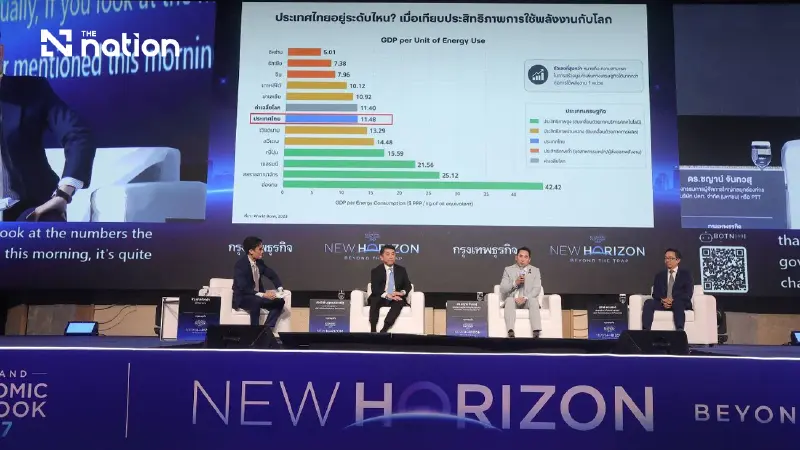


CPF, PTT, Gulf and AIS executives say an ageing Thailand must lift output per worker, attract AI investment and rethink green and subsidy policy
- Business leaders assert that due to Thailand's aging and shrinking population, economic growth must now come from increasing individual worker productivity rather than expanding the labor force.
- The adoption of technology and AI is identified as the primary method to boost productivity, with an emphasis on developing a domestic AI value chain, including data centers and sovereign infrastructure.
- Upskilling and reskilling the workforce is crucial to adapt to the shift from repetitive tasks to higher-value activities driven by AI.
- Executives also call for new government policies, such as attracting foreign investment in tech and rethinking green and subsidy strategies, to support this economic transformation.
CPF, PTT, Gulf and AIS executives say an ageing Thailand must lift output per worker, attract AI investment and rethink green and subsidy policy.
Thailand's economy can no longer grow by adding workers or leaning on the industries of the past 40 years. It must instead raise the value each person produces, using technology and AI, senior executives from some of the country's biggest companies said on Thursday (October 8).
Speaking at Thailand Economic Outlook 2027: New Horizon Beyond the Trap, hosted by Krungthep Turakij, leaders of Charoen Pokphand Foods (CPF), PTT and Gulf Development agreed that a shrinking, ageing population and slowing legacy industries demand a new approach.
They differed on emphasis: capability-building in food, a measured pace on carbon cuts, and a push to bring the AI value chain onshore.
The talk of AIS added to the case for sovereign digital infrastructure. Food sector: from "national food company" to "capability builder"
Prasit Boondoungprasert, chairman of the executive committee of CPF, said Thai food businesses are adapting to stricter global trade rules, particularly environmental criteria. The company is working with partners and suppliers to raise standards along the whole value chain.

CPF is therefore redefining its role, he said, from a "National Food Company" to a "National Capability Builder" that lifts the competitiveness of the entire Thai food industry.
That means helping suppliers and customers succeed together, especially smallholder farmers and livestock keepers, who lack the engineering expertise to develop advanced technologies such as smart farms or AI systems themselves.
Prasit warned that geopolitical conflict and climate change are raising risks and that Thailand must pay more attention to food security.
Thais have long been used to abundance and cheap food compared with neighbouring countries, he said, but a lack of preparation could invite a crisis.
He called for serious investment in science and technology, especially genetics, to raise production efficiency, alongside research into risk management.
He also argued that the state and society should protect domestic farm and food markets for goods. Thais can produce themselves, citing Japan's import tariff of up to 30 per cent on products containing rice.
PTT: new industries, new yardsticks and a measured path to net zero
Dr Chaya Chandavasu, executive vice-president for corporate strategy at PTT, said Thailand's economic structure has relied for four decades, since the “Chotchuang Chatchawan” era of the 1980s, on automotive, electrical appliance and electronics industries.
These remain competitive manufacturing bases but have limited capacity to deliver high growth, he said. Thailand must seek new industries and attract foreign direct investment to trigger another wave of large-scale infrastructure spending.

For the next four to five years, he outlined three directions:
Build on strengths and new ecosystems: keep backing tourism and health services while seizing opportunities in AI, semiconductors and data centres.
Change the yardstick: look beyond GDP growth to national income by supporting capable Thai companies to grow abroad and bring earnings home.
Lift productivity: adopt technology and AI not merely as an added cost but as something judged by real gains in staff efficiency.
On energy, Dr Chaya said PTT, as the national energy company, must balance energy security, price competitiveness and decarbonisation. He urged care over the timing, speed and framework of reaching net zero in 24 to 25 years.
European countries that cut carbon rapidly over the past decade or so incurred costs of 1 to 1.5 per cent of GDP, he said. With Thai GDP growing at a little over 2 per cent, bearing a similar burden would weigh heavily on the economy.

Gulf: more output per worker, and bring the AI value chain home
Smith Banomyong, chief strategy officer of Gulf Development, said growth can no longer rely on shifting farm labour into industry or pumping credit into consumption, as after the 1997 crisis.
Thailand's population has now fallen for a second consecutive year and is ageing rapidly. The modern growth equation, he said, is the number of workers multiplied by their productivity.
If a workforce shrinks from 10 people to five, but AI raises efficiency by 2.5 to 3.5 times, GDP could swing back to substantial growth. As an example, he cited an organisation that used AI to cut a data analysis task from two weeks to two minutes.
Thailand should not be merely a buyer or user of AI, he said, but should draw all five layers of the AI value chain into the country: energy, data centres, GPUs, AI models and applications.
Gulf is working with leading AI companies such as Google to bring technology to Thai firms, small and medium-sized enterprises (SMEs) and the public.
He likened data centres to "the first road" that must be built to support new businesses, such as high-skilled software jobs, and said Thailand has the power and water to host them.
He urged officials not to impose overly strict rules based on unfounded fears or foreign news that does not fit the Thai context, such as on water or town planning.
Capital and technology, he warned, would quickly move to Malaysia, Indonesia, the Philippines, Vietnam or India. Imposing European-level standards when Thai incomes are less than half of Europe's would cost the country growth opportunities, he said.
Targeted subsidies, not blanket support
Smith also called for energy prices to reflect true costs. Blanket subsidies, such as freezing diesel prices at the pump, also benefit luxury-car drivers and slow the shift to electric vehicles and solar power.
Support should instead go to low-income people who genuinely need it, he said, using big data and AI together with telecoms operators' data, such as from AIS or True, to target help precisely and avoid hidden long-term burdens on the budget.

AIS: building sovereign digital infrastructure
In a separate special talk on intelligent infrastructure, Pratthana Leelapanang, chief executive of Advanced Info Service (AIS), said AI is becoming core infrastructure for the new economy.
If AI is applied thoroughly across manufacturing, services, energy, agriculture and other businesses, it could add about 500 billion baht to the Thai economy in 2027, or more than 2 per cent of GDP, he said.
The Thai economy is growing by about 2 to 3 per cent, while the digital economy is expanding roughly twice as fast, driven by online services, e-commerce, ride and food delivery, digital lending and QR code payments.

Digital infrastructure investment, including data centres, could total about one trillion baht this year, he estimated. The challenge, Pratthana said, is not only to use AI but to build the infrastructure to support it: telecoms networks, data centres, cloud, GPU computing and domestic data storage.
He advocated "Sovereign AI" and "Sovereign Cloud", meaning infrastructure and AI under Thai oversight. That would let the country use the best global technology while keeping control of data and systems critical to the economy and security.
This includes a national AI model that applies global technology to Thai data and context. People must be reskilled and upskilled, he added, because AI will shift work from repetitive routine tasks to higher-value activities.
