
EA Strategy Focuses on Commercial EV Scale-Up as AAB Factory Demonstrates Production Readiness
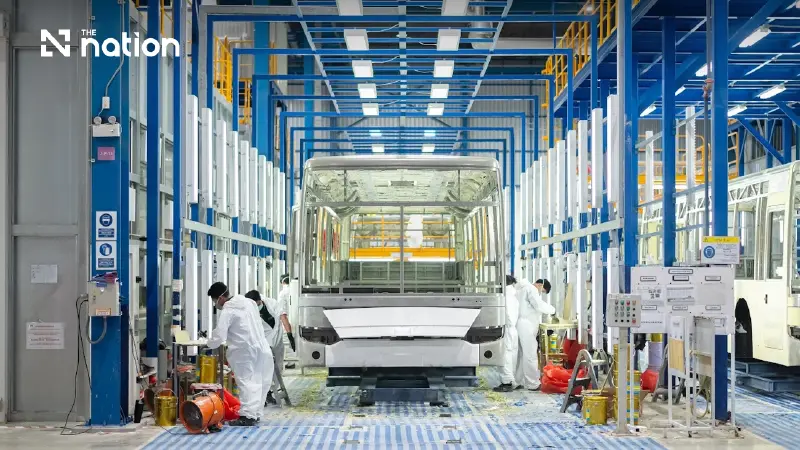


Chief Executive Chatrapon Sripratum outlines growth targets, operational expansion, and domestic manufacturing advantages during Ban Pho facility tour
- Energy Absolute (EA) is strategically focusing on scaling up its commercial electric vehicle (EV) operations by leveraging an integrated ecosystem that includes vehicle assembly, battery manufacturing, charging infrastructure, and carbon credit management.
- Its manufacturing arm, Absolute Assembly (AAB), has demonstrated production readiness at its Ban Pho factory, which has an annual capacity of 3,000 units and is currently fulfilling a major order of 1,520 electric buses for Bangkok's transit authority (BMTA).
- The company's strategy capitalizes on domestic manufacturing, which provides a structural cost advantage over imported vehicles that are expected to face higher excise taxes.
- Beyond the current BMTA contract, EA is targeting further growth in commercial segments like logistics trucks and intercity coaches, as well as pursuing future public tenders and export opportunities.
Chief Executive Chatrapon Sripratum outlines growth targets, operational expansion, and domestic manufacturing advantages during Ban Pho facility tour.
Energy Absolute Public Company Limited (EA) is sharpening its strategic focus on commercial electric vehicles (EVs), positioning its manufacturing arm, Absolute Assembly Company Limited (AAB), to capture expanding domestic market opportunities and projected 2027 growth.
Speaking during a media briefing and facility tour at AAB’s assembly plant in Ban Pho, Chachoengsao Province, on Wednesday (November 11), Chief Executive Officer and Executive Committee Chairman Chatrapon Sripratum outlined the group’s forward-looking operational readiness, commercial vehicle strategy, and structural cost advantages under evolving tax frameworks.

The strategy centres on leveraging EA's integrated ecosystem—which spans vehicle assembly at AAB, battery manufacturing, charging infrastructure via EA Anywhere, and carbon credit management—to capture growing demand across commercial transport segments.
"Our strategy is built on offering a complete, integrated solution rather than operating merely as a vehicle reseller," Chatrapon said. "By combining domestic assembly, local charging network installation, competitive electricity rates, and carbon credit structured solutions, we significantly reduce total cost of ownership for commercial fleet operators."

Production Readiness and Fleet Delivery Timeline
The Ban Pho assembly plant, operating in a designated Free Zone, has achieved commercial readiness across its key production stages: frame welding, Electro Disposition Painting (EDP) anti-corrosion dipping, vehicle assembly, and dynamic track testing.
The plant currently holds an annual assembly capacity of approximately 3,000 units under standard operating shifts, with potential expansion up to 9,000 units under maximum output.
A central focus of AAB’s current production schedule is the supply of 1,520 air-conditioned electric buses for the Bangkok Mass Transit Authority (BMTA) project, conducted in partnership with Nakhonchai Air and Nex Point Public Company Limited (NEX).
More than 200 units have already completed assembly, with daily output running at 7 to 10 vehicles. Vehicle deliveries to the BMTA are scheduled to begin towards the end of the first quarter of 2027 and run through the second quarter, aligning with the expected timeline for financial revenue recognition.

Revenue contribution from the BMTA contract alone is projected to reach approximately 6.0 to 7.0 billion baht.
"People rely on buses every day to get to work, go to school, and return home," Chatrapon stated. "Our responsibility begins while each bus is still in the factory. The expertise gained by our local workforce, from structural welding through to system testing, establishes a permanent domestic capability for public transport manufacturing."

Regulatory Tailwinds and Domestic Value
EA's commercial strategy is positioned to capitalise on impending regulatory and fiscal policy adjustments in Thailand. With excise taxes on imported commercial vehicles expected to rise from 10 per cent to 35 per cent, locally assembled vehicles meeting statutory local content thresholds stand to gain a competitive pricing margin over direct imports.
AAB’s production lines achieve a local content ratio of 40 per cent in labour and domestic components, exempting its output from import duties within the Free Zone environment.
"Import tariffs on completed commercial vehicles from foreign markets can range between 20 and 40 per cent," Chatrapon noted. "Operating a full-scale assembly line within a Free Zone that satisfies domestic content requirements creates a distinct structural cost advantage. As fiscal policies increasingly favor domestic manufacturing, our setup ensures long-term pricing competitiveness."


Beyond the BMTA fleet, EA is targeting three core commercial segments:
● Intercity Coaches and Transit Buses: Supported by annual nationwide registration replacement demand of approximately 2,500 units.
● Logistics Prime Movers (Head Trucks): A market with annual registration demand of 3,000 to 4,000 units, where electric models have achieved initial purchase price parity with Euro 5 diesel equivalents.
● Commercial Trucks and Vans: Covering light, medium, and heavy-duty trucks (15,000 to 17,000 units annually), as well as commercial passenger and cargo vans.

Carbon Offset Integration and Market Expansion
A key differentiator within EA’s business model is its active carbon credit management framework.
Under an ongoing bilateral agreement aligned with Article 6 of the Paris Agreement, EA has transferred ITMOs (Internationally Transferred Mitigation Outcomes) carbon credits generated from electric bus operations in Bangkok to Switzerland, with an export quota of up to 500,000 tonnes through 2030.
The group is currently expanding this carbon offset mechanism to cover its commercial logistics and prime mover fleets.
Looking ahead, EA is evaluating additional public sector tenders, including an anticipated 800-bus BMTA fleet procurement expected early next year, alongside potential export opportunities for right-hand-drive electric buses within Southeast Asian markets.
"We have demonstrated our capability across more than 2,000 electric buses currently operating in municipal transport," Chatrapon said. "With our ecosystem established, our primary goal is to drive operational execution, fulfil order backlogs, and maintain disciplined growth across the commercial EV sector."
