
Land Bridge final study due to reach PM in August as government keeps project on hold



Thailand has not yet decided whether to proceed with the Land Bridge megaproject, as a special committee reassesses its commercial viability, environmental impact and public benefits before reporting to the prime minister in August.
Thailand’s Land Bridge megaproject remains on hold, with a final study scheduled to be submitted to the prime minister in August as the government reassesses whether the proposed Gulf-Andaman logistics corridor is commercially viable, environmentally acceptable and beneficial to the public.
Deputy Prime Minister and Finance Minister Ekniti Nitithanprapas on Friday (June 26) chaired the second meeting of the committee studying ways to drive the project, formally known as the transport infrastructure development project linking freight transport between the Gulf of Thailand and the Andaman Sea.
The meeting acknowledged progress by three subcommittees, which are reviewing the project’s feasibility, value for money and potential impacts under a 90-day study framework.
Danucha Pichayanan, secretary-general of the National Economic and Social Development Council, in his capacity as secretary of the Land Bridge committee, said the government’s position remained unchanged: no final decision has been made on whether the project should go ahead.

“The establishment of the committee and subcommittees is aimed at carefully and transparently studying the facts, including the project’s economic value, environmental impact and the benefits that people would receive,” he said.
A coast-to-coast logistics corridor
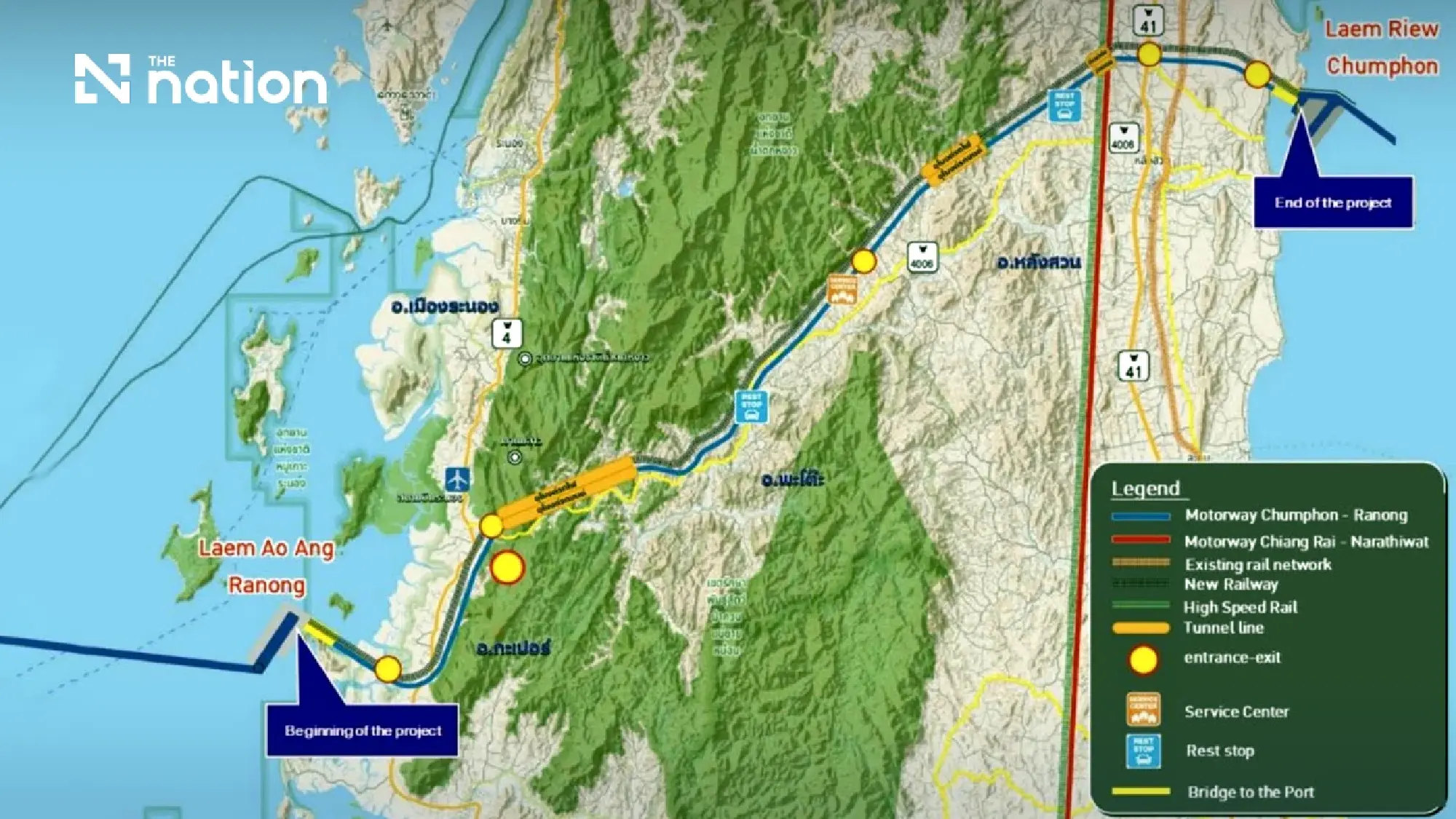
The Land Bridge is a long-discussed infrastructure scheme intended to create a logistics corridor across southern Thailand, linking Ranong on the Andaman coast with Chumphon on the Gulf of Thailand. The current proposal centres on deep-sea ports on both coasts, connected by road and rail infrastructure, as an alternative route for some cargo now moving through the Strait of Malacca.
The project has been promoted as a way to strengthen Thailand’s role in regional logistics and reduce reliance on maritime chokepoints, but it also faces scrutiny over cost, investor interest, environmental risks and local opposition. The proposed corridor is estimated at around 1 trillion baht, with analysts warning that its economic competitiveness against existing shipping routes remains a major question.
The revived Ranong-Chumphon route follows earlier versions of the Land Bridge concept, including past proposals involving Pak Bara in Satun and Songkhla. The current version has been reframed more heavily around logistics, ports and transport connectivity rather than large-scale petrochemical development.

Commercial assumptions under review
Danucha said the subcommittee on project feasibility assessment, which he chairs, met on June 12 to review the key assumptions used in studies by the Office of Transport and Traffic Policy and Planning.
The review covered commercial feasibility, expected cargo volume, transport costs, possible time savings, and the project’s ability to attract major shipping lines.
However, the subcommittee found that several parts of the data needed to be updated to reflect current conditions. These include replacing earlier study figures with the latest available information and reviewing assumptions about maritime freight patterns and the project’s operating model.
The revised information will be brought back for consideration at the subcommittee’s next meeting on July 3, 2026.
The review underlines one of the project’s most important economic uncertainties: whether enough shipping operators would actually use the Land Bridge to justify the scale of investment.
Singapore port data to be used as benchmark
One of the key issues still requiring further study is the claimed benefit from shorter freight transport times.
Danucha said the subcommittee needed more detailed information on cargo transshipment times, which are complex and depend on several factors. These include shipping schedules, waiting times for cargo handling and international shipping networks.
The subcommittee has proposed using data from the Port of Singapore, one of the world’s leading transshipment hubs, as a comparative case study. The aim is to assess actual average timeframes and provide a more realistic picture of whether the Land Bridge could deliver meaningful efficiency gains.
The issue is economically significant because the project’s business case depends heavily on whether shippers can save enough time or cost to offset the need to unload cargo, move it overland, and reload it onto another vessel.
Environmental and community risks remain unresolved
The environmental subcommittee has also held its first meeting, reviewing impact reports for key project components, including the motorway, rail system and deep-sea ports.
The subcommittee raised concerns over potential impacts from channel dredging, loss of forest areas, changes to marine ecosystems, and effects on the livelihoods, income, occupations and employment of local residents.
Danucha said the environmental subcommittee is preparing to visit affected areas in early July to collect additional information and listen directly to local residents.
“The subcommittee is preparing to visit the area in early July to gather additional information and listen directly to local residents’ views before using the findings to support the overall impact assessment,” he said.
The public consultation process is likely to be closely watched, as local opposition has become one of the major risks surrounding the project. Concerns have focused on land use, coastal ecology, fishing communities, farming areas and whether the project would permanently alter the character of southern provinces.
Public communication to be stepped up
The public relations subcommittee has assigned the Public Relations Department and relevant agencies to accelerate efforts to build public awareness and understanding of the project.
The aim is to ensure that the public, local communities and stakeholders across all sectors receive accurate, complete and consistent information.
The committee is also allowing representatives from the private sector and civil society to observe meetings online. Officials say this is intended to make the study process more transparent and build confidence among all parties involved.
Danucha said the resignation of Thom Sinsuwan, a public representative from the Rak Ranong Network, from the Land Bridge committee would not affect the review process, although he regretted the decision.
He said the committee still wanted civil-society representatives to take part as much as possible so that local facts and community perspectives could be reflected in the review.
Board says all dimensions are being studied
Danucha said public calls for a review of the Land Bridge, including issues related to the proposed Southern Economic Corridor law, are already part of the committee’s work.
He said the committee would consider the issues directly and assess whether the project is suitable, which parts may need improvement, or whether there are better alternatives.
The committee is also taking geopolitical factors into account, including slowing global trade, supply-chain volatility and international economic risks.
Danucha said these factors must be considered not only for the Land Bridge, but also for Thailand’s long-term economic development strategy.
Investment model not yet on the table
Danucha said the project would move to the next stage only if the study concludes that it is commercially feasible and sufficiently worthwhile.
Only then would the government consider the investment model, project size and funding approach.
He stressed that attracting foreign investors is not the issue currently under consideration. The priority is to determine whether the project makes economic sense and whether its benefits outweigh its risks.
“The committee is expected to complete the full study by August 2026 before submitting its report to the prime minister within the specified timeframe,” he said.
“In the meantime, no figures or assessment results will be disclosed in order to prevent incomplete information from being interpreted or used in a way that could create misunderstanding among the public.”
For now, the Land Bridge remains a high-stakes economic proposal rather than an approved project. Its future will depend on whether the government can prove that the corridor is commercially viable, environmentally manageable and beneficial enough to justify one of Thailand’s most ambitious infrastructure investments.
