
DIP warns against misuse of Lampang chicken bowl GI name and logo
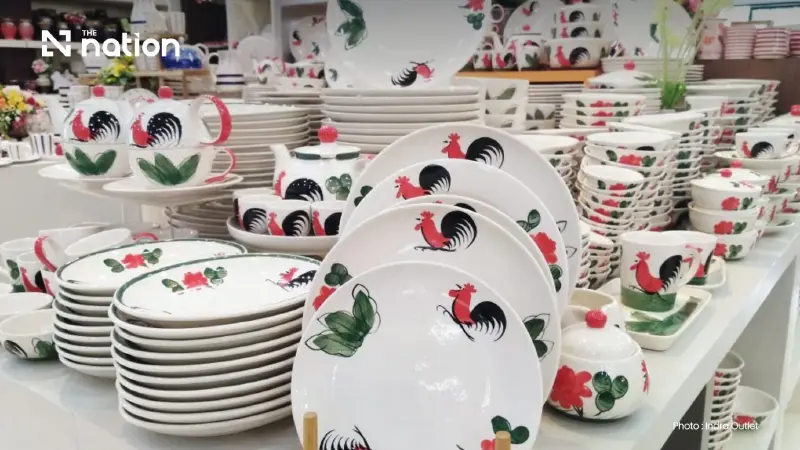


DIP explains how GI law protects the Lampang chicken bowl name and logo, while urging consumers to check authenticity before buying.
- Thailand's Department of Intellectual Property (DIP) has issued a warning against the misuse of the legally protected "Lampang chicken bowl" Geographical Indication (GI) name and its official logo.
- The GI designation is exclusively for ceramic bowls produced in Lampang province using specific local raw materials, such as kaolin, and traditional hand-painting methods.
- Using the GI name on non-compliant products carries a fine of up to 200,000 baht, while unauthorized use of the GI logo can result in imprisonment and a fine of up to 400,000 baht.
- The DIP urges consumers to look for the official GI name and logo to ensure they are buying authentic products, as the law does not protect the general design itself from being copied.
The Department of Intellectual Property (DIP), under the Commerce Ministry, has clarified the scope of geographical indication (GI) protection for the “Lampang chicken bowl” following the sale of similar-looking products on the market.
The department stressed that the protected GI name and the Thai GI logo cannot be used in ways that breach the relevant legal requirements. It also urged consumers to choose genuine GI products to support Thai producers, preserve local craftsmanship and help strengthen Lampang’s ceramics industry over the long term.
Lampang ceramic tradition behind the GI
DIP Director-General Auramon Supthaweethum explained that chicken-bowl production in Lampang began around 1957 after deposits of high-quality kaolin suitable for ceramics were discovered in Chae Hom district.
Members of the Chinese community subsequently established the province’s first factory and passed on pottery-making traditions that became widely adopted in Lampang.
The “Lampang chicken bowl” was registered as a GI in 2011 because of its distinctive quality, characteristics and reputation, which are linked to its geographical origin and local production know-how.
Under its GI registration, the designation covers ceramic tableware produced only within Lampang province and in accordance with specified production requirements.
The key production stages are:
- Locally sourced raw materials: The bowls are not made from ordinary clay. They must use Lampang kaolin mixed with black clay and other materials, including feldspar and silica sand, producing a clay body that is both plastic and strong enough to retain its shape.
- Traditional production techniques: The bowls are formed using a jiggering machine, with knives and sponges used to finish the pieces. They are then left to dry or fired at 800 degrees Celsius.
- Hand-painted traditional motifs: Each bowl is hand-painted with a combination of a chicken, banana tree and peony, using standardised ready-mixed colours. The piece is then glazed with a mixture containing feldspar, silica sand, kaolin and limestone before being fired again at 1,200–1,250 degrees Celsius for six to nine hours.
This process gives the ceramic its naturally creamy-white colour, helps the painted designs retain their colour and durability, and ensures that the product meets GI production and quality-control requirements, contributing to its quality and long service life.

GI logo subject to quality assessment
There are currently around 10 producers of Lampang chicken bowls, with combined production of approximately 2,600 pieces a year.
Producers that establish a product quality-control system and pass an assessment by the inspection committee are authorised to display the Thai GI logo on their products or packaging for two years.
When the authorisation expires, producers may undergo another assessment to renew their right to use the logo. The system is intended to provide consumers with assurance that GI products are subject to stringent quality controls and can be traced back to their actual place of production.
Law protects GI name and origin claims
Auramon stressed that the protection afforded to the Lampang chicken bowl must distinguish clearly between the GI name itself and the Thai GI logo.
Thailand’s Geographical Indications Protection Act BE 2546 (2003) is intended to prevent consumers from being confused or misled about the geographical origin of goods and protects the use of registered GI names under the conditions prescribed by law.
The use of the Thai GI logo is governed separately by the Trademark Act BE 2534 (1991).
Using the name “Lampang chicken bowl” for products that are not made in the designated geographical area or do not follow the production process registered under the GI could constitute an offence under the Geographical Indications Protection Act, carrying a maximum fine of 200,000 baht.
Unauthorised use of the Thai GI logo could constitute an offence under the Trademark Act, punishable by up to four years in prison, a fine of up to 400,000 baht, or both.
However, a product that uses designs or patterns resembling those of a GI product, without using the GI name or Thai GI logo or making a claim that misrepresents its geographical origin, may not constitute an offence under the Geographical Indications Protection Act.
The department noted that this reflects a limitation of the legislation, which focuses on protecting GI names and representations of geographical origin rather than the general appearance or design of a product.

Consumers urged to check GI identification
Auramon added that building consumer awareness is therefore as important as enforcing the law.
The DIP encourages consumers to choose Lampang chicken bowls that correctly display the GI product name and authorised GI logo. If a GI logo is not displayed or the product’s origin is unclear, buyers are advised to check the information carefully before making a purchase.
The department explained that this can help support Thai GI producers while reducing the risk of consumers buying products that may improperly claim to be GI goods.
Anyone who encounters a product using a GI name and suspects that it may not originate from the designated production area or meet its registered standards can contact any provincial commerce office or the DIP hotline on 1368.
The department can then investigate and coordinate with relevant consumer-protection agencies where necessary.
DIP seeks to expand Lampang’s GI producer base
The DIP has continued to support and develop the capabilities of Lampang chicken bowl GI producers, with efforts focused on expanding market opportunities, adding value and encouraging wider commercial use of GI products across different industries.
It is also monitoring the availability of clay raw materials used in production and holding discussions with Lampang province and relevant agencies to prepare appropriate measures for future circumstances.
The department is also encouraging more eligible ceramic producers to enter the GI system, with the aim of broadening the Lampang chicken bowl producer base, strengthening local communities and improving the long-term competitiveness of the province’s ceramics industry.
The DIP urged consumers to support genuine Lampang chicken bowl GI products that correctly use the registered name and GI logo to help sustain local craftspeople and producers, preserve the product’s traditional knowledge and identity and strengthen the community economy.
