
Thai firms’ 500bn baht Vietnam investment fuels partnership push as GDP could overtake Thailand’s in two years
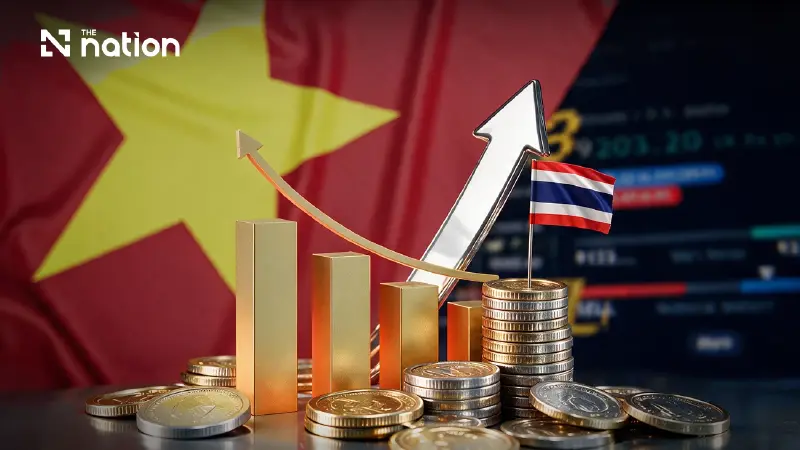


Business leader Sanan Angubolkul says Vietnam’s economy could overtake Thailand’s in one to two years, urging closer supply-chain ties
- By mid-2026, registered investment from Thai firms in Vietnam surpassed 500 billion baht (approximately US$15.4 billion), distributed across nearly 800 active projects.
- This level of investment positions Thailand as one of Vietnam's largest foreign investors and the second-largest from the ASEAN bloc, trailing only Singapore.
- Thai investment is diversified across key sectors, including renewable energy, petrochemicals, manufacturing, retail, and the development of industrial estates.
- The surge in investment is attributed to Vietnam's large domestic market, substantial workforce, competitive production costs, and its broad network of free-trade agreements.
Sanan Angubolkul, president of the Thailand–Vietnam Friendship Association and senior chairman of the Thai Chamber of Commerce, has urged Thailand to build a strategic partnership with Vietnam as Thai businesses’ registered investment there exceeds 500 billion baht. In an interview published by Thansettakij on September 16, 2026, Sanan said Vietnam’s economy could overtake Thailand’s within one to two years.
Sanan argued that Vietnam’s role had expanded beyond an export market and a competitively priced manufacturing base to become a major economic centre within the Association of Southeast Asian Nations (ASEAN). Thailand should therefore connect the two countries’ strengths as trading and strategic partners, rather than view Vietnam solely as a manufacturing and export rival.
Thai investment in Vietnam exceeds 500 billion baht
Vietnamese government figures cited by Thansettakij put the number of active Thai investment projects at around 797–805 in mid-2026, with combined registered capital of approximately US$15.4 billion. That is equivalent to about 508 billion baht using an exchange rate of 33 baht to US$1, making Thailand one of Vietnam’s largest foreign investors and the second-largest from ASEAN after Singapore.
Thai investment in Vietnam spans renewable energy, petrochemicals, manufacturing and processing, retail and industrial estates. Thansettakij identified investors including Siam Cement Group (SCG), Charoen Pokphand (CP) Group, Central Retail, Big C, Amata, B.Grimm, Gulf, WHA, Banpu, PTT, Srithai Superware and Thai commercial banks.

Sanan attributed Vietnam’s appeal to its large domestic market, substantial workforce, infrastructure investment and expanding network of free-trade agreements, alongside competitive production costs.
Sanan highlighted Amata’s industrial-estate network in Vietnam, covering more than 2,500 hectares. Amata City Phu Tho received an investment certificate in late 2025 for a 476-hectare project worth US$185 million, illustrating opportunities for long-term industrial and supply-chain development.
Vietnam’s economy could overtake Thailand’s around 2028
Associate Professor Dr Aat Pisanwanich, a lecturer at Rangsit University’s Faculty of Economics and an expert in international economics and trade, estimated that Vietnam could overtake Thailand in economic size around 2028 if current trends continued.

Sanan cited Vietnamese gross domestic product (GDP) growth of 8.18% in the first half of 2026 and 8.39% in the second quarter, alongside the Vietnamese government’s long-term growth target of 10% a year.
Aat put Vietnam’s GDP at approximately US$514.7 billion in 2025 and forecast US$528 billion for 2026. The corresponding Thai figures were around US$577 billion and US$580 billion, placing Vietnam at about 91% of Thailand’s economic size on the 2026 estimates.
Vietnam’s emergence as a larger domestic market and an increasingly important base for supply-chain decisions, beyond its role in export manufacturing, is expected to influence multinational companies’ investment choices, Thansettakij reported.
Vietnam’s trade agreements strengthen export access
Sanan identified Vietnam’s broader network of free-trade agreements (FTAs) as a major competitive advantage over Thailand. Vietnam had 16–17 agreements signed or in force, covering more than 50 partner countries, according to his assessment.
Sanan cited the Comprehensive and Progressive Agreement for Trans-Pacific Partnership (CPTPP), the EU–Vietnam Free Trade Agreement (EVFTA), the Regional Comprehensive Economic Partnership (RCEP) and the UK–Vietnam Free Trade Agreement (UKVFTA).
Vietnam joined the CPTPP in 2019, while the EU–Vietnam agreement provides for the phased elimination of 99% of tariffs. Sanan argued that preferential access made Vietnam more attractive to investors seeking a manufacturing base for exports to major global markets.
Thailand has no free-trade agreement in force with the European Union and is not a CPTPP member. Sanan warned that Thailand’s competitiveness would face greater pressure if Vietnam continued to advance faster.
Sanan urged Thailand to accelerate strategic trade agreements, particularly with European markets, while reducing administrative delays and regulatory uncertainty over land, energy, visas, data governance and licences.
Thailand must compete on speed and technology, Sanan argues
Sanan argued that Thailand should compete through speed, technology, efficiency and business certainty, rather than try to become “cheaper” than Vietnam.
Vietnam has advantages in labour costs, market size and trade agreements, but Sanan identified Thai strengths in infrastructure, established industrial systems and supply-chain readiness, particularly in automotive production, petrochemicals, food and manufacturing technology.
Sanan set out four urgent priorities for Thailand: accelerating FTAs; reducing regulations and approval times; providing competitively priced green energy; and upgrading workforce skills, particularly in artificial intelligence (AI), semiconductors, advanced electronics, robotics and automation.
Thai agriculture should shift from competing on volume towards higher-value products through branding, traceability, health foods and food technology, Sanan argued. Thailand’s electronics industry should move beyond assembly into power-electronics components, printed circuit boards (PCBs), semiconductor back-end operations and design centres.
Linked supply chains could support US$25 billion in bilateral trade
Sanan considered a US$25 billion bilateral trade target highly achievable, with substantial longer-term growth possible if trade, logistics and regulatory obstacles were addressed. Thailand–Vietnam trade already exceeds US$20 billion, reaching about US$22.1 billion in 2025 and US$8.6 billion in the first four months of 2026, according to the figures cited in Thansettakij’s report.
Sanan advocated “co-opetition”, combining competition with cooperation to connect the countries’ complementary strengths. Vietnam offers large-scale manufacturing and electronics assembly, while Thailand has capabilities in automotive production, petrochemicals, food, power electronics, industrial estates, energy and infrastructure services.
Sanan also proposed connecting Thai small and medium-sized enterprises (SMEs), particularly those in the Northeast, to ports and Chinese markets through routes linking Thailand, Laos and Vietnam. Further opportunities include clean energy, green industrial estates, electric-vehicle supply chains and the low-carbon economy.
Over the next three years, Sanan envisaged Thailand and Vietnam becoming “Twin Growth Engines of Mainland Southeast Asia”, using their differences as shared strengths rather than competing over which country would win.
Aat identified four areas for cooperation: industrial supply chains, SMEs, the low-carbon economy and logistics. Vietnam could serve as a gateway linking Thailand with China and the Mekong subregion, Aat said.
Sanan said the Thai royal visit to Vietnam on September 14–16, 2026, marking 50 years of diplomatic relations, signalled a long-term relationship and could strengthen investment confidence over the next 20–30 years.
Source: Thansettakij
