
World Bank Urges Thailand to Build Network of Cities Beyond Bangkok
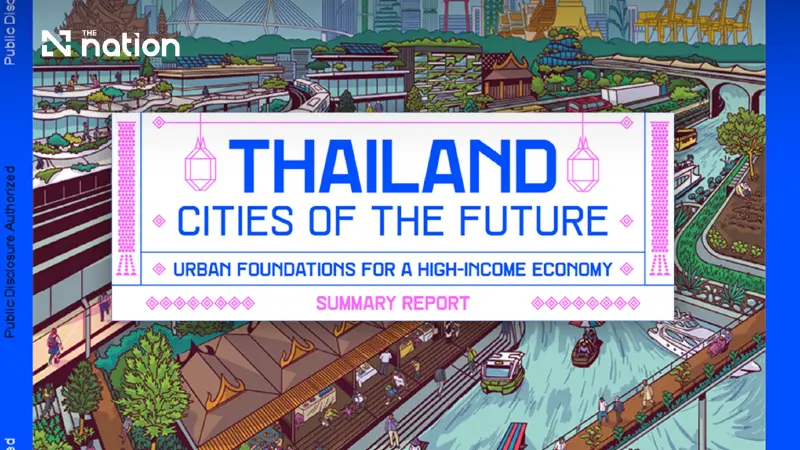


New World Bank report urges Thailand to invest at scale in secondary cities such as Khon Kaen and Chiang Mai to hit its 2037 high-income target
- A World Bank report urges Thailand to invest heavily in secondary cities like Chiang Mai and Khon Kaen to meet its 2037 high-income economy goal.
- The recommendation stems from the finding that Bangkok is experiencing diminishing returns, with severe congestion and infrastructure strain hindering further growth.
- The report argues that secondary cities possess significant "latent productivity" and have the potential to take on larger, specialized economic roles to drive national growth.
- The proposed strategy involves strengthening Bangkok as an anchor while simultaneously preparing a select group of secondary cities to become complementary economic hubs.
A new World Bank report urges Thailand to invest at scale in secondary cities such as Khon Kaen and Chiang Mai to hit its 2037 high-income target.
Thailand should channel a large share of its next urban investment cycle into secondary cities such as Khon Kaen, Chiang Mai, Chonburi, and Phuket rather than continuing to pour money into an increasingly congested Bangkok, according to a new World Bank report launched in the capital on Tuesday (22 September).
Thailand Cities of the Future: Urban Foundations for a High-Income Economy—co-authored with the Program Management Unit on Area-Based Development (PMU-A) and the Urban Design and Development Centre (UDDC)—sets out a three-track policy agenda.
According to the World Bank, Thailand must pursue these strategies simultaneously to achieve high-income status by 2037:
• Strengthening Bangkok as a more efficient national anchor.
• Laying "no-regret" foundations—such as fiscal reform and climate resilience—across every Thai city.
• Preparing a select group of secondary cities to take on significantly larger economic roles.
The report's central recommendation is stark in scale.
Modelling of Thailand's 75 urban centres to 2050 found that once the national urban investment envelope exceeds roughly 2.1 per cent of urban GDP—about $20 billion a year—the returns from directing four-fifths of that spending towards secondary cities begin to outstrip a Bangkok-first strategy.
Below that threshold, continued investment in the capital still makes more sense. Splitting funds evenly between the two tiers underperforms both scenarios, because neither Bangkok nor the secondary cities then receive enough to activate the productivity gains that come with scale.

Cities as the engine of growth
The report's starting point is a simple but urgent piece of arithmetic. Thailand's real GDP per capita grew by an average of just 2.2 per cent a year between 2021 and 2024—well short of the roughly 5.4 per cent needed annually to reach high-income status by 2037.
Nearly nine-tenths of the country's economic growth since 2010 has come from its urban districts, and each of the five industries the government has identified for its high-income transition—advanced manufacturing, digital services, sustainable and wellness tourism, agrifood, and creative industries—depends on functioning urban labour markets, infrastructure, and supplier networks.
Closing the growth gap, the report argues, is therefore a question of urban productivity, and productivity gains at this stage of development "almost always come from cities."

Why Bangkok cannot do it alone
Bangkok generates roughly half of national output and remains, in the Bank's words, Thailand's only city operating at genuinely international scale.
But the report finds the capital is now firmly in the diminishing-returns part of the urban growth curve.
Congestion alone is estimated to cost Bangkok's economy between 7 and 10 per cent of its Gross Regional Product every year, with residents losing an average of 96 hours annually to traffic delays.
Only 28.9 per cent of urban residents live within a kilometre of a rail station, less than half the share in Singapore, Seoul, or Hong Kong.
Rising heat, projected to bring close to 300 days above 35°C a year by mid-century, and flooding—which already costs Thailand around $18 billion annually, close to 3 per cent of GDP—compound the strain.
Meanwhile, Bangkok's population is nearly 27 times that of Chiang Mai, the country's second city, a primacy ratio far higher than the four-to-six ratio typical of high-income economies.

The case for secondary cities
By contrast, Thailand’s secondary cities have "room to run". Their population density has roughly doubled over the past two decades to levels on par with high-income cities, yet productivity has not kept pace.
A 2024 study found a density-wage elasticity of just 8.9 per cent in Bangkok, Chiang Mai, Khon Kaen, and Songkhla—well below the 12 to 19 per cent typical of developing-country cities.
This is evidence, the report notes, of "latent productivity that has not yet been activated."
City roles across the country are already distinctly defined:
• Chonburi and Nakhon Pathom anchor manufacturing and logistics.
• Chiang Mai and Phuket lean heavily on tourism and creative industries.
• Khon Kaen, Nakhon Ratchasima, and Ubon Ratchathani serve as regional administrative and healthcare hubs.
The report frames this differentiation not as a structural flaw, but as "the precondition for complementary specialisation"—provided these cities can develop the requisite fiscal tools, transport links, resilient infrastructure, and institutional capacity to capitalise on their unique strengths.

Speakers call for action, not just analysis
Opening the launch, Alejandro Alcala-Gerez, World Bank Operations Manager for Thailand and Myanmar, said the report’s central message was that Thailand "does not need to face a choice between Bangkok and the rest of the economy."
He added, "Bangkok will remain the country's main economic anchor and gateway to global markets. At the same time, stronger secondary cities can play larger and more complementary roles in supporting productivity, investment, jobs, and resilience across the country."
The aim of the event, he noted, was "not only about presenting the report" but to "help move the discussion from analysis to action."
Presenting the findings, lead author Dr Steven Rubinyi, Senior Disaster Risk Management Specialist at the World Bank, explained that growth in the capital "has become more expensive," while secondary cities "have been densifying" without translating that density into productivity gains.
Dr Rubinyi highlighted that the report’s investment scenarios showed that "if Thailand commits at sufficient scale, the big push needs to go to the secondary cities."
Meanwhile, Bangkok’s share of investment should shift "away from capacity expansion and towards congestion relief, efficiency, resilience, and digital infrastructure."
"Building Thailand's cities of the future is not simply an urban planning agenda. It is an agenda for growth, competitiveness, jobs, and resilience," Rubinyi emphasised.
Weerasak Kowsurat, chief adviser to Deputy Prime Minister Suphajee Suthumpun, told the audience that Thailand’s "K-shaped economy" remains one of its most pressing challenges, with the lower arm—encompassing the majority of citizens and secondary cities—sinking further behind.
Weerasak argued that Thailand should treat tourism "not as a goal but as a tool", promoting a broader "visitor economy" that draws in investors and skilled workers alongside holidaymakers.
He called for greater adoption of AI and digital data to strengthen local decision-making, alongside a revival of the country’s 1995 social finance master plan to bolster community-level resilience.
Ennoo Suesuwan, a member of the National Economic and Social Development Council and chair of the PMU-A Monitoring Working Group, welcomed the report.
However, he pushed back against any suggestion of further concentrating growth in Bangkok, which he warned was already "overwhelmed" by congestion and infrastructure strain. Ennoo backed the report’s call to prioritise secondary hubs—citing Khon Kaen, Nakhon Ratchasima, Songkhla, and Phuket as candidates—while stressing that development must be "liveable and smart," rooted in the late King Bhumibol’s Sufficiency Economy Philosophy.
"A city is its people," he said. "A city is not an instrument, not a building, and not money—a city is the happiness of everyone."
Echoing these views, Dr Poon Thiengburanathum, Deputy Director for Planning and Strategic Management at PMU-A, stressed that Thailand needs to "invest more strategically" in its urban centres.
"Thailand can get more from its urban investments by concentrating complementary infrastructure and services in places where they reinforce a city's economic strengths, rather than spreading resources too thinly," Dr Poon said.

A narrow window to act
The report warns that the window to embed these foundations cheaply is closing. Building resilience into new infrastructure at the design stage costs only around 3 per cent more than standard construction, but retrofitting non-resilient assets already in service is "an order of magnitude higher."
It also cautions that a secondary-cities strategy will take time to show results—its modelling suggests it could underperform a Bangkok-focused approach for roughly 15 years before overtaking it by 2050—meaning any programme will need sustained political backing across electoral cycles.
The report builds on the World Bank Group's Building Thailand's Future Today flagship study, launched earlier this month at the Bangkok Business Summit, and forms part of the Bank's affiliated programme ahead of its 2026 Annual Meetings.
Thailand crossed its urban-majority threshold around 2018, and roughly six in ten Thais now live in cities—a share the report says will only grow as the country's next phase of development unfolds.
