
Floods hit Thai farms, exports and growth as losses top THB69bn



Flood damage to Thailand’s agricultural supply chain is estimated at THB69.1bn, with Q4 risks spreading to food, exports, retail and tourism.
- Widespread flooding has caused an estimated THB69.1 billion in losses across Thailand's agricultural supply chain, from farms to consumers.
- The disaster is projected to reduce third-quarter economic growth by approximately 0.5 percentage points and is a key factor in the lowered full-year growth forecast.
- Agricultural exports have suffered an estimated loss of THB5.483 billion due to flood-related disruptions, particularly affecting rice and cassava deliveries.
- The disruption to farms and transport is expected to create food shortages and push consumer price inflation higher.
Thailand’s economy is facing additional pressure in the final months of 2026 as widespread flooding disrupts agriculture, food supplies, manufacturing, transport, exports and consumption, forcing businesses in sectors ranging from retail and tourism to property to adjust their plans.
The disruption comes as tourism and the housing market are still recovering cautiously, raising concerns that flood-related damage could extend into the fourth quarter and weigh on full-year economic growth.
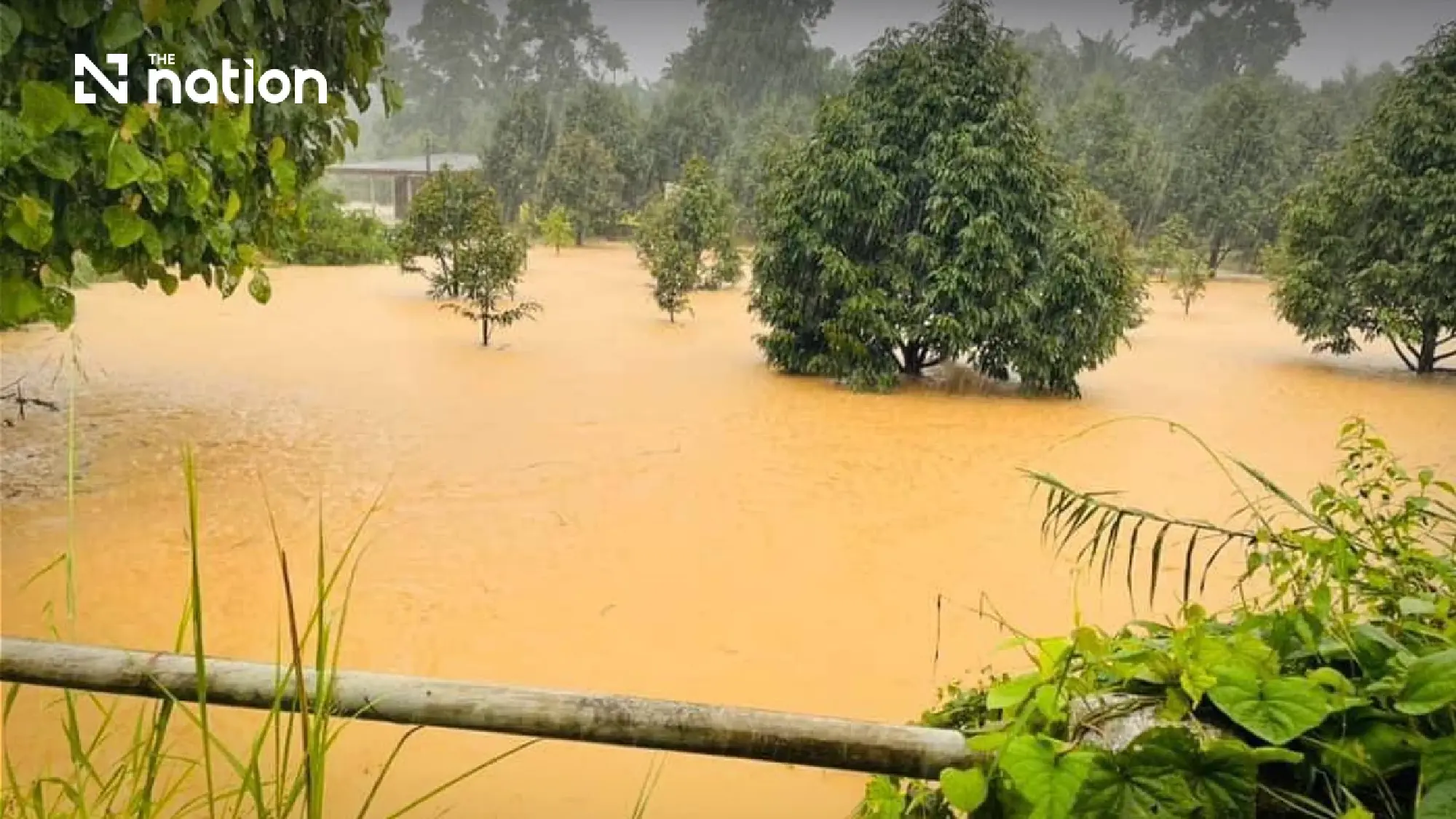

Floods could shave 0.5 percentage point off Q3 growth
Associate Professor Aat Pisanwanich, an economist at Rangsit University’s Faculty of Economics and an expert on international trade and ASEAN economies, estimated that flooding across several provinces, including Bangkok, could reduce third-quarter economic growth by around 0.5 percentage point.
Using Thailand’s second-quarter gross domestic product growth of 1.9% as a reference, he estimated that growth could fall to about 1.4% in the third quarter.
However, stimulus to spending and purchasing power through the government’s Thais Help Thais Plus scheme could add around 0.1 percentage point to growth each month, or about 0.3 percentage point over three months, potentially lifting third-quarter growth to around 1.7–1.8%, he said.
For the full year, Aat estimated that Thailand’s economy would expand by around 2.1% in 2026, compared with 2.4% in 2025, as flooding adds further pressure towards the end of the year.
Agricultural supply-chain losses estimated at THB69.1bn
The impact extends well beyond direct damage to farms.
An assessment by Rangsit University’s Faculty of Economics covering flooding from September 24–30 across 31 provinces and Bangkok estimated total losses throughout the agricultural industry supply chain at THB69.103 billion, equivalent to about 0.36% of Thailand’s GDP.
The Central region suffered the heaviest losses at THB31.522 billion, representing around 45.6% of the total. This was followed by the East at THB19.924 billion, the North at THB11.796 billion and the Northeast at THB5.862 billion.
At the upstream end of the supply chain, farmers suffered losses estimated at THB25.865 billion from damaged crops, agricultural output and livestock.
Midstream agricultural processors sustained an estimated THB18.307 billion in losses as shortages of raw materials affected rice mills, cassava starch factories and animal-feed plants, causing some production to be interrupted.
At the downstream level, consumers faced an estimated THB13.402 billion in higher living costs and additional spending because of shortages of agricultural and food products.
Additional spending on rice was estimated at around THB6.5 billion, while meat added about THB2 billion and chicken about THB1.7 billion. Restaurants faced another THB3.479 billion in higher raw-material and transport costs.

Farm exports also take a hit
Agricultural exports were estimated to have lost THB5.483 billion, with rice accounting for around THB2.36 billion and cassava THB2.14 billion, partly because flood disruption delayed deliveries.
Retail, wholesale and transport businesses were meanwhile estimated to face more than THB2.5 billion in additional costs because of difficulties moving people and goods.
Aat warned that a key risk in the fourth quarter would be a supply shock affecting agricultural and processed-food production and exports.
The disruption is expected to be most evident in October and could last for around one month, with vegetables, chicken, pork, duck and eggs among the products requiring close attention.
Processed fruit is expected to be less affected because the main production season in the Eastern region has already ended.
Despite the flooding, Aat expects Thailand’s exports for the full year to continue expanding at a double-digit rate, with preliminary growth estimated at around 10–15%.

Food supply pressures could push inflation higher
Flood disruption could also feed through into consumer prices.
Aat noted that during the severe floods of 2011, inflation rose sharply as supply disruption drove up prices. For 2026, he said inflation stood at about 2.5% in August and could increase to 2.8–3.0% in September, a rise of around 0.3–0.5 percentage point.
The main pressure is expected to come from damaged supplies of fresh agricultural and food products in the Central region, particularly vegetables, pork, chicken and eggs.
Shortages of some products could push prices higher, with the impact spreading to households, restaurants, retailers and businesses that depend on food ingredients. Transport disruption could add another layer of costs, although the overall impact will depend on how quickly flood conditions improve.
NESDC monitors final-quarter risks
Danucha Pichayanan, Secretary-General of the National Economic and Social Development Council (NESDC), said economic conditions during the remainder of 2026 would need to be monitored closely, with investment and exports expected to continue supporting growth.
The NESDC has forecast Thailand’s economy to grow by 2.0–2.5% in 2026, with a midpoint of 2.2%, compared with growth of 2.4% in 2025. The latest forecast is supported by relatively strong private investment, continued household consumption, goods exports and government spending.
Calls for liquidity support for households and SMEs
Thanit Sorat, Vice Chairman of the Employer’s Confederation of Thai Trade and Industry (ECONTHAI), warned that flooding could compound existing liquidity problems among households and small and medium-sized enterprises.
Households and businesses already facing weak finances could see their positions deteriorate further as they take on repair and recovery expenses, potentially increasing bad debts and further weakening purchasing power during the final quarter.
Thanit called for government measures that combine economic stimulus with liquidity assistance, including debt-payment holidays or reduced instalments for flood-hit households and businesses, to ease financial burdens and help maintain consumer spending.
Retailers adjust flood response
In the retail sector, Dr Nattakit Tangpoonsinthana, Chief Marketing Officer of Central Pattana Plc, said the company was monitoring flooding in several areas and assessing the impact location by location.
Central shopping centres nationwide have made parking areas available to people seeking safe places for their vehicles, established donation points for essential supplies and coordinated with national and local authorities to deliver assistance to affected communities.
The company is also adjusting working arrangements for employees where necessary.
For tourism, Central Pattana is continuing preparations for China’s Golden Week while closely monitoring travel sentiment and coordinating with tourism, transport and payment partners to maintain confidence among Chinese visitors.
Transport remains an important challenge for retailers.
Big C Supercenter, part of BJC Group, is accelerating stock management and working with suppliers to maintain adequate supplies of essential goods. The company is using its logistics network to distribute products from its Bang Pa-in distribution centre to Big C branches nationwide.
Hotels see limited cancellations
Thienprasit Chaiyapatranun, President of the Thai Hotels Association (THA), said hotels had experienced only limited disruption so far.
In flooded parts of Bangkok, including Srinakarin Road, some guests have requested postponements or cancelled reservations.
Operators have been able to coordinate with partner hotels and move visitors to locations with easier access and no flooding, including the Rama IX area.
New bookings could slow by around 5–10% in October, Thienprasit estimated, although the market could recover quickly if flood conditions improve.
The association still expects the overall tourism sector to avoid a significant full-year impact.
Housing market expected to recover gradually
The residential property sector is also entering the fourth quarter cautiously.
Sunthorn Sathaporn, President of the Housing Business Association, said the market had begun to recover but that the improvement remained gradual and selective, particularly among genuine homebuyers and properties priced within consumers’ purchasing power.
Real Estate Information Center data showed 167,665 residential transfers nationwide in the first half of 2026, up 17.6%, while the value of transfers rose 9.8% to THB429.839 billion.
The recovery began to emerge in the first quarter, when nationwide transfers increased by 11.2%, before gaining more momentum in the second quarter.
However, new housing supply has continued to contract as developers remain cautious about launching projects.
Part of the first-half growth also reflected buyers accelerating transfers before previous support measures expired in June, meaning the third and fourth quarters will provide a clearer test of the strength of genuine demand.
Sunthorn said flooding could temporarily delay property transactions. A more severe flood event could become another drag on the market alongside broader economic weakness and constrained purchasing power.
The housing market is therefore expected to show a gradual recovery in the fourth quarter rather than a sharp rebound.
Source: Thansettakij
