
Suphajee seeks Swiss partnerships to bring Thai SMEs to global markets
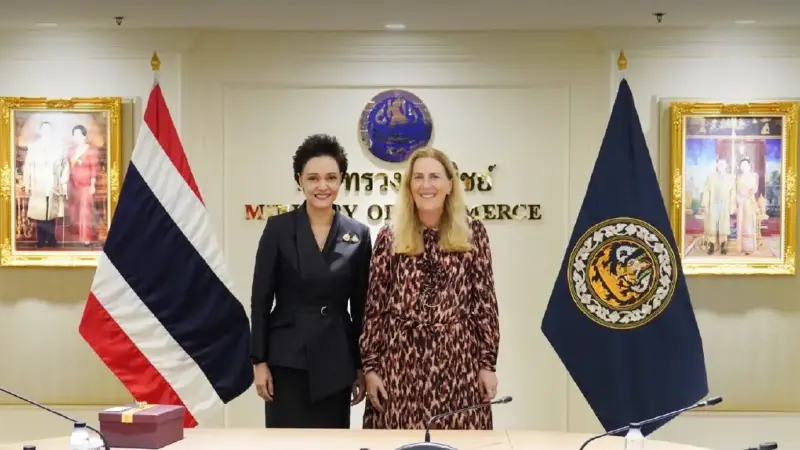


Deputy Prime Minister Suphajee Suthumpun meets Swiss firms to link Thai SMEs to global supply chains ahead of the Thailand–EFTA pact's planned entry into force on March 1, 2027.
- Thailand's Commerce Minister, Suphajee Suthumpun, is seeking partnerships with leading Swiss companies to help integrate Thai small and medium-sized enterprises (SMEs) into global supply chains.
- This initiative is in preparation for the forthcoming Thailand-EFTA free trade agreement, which is scheduled to come into force in March 2027.
- Discussions with major Swiss firms in sectors such as food, logistics, and pharmaceuticals have centred on expanding investment and technology transfer to Thailand.
- A key objective is to support Thai SMEs in raising their product and service standards, enabling them to connect with multinational corporations and benefit from the trade deal.
Thailand is seeking closer investment and technology partnerships with leading Swiss companies to help Thai small and medium-sized enterprises (SMEs) enter global supply chains as it prepares to implement its free trade agreement with the European Free Trade Association (EFTA).
Deputy Prime Minister and Commerce Minister Suphajee Suthumpun hosted Helene Budliger Artieda, Switzerland’s State Secretary for Economic Affairs, along with executives from major Swiss companies and business organisations, at the Commerce Ministry on Friday (October 16).
The discussions focused on expanding bilateral trade and investment, promoting technology transfers and preparing businesses to benefit from the Thailand–EFTA agreement, which both sides aim to bring into force on March 1, 2027.

Swiss companies explore investment opportunities
The meeting brought together representatives from leading Swiss companies in sectors including food manufacturing, logistics, pharmaceuticals and advanced materials.
Food and beverage giant Nestlé outlined plans for continued investment in Thailand, including a new coffee production facility and further development of its pet food business.
Global logistics provider Kuehne+Nagel identified opportunities in supply chains supporting cloud computing and data centres. The company also plans to invest in warehousing and air freight operations in Thailand.
In the healthcare sector, pharmaceutical companies Novartis and Roche were among those involved in discussions on potential cooperation in medical research and innovation.
Meanwhile, advanced materials technology group Oerlikon expressed interest in expanding its investment in Thailand to support the aviation and semiconductor industries.
Representatives from several Swiss business and economic organisations also attended, including economiesuisse, Swissmem, Swissrail, SIFEM, SERV, Switzerland Global Enterprise (S-GE) and DKSH.
The range of participants reflected opportunities for wider cooperation in manufacturing, technology, transport and finance, as well as trade and investment promotion.
Focus on helping Thai SMEs benefit from free trade
Suphajee emphasised that the success of a free trade agreement depends not only on concluding negotiations but also on ensuring that businesses can benefit from it in practice.
The Commerce Ministry is therefore prioritising support for Thai enterprises, particularly SMEs, to bring their products and services up to international standards and build links with multinational companies, helping them enter global supply chains and generate greater value domestically.
The government is also seeking investment in advanced technology, innovation and renewable energy, with an emphasis on knowledge transfer, workforce skills development and new business opportunities for both countries.
Suphajee also stressed the need for mutually beneficial cooperation to strengthen Thailand’s competitiveness, expand opportunities for Swiss companies and support sustainable economic growth in both countries.

Thailand and Switzerland seek easier trade and investment
The two sides also discussed ways to improve the business environment, including measures to protect intellectual property, reduce customs-related barriers and use digital systems to simplify business procedures.
They also considered establishing dedicated communication channels through which companies could obtain information, raise concerns and resolve operational difficulties more efficiently.
Trade between Thailand and Switzerland reached US$14.24 billion in 2025, an increase of 31.12% from the previous year.
During the first eight months of 2026, bilateral trade totalled US$9.56 billion, up 26% year on year.
Thailand and Switzerland are continuing their respective domestic procedures to enable the Thailand–EFTA agreement to enter into force as planned.
