
Anutin rejects claims Thailand will lose out in US trade deal, pledges safeguards for farmers
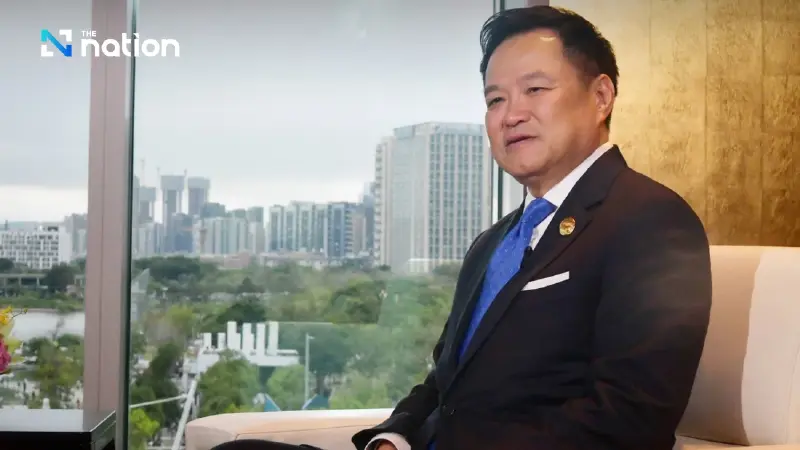


PM Anutin Charnvirakul insists Thailand will not be disadvantaged by its US trade agreement, citing import safeguards, quotas and expanded export opportunities.
Prime Minister Anutin Charnvirakul has defended Thailand's trade negotiations with the United States, insisting the country will not be disadvantaged by the proposed reciprocal trade agreement and that safeguards, including import conditions and quotas, will help protect domestic producers.
Speaking on his weekly programme, "Talk with PM Anutin", broadcast on Saturday (November 21), Anutin said the joint statement signed by Thailand and the United States was intended to increase bilateral trade and create more opportunities for Thai products, particularly agricultural goods, to enter the American market.
The programme was recorded during his visit to Shenzhen, China, for the Asia-Pacific Economic Cooperation (APEC) Economic Leaders' Meeting.
US remains Thailand's largest export market
Anutin, who also serves as interior minister, explained that reciprocal trade arrangements required both countries to adjust tariffs on certain products.
He rejected claims that Thai products would face import duties in the United States while American goods could enter Thailand entirely duty-free, saying such interpretations did not reflect the full picture of bilateral trade.
"The United States is Thailand's largest customer. It buys our products, generating substantial profits for Thailand. We have such a large trade surplus with the US that it has asked us to adjust our approach. But making adjustments does not mean Thailand must be at a disadvantage," he said.
The prime minister stressed that the negotiations must be assessed in terms of their overall economic benefits rather than focusing solely on which country appeared to gain more from individual concessions.
Thailand and the United States signed a joint statement on November 17 confirming that negotiations on the substantive elements of an Agreement on Reciprocal Trade (ART) had been substantially concluded.
However, the statement is not the final trade agreement, with both countries still required to complete legal and domestic procedures before the agreement can be signed and enter into force.
Agricultural imports subject to conditions and quotas
Anutin said certain agricultural products imported from the United States could be subject to specific conditions designed to protect Thai producers.
These could include requirements to prioritise domestic agricultural output before allowing imports, as well as import quota arrangements.
He said the Ministry of Commerce would gradually explain the relevant conditions and details to the public.
The prime minister added that he had instructed Deputy Prime Minister and Commerce Minister Suphajee Suthumpun, who leads Thailand's negotiating team, to prioritise the country's national interests throughout the discussions.
The objective, he said, was not to compare whether Thailand or the United States gained more from the agreement, but to ensure the best possible overall outcome for Thailand.
Failure to reach agreement could hurt Thai exports
Anutin warned that failing to conclude a trade agreement with Washington could expose Thai exports to higher tariffs, weakening their competitiveness against products from other countries.
He highlighted Thailand's strengths in agricultural products, processed foods and industrial components, which could benefit from continued access to the US market.
"If we only focus on who gains and who loses, and ultimately fail to conclude a trade agreement, Thai products could face higher tariffs. That would make it increasingly difficult for us to compete with other countries," he said.
The prime minister maintained that protecting Thailand's access to the American market was essential to sustaining export opportunities and supporting the country's wider economic interests.
Thailand pushes ASEAN digital economy agreement
Anutin also discussed the ASEAN Digital Economy Framework Agreement (DEFA), which Thailand has been promoting alongside other ASEAN member states.
He said the initiative was intended to establish greater trust in online business transactions by strengthening standards covering digital payment systems, cybersecurity, fraud prevention, protection against hacking and product quality.
The framework would also promote consumer protection, including mechanisms for warranties, product returns and refunds when goods fail to meet required standards.
Member countries would be responsible for applying appropriate regulations to businesses and manufacturers operating within their jurisdictions.
Anutin said digital commerce was becoming increasingly important, not only for consumer products but also for industrial components, equipment and machinery.
He stressed that reliable systems were essential to building confidence between buyers and sellers as cross-border electronic commerce continued to expand.
Thailand, he noted, was not merely a buyer in the digital marketplace but also an important seller of products to consumers and businesses abroad.
Strengthening trust and common standards in digital transactions would therefore help Thai businesses expand their market opportunities while supporting the development of ASEAN's digital economy.
