
Thailand looks beyond cars to chips and space in Tokyo investment talks
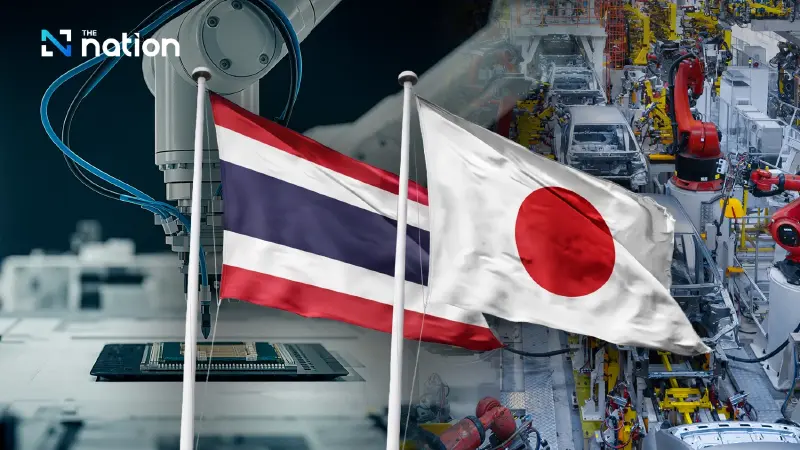


In Tokyo, Thailand sought investment in chip design and discussed satellite parts. Carmakers asked for a mid-tier tax rate on imported vehicles.
- A Thai delegation visited Tokyo to attract Japanese investment, aiming to expand the country's industrial base beyond its traditional automotive manufacturing focus.
- The talks prioritized new high-tech sectors, securing potential investments in the semiconductor industry and proposing to use Thailand's manufacturing base to supply Japan's space industry.
- While seeking new opportunities, Thailand also reinforced its automotive sector, securing a THB 134 billion investment pledge from six major Japanese carmakers for electric and hybrid vehicle production.
For more than half a century, Japanese investment has been a mainstay of Thai industry, helping to establish Thailand as a regional manufacturing base for vehicles and electronics.
Recent figures, however, offer a warning amid intense competition.
Japan’s cumulative investment in Thailand still exceeds that of any other country, and more than 6,000 Japanese companies operate in the country.
Yet for three years running, Japan has ranked fourth in annual applications for investment promotion submitted to Thailand’s Board of Investment (BOI), behind Singapore and China.
That challenge prompted Deputy Prime Minister and Finance Minister Ekniti Nitithanprapas to lead a “Team Thailand” investment roadshow in Tokyo from November 17 to 20, 2026.
The delegation included Industry Minister Varawut Silpa-archa, representatives of the Office of the Board of Investment and leaders of the Joint Standing Committee on Commerce, Industry and Banking (JSCCIB), which brings together three Thai business organisations.
The mission aimed to attract investment and build confidence.
Over five days, the delegation held talks with the Japanese government, carmakers, semiconductor chipmakers, representatives of the space industry, financial institutions and the Japan Business Federation (Keidanren).
The talks yielded investment pledges worth hundreds of billions of baht.
In particular, they opened the way for industries new to Thailand while helping to preserve the industrial base Japanese investors had already built there.
“The results of Team Thailand’s roadshow exceeded our target. We came back with more than short-term funds. We also reached an agreement for our two countries to grow together under the Stronger Together approach,” Ekniti stressed.

Team Thailand sets out a common message on investment
Summing up the visit, Ekniti said Team Thailand had gone to Tokyo with a clear plan and three messages.
These were Trust, Second Take-off and Made with Thailand.
All three formed part of the TRUST strategy.
The first T emphasised Thailand’s role as a reliable partner with sound rules and good infrastructure, ready to serve as a gateway to the Association of Southeast Asian Nations (ASEAN).
The remaining letters covered closer ties, building on existing industries, seizing opportunities in space and shifting the emphasis from Made in Thailand to Made with Thailand.
Japan faces pressure from trade tariffs, an ageing population and a market shrinking in the face of competition.
It therefore needs to find a secure, familiar manufacturing base.
Ekniti said Thailand had drawn on the two countries’ shared history in the negotiations.
Japan helped Thailand achieve its First Take-off between 1982 and 1987 by establishing manufacturing bases in Rayong and Prachin Buri.
Thailand went on to earn the name “Detroit of the East”.
The government sees the visit as the start of a Second Take-off that would move Thailand into high-tech industries and help it escape the middle-income trap.
The seven sectors are Smart Agriculture, Food, Smart Electronics, Future Mobility, Quality Tourism, Wellness, and Creative Economy & Retail.
Investment is like planting a tree.
Reviving the economy through consumption is more like a meal that is gone once eaten.


Thailand looks to investment for a V-shaped recovery
The government also raised the issue of economic figures understating activity.
The previous Manufacturing Production Index (MPI) did not cover semiconductors, AI data centres or the space industry.
Its vehicle figures counted only vehicles running on petroleum fuels, excluding electric models.
Varawut said just 10 factories in newer industries had recently been added to the calculation.
After the MPI was revised, the GDP estimate rose from 2.2% to 2.5%.
The government wants investment to drive a shift from a K-shaped recovery to a V-shaped one.
Six carmakers pledge about THB134 billion in fresh investment
The most tangible result came in the automotive sector.
On November 20, six leading carmakers, Toyota, Honda, Isuzu, Mitsubishi, Mazda and Nissan, confirmed they would invest about THB134 billion more in Thailand over the period 2026–2030.
From 2021 to September 2026, Japanese investors applied for investment promotion for 367 automotive projects worth more than THB79 billion.
Automotive projects accounted for more Japanese applications than any other sector. The new pledge comes to nearly twice the value of applications over the previous five years.
The plans vary with each carmaker’s choice of technology.
Toyota will build on its car and pick-up manufacturing base.
Its plans include a new fuel-cell electric vehicle (FCEV), a pick-up for export.
Honda is developing its Smart Hybrid technology.
Mitsubishi is developing hybrid electric vehicle (HEV) and plug-in hybrid electric vehicle (PHEV) technology for pick-ups and pick-up passenger vehicles (PPVs).
Mazda is investing in a production line for mild hybrid electric vehicles (MHEVs) and preparing to move into battery electric vehicles (BEVs).
Nissan is expanding its work to develop supply chains and skills in Thailand.
Isuzu will maintain Thailand’s role as a manufacturing and export hub for pick-ups and commercial vehicles.
It will develop BEV pick-ups and FCEV lorries, promote the use of B20 and prepare to test B30.
New excise tax structure wins carmakers’ backing
The new excise tax structure prompted the carmakers’ response.
From January 1, 2027, a 35% excise tax will apply to fully built-up imports of BEVs and range-extended electric vehicles (REEVs) where the carmaker has no production base in Thailand.
For carmakers with a Thai production base, the rate will depend on their investment, employment and use of locally made parts.
During the talks, senior executives of Japanese carmakers thanked the Thai government for raising taxes to protect domestic investment.
Ekniti confirmed that the measure applied to all automotive investors and that Japan had not been singled out.
Six or seven other electric vehicle makers, possibly more, from Europe, China, Japan and Korea have also expressed interest in investing in Thailand.
“The carmakers came back with several proposals. First, they asked to import certain models to test the market. The Thai side said this needed further discussion and that a quota or a memorandum of understanding (MOU) might be an option. Second, they asked for a mid-tier tax rate on imported vehicles. That still has to be negotiated. Third, they asked for help with credit, which the government will consider alongside people’s ability to repay their debts. They also asked for clarity on the timeframe for producing e-Parts for HEVs, for less duplication in procedures relating to standards and customs, and for a timetable for enforcing Euro 6,” Ekniti said.
A scheme to trade in old vehicles for new ones is the proposal most likely to be adopted first.
Carmakers are willing to contribute funding alongside the government, provided the old vehicles are taken out of circulation.
The main aim is to encourage the use of E20 and B20, which are linked to the incomes of sugar cane, cassava and oil palm growers.
Ekniti confirmed that there had been no discussion of discontinuing 91-octane petrol.
Tax on hybrids will depend on their carbon emissions.
The proposal still needs to be assessed for its cost to the budget and its fairness before it can be adopted.
Thailand targets THB5 trillion in annual semiconductor revenue
Semiconductors were another priority.
At a roundtable with 11 Japanese semiconductor executives, Thailand highlighted its strengths in photonics, power units and sensors.
It invited investment upstream, including in integrated circuit (IC) design and wafers.
Ekniti put investment in semiconductors and related industries in this round at about THB70 billion.
Thailand’s chip strategy sets ambitious targets.
It aims to attract at least THB500 billion in investment by 2030 and more than THB2.5 trillion by 2050, generate THB5 trillion in annual industry revenue and create more than 230,000 highly skilled jobs.
From 2023 to September 2026, Japanese investors applied for investment promotion for 108 projects in the sector worth more than THB59 billion.
Beyond attracting capital, Thailand wants to work with Japan to build capabilities across the entire semiconductor ecosystem.
The risk of natural disasters also came up in the talks.
Ekniti said Japanese investors understood the situation.
He cited major global server manufacturers that had moved production out of Thailand after earlier floods.
They were now returning, he said, because they saw Thailand as an important part of the supply chain and the AI manufacturing ecosystem.
The BOI stood ready to offer its full support. Before the talks, the delegation visited an NTT data centre in Mitaka.
NTT has designated Thailand a strategic hub for the Asia-Pacific region and has secured BOI support for two projects in Bangkok and Chon Buri.
Thailand seeks a role for its automotive industry in the space sector
Space was the most unusual industry on the agenda for this visit.
Suppliers that once made parts for vehicles with internal combustion engines now produce some 60–70% of Japan’s satellite components, possibly more.
Japan faces a shortage of skilled labour, while Thailand has both the workforce and a precision manufacturing base.
In talks with Japan’s Ministry of Economy, Trade and Industry (METI), the Japanese side proposed drawing on Thai precision engineering for the satellite supply chain and working together on optical quantum computing.
This also offers an opportunity for Thailand’s more than three million small and medium-sized enterprises (SMEs).
Thai businesses meet 38 leading Keidanren companies
The Thailand–Japan Investment and Business Dialogue 2026 brought together 64 Keidanren members from 38 companies across nine industries, including trading, finance, energy, data centres and machinery.
Each Thai business group set out the issues it wanted to address.
The Federation of Thai Industries (FTI) estimated that if Thailand could accommodate the roughly 10 GW of data centre capacity covered by applications to the BOI, it would attract more than THB2 trillion in investment.
The Thai Bankers’ Association proposed closer financial links to attract Japanese capital and further development of the Joint Crediting Mechanism (JCM) to generate high-quality carbon credits.
In supporting industries, the Japan External Trade Organization (JETRO) expressed interest in matching Thai parts manufacturers with Japanese space start-ups.
Its other areas of interest included recycling vehicle batteries and electronic waste, food-processing machinery, and workforce development.
JETRO’s chairman said its ambitions went beyond attracting investment.
It wanted to build an industrial ecosystem and develop technology jointly.
Thailand’s Ministry of Industry plans to follow up with an integrated recycling industrial estate modelled on Japan’s approach, handling electronic waste, electrical appliances and end-of-life vehicles.
Thailand and Japan pursue trade and tax changes to ease barriers to business
The two prime ministers had already agreed during talks in the Philippines to update the Japan–Thailand Economic Partnership Agreement (JTEPA), given how much the world had changed in the many years since it took effect.
In talks with Japanese Finance Minister Satsuki Katayama, the two sides proposed updating the agreement to keep pace with the global economy and reviewing the tax convention between Thailand and Japan to ease barriers to business and encourage investment.
The first follow-up task with a clear timeframe is to prepare an Energy and Investment Dialogue with METI before Thailand welcomes the Japanese prime minister in 2027 for the 140th anniversary of relations between the two countries.
Both sides want to move quickly enough to deliver results before their leaders meet.
The BOI has been tasked with coordinating the relevant agencies’ assessment of the carmakers’ proposals.
Ekniti credited Team Thailand with the success of the visit.
He said the three business organisations that make up the JSCCIB and businesses from seven sectors had worked to a common plan, with gains for both countries.
This roadshow may yield clearer results more quickly than earlier visits.
The Thai government secured THB134 billion in pledges from carmakers.
A semiconductor roundtable was held abroad for the first time and talks began on the space industry.
The Japanese side also raised a mid-tier tax rate, quotas for vehicles imported to test the market, the Euro 6 timetable and the rules on e-Parts.
Tokyo was the venue for the talks.
Bangkok is where all four questions must be settled.
The 140th anniversary of Thai–Japanese relations in 2027 may therefore be the deadline that shows whether Thailand’s Second Take-off gets off the ground or is still waiting at the boarding gate.


Source: Thansettakij
